
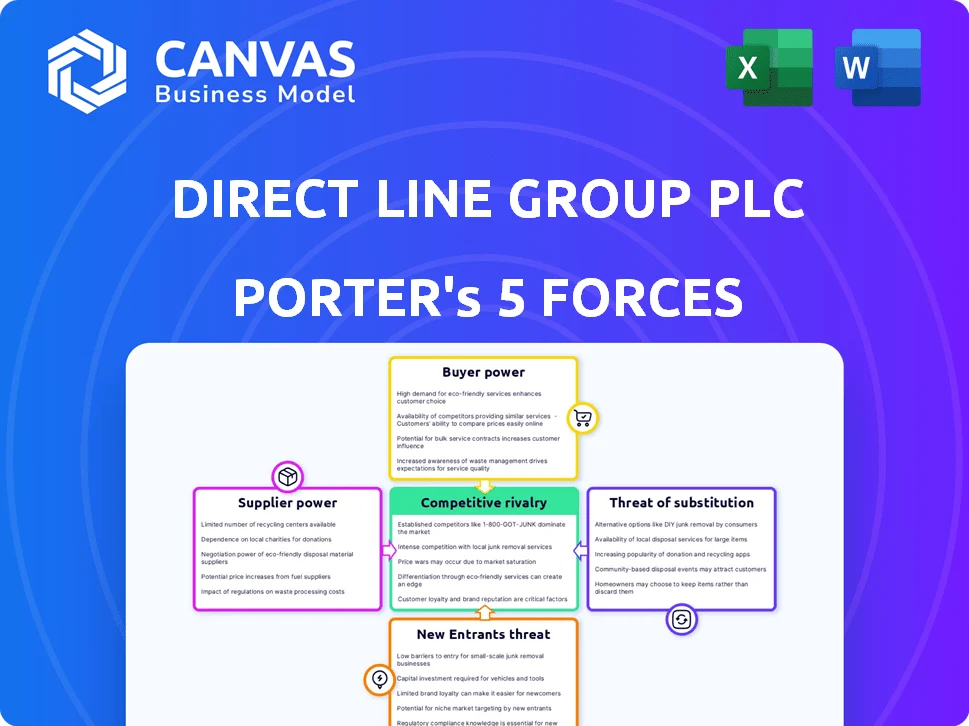
DIRECT LINE GROUP PLC PORTER'S FIVE FORCES TEMPLATE RESEARCH
What is included in the product
 Detailed Word Document
Tailored exclusively for Direct Line Group Plc, analyzing its position within its competitive landscape.

 Customizable Excel Spreadsheet
Instantly understand strategic pressure with a powerful spider/radar chart.
Preview Before You Purchase
Direct Line Group Plc Porter's Five Forces Analysis
This preview reflects the complete Porter's Five Forces analysis for Direct Line Group Plc. It provides a thorough examination of industry competition, supplier power, buyer power, threats of new entrants, and threats of substitutes.

Porter's Five Forces Analysis Template

A Must-Have Tool for Decision-Makers
Direct Line Group Plc faces moderate rivalry, pressured by established insurers. Buyer power is significant due to price sensitivity and comparison websites. Supplier power is concentrated with claims adjusters and repair networks. The threat of new entrants is moderate, impacted by capital requirements. Substitute products, such as self-insurance, pose a limited threat.
Our full Porter's Five Forces report goes deeper—offering a data-driven framework to understand Direct Line Group Plc's real business risks and market opportunities.
Suppliers Bargaining Power

Reinsurance Costs
Direct Line Group's profitability is sensitive to reinsurance costs. Reinsurers, impacted by global claims, can raise prices. In 2024, the reinsurance market saw increased rates. Higher costs can squeeze Direct Line's margins. This impacts its competitive position.
Third-Party Service Providers
Direct Line Group (DLG) relies on third-party services, including repair networks and claims handlers. The bargaining power of these suppliers fluctuates with service uniqueness and market concentration. For example, in 2024, DLG handled over 1.5 million claims, making supplier relationships vital. High switching costs for DLG can increase supplier power.

Technology and Data Providers
Direct Line Group heavily depends on tech and data suppliers. Their influence is notable, particularly for specialized software or unique data crucial for operations. For instance, in 2024, the cost of data analytics software for insurance companies rose by 10-15% due to increased demand and specialized features.

Marketing and Distribution Channels
Direct Line's marketing and distribution channels, crucial for reaching customers, present supplier power dynamics. These channels, encompassing online platforms and partnerships, significantly influence customer acquisition costs. The terms and costs of these channels impact profitability, mirroring supplier influence. For instance, digital marketing expenses rose in 2024, affecting customer acquisition costs.
- Digital marketing costs are a major expense, impacting acquisition costs.
- Partnerships can dictate terms and influence marketing strategies.
- Channel costs directly affect Direct Line's profit margins.
- Negotiating favorable terms with channel providers is key.
Labor Market
Direct Line Group faces supplier power in the labor market. The availability and cost of skilled labor, particularly in data analytics and claims handling, affects operational expenses. A tight labor market increases employee bargaining power.
- In 2024, the UK's unemployment rate was around 4%.
- Demand for data analysts and tech specialists has grown.
- This can lead to higher salary expectations.
- Direct Line's operational costs are influenced by these factors.
Direct Line's Supplier Dynamics Unveiled
Direct Line Group's supplier power analysis reveals various influences.
Reinsurance costs, third-party services, tech, and marketing channels shape supplier dynamics. Labor market conditions further affect operational expenses.
These factors impact Direct Line's profitability and competitive position.
| Supplier Type | Impact | 2024 Data/Example |
|---|---|---|
| Reinsurers | Pricing Power | Reinsurance rates increased due to global claims. |
| Third-Party Services | Negotiating Power | DLG handled 1.5M+ claims, vital supplier relationships. |
| Tech & Data Suppliers | Cost Influence | Data analytics software cost rose 10-15%. |
Customers Bargaining Power

Price Sensitivity
Customers in insurance markets are price-sensitive. Price comparison websites make it easy to compare options. In 2024, Direct Line faced challenges due to competitive pricing. The company saw a decrease in premiums, reflecting customer focus on costs. This impacts profitability.
Availability of Information
Customers now have easy access to insurance details and pricing through the internet and comparison sites. This increased transparency boosts customer bargaining power. In 2024, approximately 70% of UK insurance customers used online comparison tools before purchasing or renewing their policies. This enables consumers to quickly find and switch to better deals, increasing competition. The average customer saves around 15% by switching insurers.

Low Switching Costs
Direct Line Group faces significant customer bargaining power due to low switching costs within the insurance sector. For instance, in 2024, the average time to switch car insurance providers was under 15 minutes online. This ease of switching allows customers to quickly compare and choose better deals, increasing their leverage. The UK insurance market saw approximately 8.5 million policy switches in 2023, highlighting customer mobility. This competitive landscape pressures Direct Line to offer attractive pricing and service.

Variety of Distribution Channels
Direct Line's diverse distribution channels, such as online platforms and phone services, influence customer bargaining power. Customers can easily compare prices and service offerings across different channels, increasing their ability to choose the best deal. This flexibility allows customers to switch between channels or competitors, applying pressure on Direct Line to offer competitive terms. In 2024, Direct Line’s online sales accounted for a significant portion of its overall business, highlighting the importance of this channel for customer interactions.
- Online sales are a key driver for customer choice and price sensitivity.
- Phone services offer an alternative for negotiation and comparison.
- Channel choice enhances customer ability to seek better deals.
- Competition in online insurance is high.
Brand Loyalty vs. Price
In the UK insurance market, customers have substantial bargaining power. Brand loyalty, while present, is often secondary to price in customer decisions. This is due to the ease of comparing insurance quotes online. In 2024, price comparison websites drove significant competition.
- Competition in the UK insurance market is fierce, with numerous providers vying for customers.
- Price comparison websites enable easy comparison, making price a key decision factor.
- Established brands may struggle to maintain premium pricing due to price sensitivity.
- Customer choice is heavily influenced by the lowest available quote.
Customer Power Drives Insurer Challenges
Direct Line Group faces strong customer bargaining power. Customers easily compare and switch insurers, enhancing their leverage. Online tools and price sensitivity intensify competition, affecting profitability. In 2024, switching rates remained high, reflecting customer focus on cost.
| Aspect | Details | 2024 Data |
|---|---|---|
| Switching Rate | Percentage of customers switching insurers | ~20% |
| Online Usage | % using comparison sites | ~70% |
| Average Savings | Savings from switching | ~15% |
Rivalry Among Competitors

Large Number of Competitors
The UK insurance market boasts many competitors, from giants to startups. This abundance fuels intense rivalry. In 2024, the UK insurance sector saw over 200 active insurers, creating a highly competitive environment. This drives price wars and innovation.
Price Competition
Price competition is intense in the UK insurance market, where customers are highly price-sensitive and easily compare options. Insurers frequently use aggressive pricing to gain and keep customers, squeezing profit margins. For example, Direct Line's 2023 combined operating ratio was 109.8%, indicating underwriting losses. This environment forces companies to constantly seek efficiency gains.

Product Differentiation
Direct Line Group Plc faces product differentiation challenges in a competitive insurance market. While insurance products are similar, companies use features and service to stand out. In 2024, Direct Line's focus on digital services aims to improve customer experience. Effective differentiation impacts profitability and market share.

Market Growth Rate
The UK insurance market's growth rate significantly shapes competitive rivalry. Slower growth often intensifies competition as companies battle for market share, potentially leading to price wars and increased marketing efforts. Conversely, faster growth can ease rivalry, allowing multiple players to thrive. In 2024, the UK insurance market experienced moderate growth, influencing the intensity of competition among firms like Direct Line.
- 2023: UK insurance market growth was approximately 3-4%.
- 2024: Forecasted growth rate is around 2-3%, indicating a slight slowdown.
- This moderate growth suggests continued, but possibly less aggressive, competitive behavior.
- Direct Line, like other insurers, must adapt to these market dynamics.
Potential for Consolidation
Merger and acquisition (M&A) activity significantly influences competition within the insurance industry. The proposed acquisition of Direct Line by Aviva exemplifies this, potentially concentrating market share among fewer, larger firms. This consolidation can intensify rivalry as surviving entities vie for dominance. Such changes can also impact pricing strategies and service offerings.
- Aviva's market capitalization was approximately £14.02 billion as of March 2024.
- Direct Line's market capitalization was about £2.7 billion in March 2024.
- The UK insurance market's overall value was around £280 billion in 2023.
UK Insurance: Fierce Competition Ahead!
Competitive rivalry in the UK insurance market is high due to numerous players and price sensitivity. Intense price competition and product differentiation efforts are common. Market growth influences rivalry; moderate growth in 2024 suggests ongoing competition. M&A activity, like the Aviva-Direct Line proposal, further shapes the competitive landscape.
| Factor | Impact | Example (2024) |
|---|---|---|
| Market Structure | Many competitors increase rivalry. | Over 200 active insurers. |
| Price Competition | Price wars impact profitability. | Direct Line's 2023 combined operating ratio of 109.8%. |
| Market Growth | Moderate growth can intensify competition. | Forecasted growth of 2-3%. |
DIRECT LINE GROUP PLC PORTER'S FIVE FORCES TEMPLATE RESEARCH
What is included in the product
Detailed Word Document
Tailored exclusively for Direct Line Group Plc, analyzing its position within its competitive landscape.
Customizable Excel Spreadsheet
Instantly understand strategic pressure with a powerful spider/radar chart.
Preview Before You Purchase
Direct Line Group Plc Porter's Five Forces Analysis
This preview reflects the complete Porter's Five Forces analysis for Direct Line Group Plc. It provides a thorough examination of industry competition, supplier power, buyer power, threats of new entrants, and threats of substitutes.
Porter's Five Forces Analysis Template
A Must-Have Tool for Decision-Makers
Direct Line Group Plc faces moderate rivalry, pressured by established insurers. Buyer power is significant due to price sensitivity and comparison websites. Supplier power is concentrated with claims adjusters and repair networks. The threat of new entrants is moderate, impacted by capital requirements. Substitute products, such as self-insurance, pose a limited threat.
Our full Porter's Five Forces report goes deeper—offering a data-driven framework to understand Direct Line Group Plc's real business risks and market opportunities.
Suppliers Bargaining Power
Reinsurance Costs
Direct Line Group's profitability is sensitive to reinsurance costs. Reinsurers, impacted by global claims, can raise prices. In 2024, the reinsurance market saw increased rates. Higher costs can squeeze Direct Line's margins. This impacts its competitive position.
Third-Party Service Providers
Direct Line Group (DLG) relies on third-party services, including repair networks and claims handlers. The bargaining power of these suppliers fluctuates with service uniqueness and market concentration. For example, in 2024, DLG handled over 1.5 million claims, making supplier relationships vital. High switching costs for DLG can increase supplier power.
Technology and Data Providers
Direct Line Group heavily depends on tech and data suppliers. Their influence is notable, particularly for specialized software or unique data crucial for operations. For instance, in 2024, the cost of data analytics software for insurance companies rose by 10-15% due to increased demand and specialized features.
Marketing and Distribution Channels
Direct Line's marketing and distribution channels, crucial for reaching customers, present supplier power dynamics. These channels, encompassing online platforms and partnerships, significantly influence customer acquisition costs. The terms and costs of these channels impact profitability, mirroring supplier influence. For instance, digital marketing expenses rose in 2024, affecting customer acquisition costs.
- Digital marketing costs are a major expense, impacting acquisition costs.
- Partnerships can dictate terms and influence marketing strategies.
- Channel costs directly affect Direct Line's profit margins.
- Negotiating favorable terms with channel providers is key.
Labor Market
Direct Line Group faces supplier power in the labor market. The availability and cost of skilled labor, particularly in data analytics and claims handling, affects operational expenses. A tight labor market increases employee bargaining power.
- In 2024, the UK's unemployment rate was around 4%.
- Demand for data analysts and tech specialists has grown.
- This can lead to higher salary expectations.
- Direct Line's operational costs are influenced by these factors.
Direct Line's Supplier Dynamics Unveiled
Direct Line Group's supplier power analysis reveals various influences.
Reinsurance costs, third-party services, tech, and marketing channels shape supplier dynamics. Labor market conditions further affect operational expenses.
These factors impact Direct Line's profitability and competitive position.
| Supplier Type | Impact | 2024 Data/Example |
|---|---|---|
| Reinsurers | Pricing Power | Reinsurance rates increased due to global claims. |
| Third-Party Services | Negotiating Power | DLG handled 1.5M+ claims, vital supplier relationships. |
| Tech & Data Suppliers | Cost Influence | Data analytics software cost rose 10-15%. |
Customers Bargaining Power
Price Sensitivity
Customers in insurance markets are price-sensitive. Price comparison websites make it easy to compare options. In 2024, Direct Line faced challenges due to competitive pricing. The company saw a decrease in premiums, reflecting customer focus on costs. This impacts profitability.
Availability of Information
Customers now have easy access to insurance details and pricing through the internet and comparison sites. This increased transparency boosts customer bargaining power. In 2024, approximately 70% of UK insurance customers used online comparison tools before purchasing or renewing their policies. This enables consumers to quickly find and switch to better deals, increasing competition. The average customer saves around 15% by switching insurers.
Low Switching Costs
Direct Line Group faces significant customer bargaining power due to low switching costs within the insurance sector. For instance, in 2024, the average time to switch car insurance providers was under 15 minutes online. This ease of switching allows customers to quickly compare and choose better deals, increasing their leverage. The UK insurance market saw approximately 8.5 million policy switches in 2023, highlighting customer mobility. This competitive landscape pressures Direct Line to offer attractive pricing and service.
Variety of Distribution Channels
Direct Line's diverse distribution channels, such as online platforms and phone services, influence customer bargaining power. Customers can easily compare prices and service offerings across different channels, increasing their ability to choose the best deal. This flexibility allows customers to switch between channels or competitors, applying pressure on Direct Line to offer competitive terms. In 2024, Direct Line’s online sales accounted for a significant portion of its overall business, highlighting the importance of this channel for customer interactions.
- Online sales are a key driver for customer choice and price sensitivity.
- Phone services offer an alternative for negotiation and comparison.
- Channel choice enhances customer ability to seek better deals.
- Competition in online insurance is high.
Brand Loyalty vs. Price
In the UK insurance market, customers have substantial bargaining power. Brand loyalty, while present, is often secondary to price in customer decisions. This is due to the ease of comparing insurance quotes online. In 2024, price comparison websites drove significant competition.
- Competition in the UK insurance market is fierce, with numerous providers vying for customers.
- Price comparison websites enable easy comparison, making price a key decision factor.
- Established brands may struggle to maintain premium pricing due to price sensitivity.
- Customer choice is heavily influenced by the lowest available quote.
Customer Power Drives Insurer Challenges
Direct Line Group faces strong customer bargaining power. Customers easily compare and switch insurers, enhancing their leverage. Online tools and price sensitivity intensify competition, affecting profitability. In 2024, switching rates remained high, reflecting customer focus on cost.
| Aspect | Details | 2024 Data |
|---|---|---|
| Switching Rate | Percentage of customers switching insurers | ~20% |
| Online Usage | % using comparison sites | ~70% |
| Average Savings | Savings from switching | ~15% |
Rivalry Among Competitors
Large Number of Competitors
The UK insurance market boasts many competitors, from giants to startups. This abundance fuels intense rivalry. In 2024, the UK insurance sector saw over 200 active insurers, creating a highly competitive environment. This drives price wars and innovation.
Price Competition
Price competition is intense in the UK insurance market, where customers are highly price-sensitive and easily compare options. Insurers frequently use aggressive pricing to gain and keep customers, squeezing profit margins. For example, Direct Line's 2023 combined operating ratio was 109.8%, indicating underwriting losses. This environment forces companies to constantly seek efficiency gains.
Product Differentiation
Direct Line Group Plc faces product differentiation challenges in a competitive insurance market. While insurance products are similar, companies use features and service to stand out. In 2024, Direct Line's focus on digital services aims to improve customer experience. Effective differentiation impacts profitability and market share.
Market Growth Rate
The UK insurance market's growth rate significantly shapes competitive rivalry. Slower growth often intensifies competition as companies battle for market share, potentially leading to price wars and increased marketing efforts. Conversely, faster growth can ease rivalry, allowing multiple players to thrive. In 2024, the UK insurance market experienced moderate growth, influencing the intensity of competition among firms like Direct Line.
- 2023: UK insurance market growth was approximately 3-4%.
- 2024: Forecasted growth rate is around 2-3%, indicating a slight slowdown.
- This moderate growth suggests continued, but possibly less aggressive, competitive behavior.
- Direct Line, like other insurers, must adapt to these market dynamics.
Potential for Consolidation
Merger and acquisition (M&A) activity significantly influences competition within the insurance industry. The proposed acquisition of Direct Line by Aviva exemplifies this, potentially concentrating market share among fewer, larger firms. This consolidation can intensify rivalry as surviving entities vie for dominance. Such changes can also impact pricing strategies and service offerings.
- Aviva's market capitalization was approximately £14.02 billion as of March 2024.
- Direct Line's market capitalization was about £2.7 billion in March 2024.
- The UK insurance market's overall value was around £280 billion in 2023.
UK Insurance: Fierce Competition Ahead!
Competitive rivalry in the UK insurance market is high due to numerous players and price sensitivity. Intense price competition and product differentiation efforts are common. Market growth influences rivalry; moderate growth in 2024 suggests ongoing competition. M&A activity, like the Aviva-Direct Line proposal, further shapes the competitive landscape.
| Factor | Impact | Example (2024) |
|---|---|---|
| Market Structure | Many competitors increase rivalry. | Over 200 active insurers. |
| Price Competition | Price wars impact profitability. | Direct Line's 2023 combined operating ratio of 109.8%. |
| Market Growth | Moderate growth can intensify competition. | Forecasted growth of 2-3%. |
Product Information
Product Information
Shipping & Returns
Shipping & Returns
Description
What is included in the product
Detailed Word Document
Tailored exclusively for Direct Line Group Plc, analyzing its position within its competitive landscape.
Customizable Excel Spreadsheet
Instantly understand strategic pressure with a powerful spider/radar chart.
Preview Before You Purchase
Direct Line Group Plc Porter's Five Forces Analysis
This preview reflects the complete Porter's Five Forces analysis for Direct Line Group Plc. It provides a thorough examination of industry competition, supplier power, buyer power, threats of new entrants, and threats of substitutes.
Porter's Five Forces Analysis Template
A Must-Have Tool for Decision-Makers
Direct Line Group Plc faces moderate rivalry, pressured by established insurers. Buyer power is significant due to price sensitivity and comparison websites. Supplier power is concentrated with claims adjusters and repair networks. The threat of new entrants is moderate, impacted by capital requirements. Substitute products, such as self-insurance, pose a limited threat.
Our full Porter's Five Forces report goes deeper—offering a data-driven framework to understand Direct Line Group Plc's real business risks and market opportunities.
Suppliers Bargaining Power
Reinsurance Costs
Direct Line Group's profitability is sensitive to reinsurance costs. Reinsurers, impacted by global claims, can raise prices. In 2024, the reinsurance market saw increased rates. Higher costs can squeeze Direct Line's margins. This impacts its competitive position.
Third-Party Service Providers
Direct Line Group (DLG) relies on third-party services, including repair networks and claims handlers. The bargaining power of these suppliers fluctuates with service uniqueness and market concentration. For example, in 2024, DLG handled over 1.5 million claims, making supplier relationships vital. High switching costs for DLG can increase supplier power.
Technology and Data Providers
Direct Line Group heavily depends on tech and data suppliers. Their influence is notable, particularly for specialized software or unique data crucial for operations. For instance, in 2024, the cost of data analytics software for insurance companies rose by 10-15% due to increased demand and specialized features.
Marketing and Distribution Channels
Direct Line's marketing and distribution channels, crucial for reaching customers, present supplier power dynamics. These channels, encompassing online platforms and partnerships, significantly influence customer acquisition costs. The terms and costs of these channels impact profitability, mirroring supplier influence. For instance, digital marketing expenses rose in 2024, affecting customer acquisition costs.
- Digital marketing costs are a major expense, impacting acquisition costs.
- Partnerships can dictate terms and influence marketing strategies.
- Channel costs directly affect Direct Line's profit margins.
- Negotiating favorable terms with channel providers is key.
Labor Market
Direct Line Group faces supplier power in the labor market. The availability and cost of skilled labor, particularly in data analytics and claims handling, affects operational expenses. A tight labor market increases employee bargaining power.
- In 2024, the UK's unemployment rate was around 4%.
- Demand for data analysts and tech specialists has grown.
- This can lead to higher salary expectations.
- Direct Line's operational costs are influenced by these factors.
Direct Line's Supplier Dynamics Unveiled
Direct Line Group's supplier power analysis reveals various influences.
Reinsurance costs, third-party services, tech, and marketing channels shape supplier dynamics. Labor market conditions further affect operational expenses.
These factors impact Direct Line's profitability and competitive position.
| Supplier Type | Impact | 2024 Data/Example |
|---|---|---|
| Reinsurers | Pricing Power | Reinsurance rates increased due to global claims. |
| Third-Party Services | Negotiating Power | DLG handled 1.5M+ claims, vital supplier relationships. |
| Tech & Data Suppliers | Cost Influence | Data analytics software cost rose 10-15%. |
Customers Bargaining Power
Price Sensitivity
Customers in insurance markets are price-sensitive. Price comparison websites make it easy to compare options. In 2024, Direct Line faced challenges due to competitive pricing. The company saw a decrease in premiums, reflecting customer focus on costs. This impacts profitability.
Availability of Information
Customers now have easy access to insurance details and pricing through the internet and comparison sites. This increased transparency boosts customer bargaining power. In 2024, approximately 70% of UK insurance customers used online comparison tools before purchasing or renewing their policies. This enables consumers to quickly find and switch to better deals, increasing competition. The average customer saves around 15% by switching insurers.
Low Switching Costs
Direct Line Group faces significant customer bargaining power due to low switching costs within the insurance sector. For instance, in 2024, the average time to switch car insurance providers was under 15 minutes online. This ease of switching allows customers to quickly compare and choose better deals, increasing their leverage. The UK insurance market saw approximately 8.5 million policy switches in 2023, highlighting customer mobility. This competitive landscape pressures Direct Line to offer attractive pricing and service.
Variety of Distribution Channels
Direct Line's diverse distribution channels, such as online platforms and phone services, influence customer bargaining power. Customers can easily compare prices and service offerings across different channels, increasing their ability to choose the best deal. This flexibility allows customers to switch between channels or competitors, applying pressure on Direct Line to offer competitive terms. In 2024, Direct Line’s online sales accounted for a significant portion of its overall business, highlighting the importance of this channel for customer interactions.
- Online sales are a key driver for customer choice and price sensitivity.
- Phone services offer an alternative for negotiation and comparison.
- Channel choice enhances customer ability to seek better deals.
- Competition in online insurance is high.
Brand Loyalty vs. Price
In the UK insurance market, customers have substantial bargaining power. Brand loyalty, while present, is often secondary to price in customer decisions. This is due to the ease of comparing insurance quotes online. In 2024, price comparison websites drove significant competition.
- Competition in the UK insurance market is fierce, with numerous providers vying for customers.
- Price comparison websites enable easy comparison, making price a key decision factor.
- Established brands may struggle to maintain premium pricing due to price sensitivity.
- Customer choice is heavily influenced by the lowest available quote.
Customer Power Drives Insurer Challenges
Direct Line Group faces strong customer bargaining power. Customers easily compare and switch insurers, enhancing their leverage. Online tools and price sensitivity intensify competition, affecting profitability. In 2024, switching rates remained high, reflecting customer focus on cost.
| Aspect | Details | 2024 Data |
|---|---|---|
| Switching Rate | Percentage of customers switching insurers | ~20% |
| Online Usage | % using comparison sites | ~70% |
| Average Savings | Savings from switching | ~15% |
Rivalry Among Competitors
Large Number of Competitors
The UK insurance market boasts many competitors, from giants to startups. This abundance fuels intense rivalry. In 2024, the UK insurance sector saw over 200 active insurers, creating a highly competitive environment. This drives price wars and innovation.
Price Competition
Price competition is intense in the UK insurance market, where customers are highly price-sensitive and easily compare options. Insurers frequently use aggressive pricing to gain and keep customers, squeezing profit margins. For example, Direct Line's 2023 combined operating ratio was 109.8%, indicating underwriting losses. This environment forces companies to constantly seek efficiency gains.
Product Differentiation
Direct Line Group Plc faces product differentiation challenges in a competitive insurance market. While insurance products are similar, companies use features and service to stand out. In 2024, Direct Line's focus on digital services aims to improve customer experience. Effective differentiation impacts profitability and market share.
Market Growth Rate
The UK insurance market's growth rate significantly shapes competitive rivalry. Slower growth often intensifies competition as companies battle for market share, potentially leading to price wars and increased marketing efforts. Conversely, faster growth can ease rivalry, allowing multiple players to thrive. In 2024, the UK insurance market experienced moderate growth, influencing the intensity of competition among firms like Direct Line.
- 2023: UK insurance market growth was approximately 3-4%.
- 2024: Forecasted growth rate is around 2-3%, indicating a slight slowdown.
- This moderate growth suggests continued, but possibly less aggressive, competitive behavior.
- Direct Line, like other insurers, must adapt to these market dynamics.
Potential for Consolidation
Merger and acquisition (M&A) activity significantly influences competition within the insurance industry. The proposed acquisition of Direct Line by Aviva exemplifies this, potentially concentrating market share among fewer, larger firms. This consolidation can intensify rivalry as surviving entities vie for dominance. Such changes can also impact pricing strategies and service offerings.
- Aviva's market capitalization was approximately £14.02 billion as of March 2024.
- Direct Line's market capitalization was about £2.7 billion in March 2024.
- The UK insurance market's overall value was around £280 billion in 2023.
UK Insurance: Fierce Competition Ahead!
Competitive rivalry in the UK insurance market is high due to numerous players and price sensitivity. Intense price competition and product differentiation efforts are common. Market growth influences rivalry; moderate growth in 2024 suggests ongoing competition. M&A activity, like the Aviva-Direct Line proposal, further shapes the competitive landscape.
| Factor | Impact | Example (2024) |
|---|---|---|
| Market Structure | Many competitors increase rivalry. | Over 200 active insurers. |
| Price Competition | Price wars impact profitability. | Direct Line's 2023 combined operating ratio of 109.8%. |
| Market Growth | Moderate growth can intensify competition. | Forecasted growth of 2-3%. |


