DIGIKEY PESTLE ANALYSIS TEMPLATE RESEARCH
What is included in the product
 Detailed Word Document
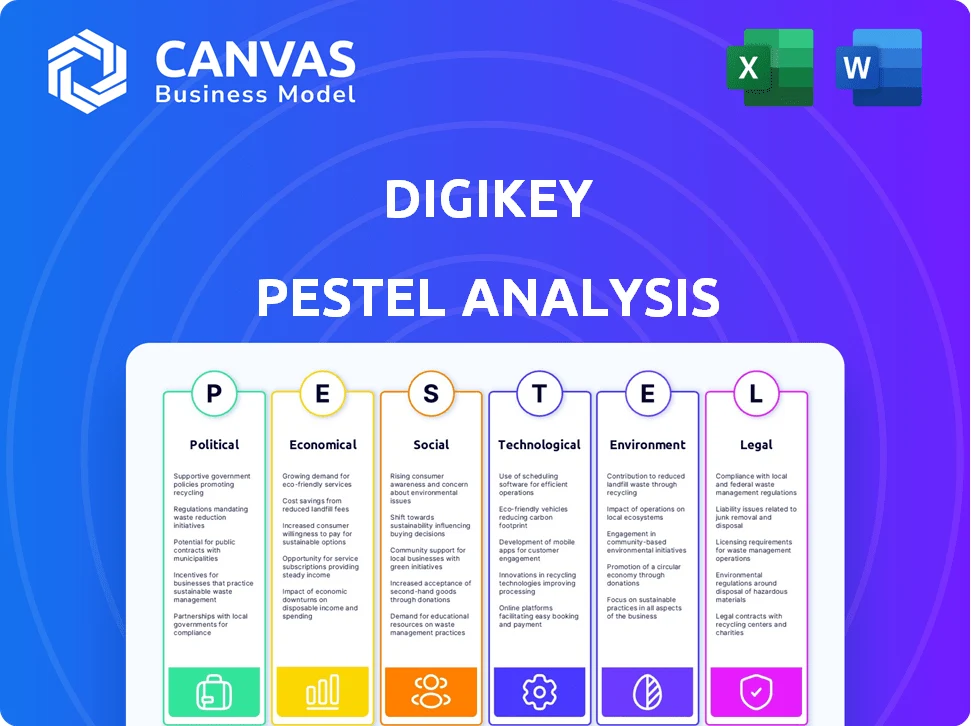
A PESTLE analysis examines external factors affecting DigiKey across Political, Economic, Social, Technological, etc. dimensions.

 Customizable Excel Spreadsheet
DigiKey's PESTLE offers clear market insights, quickly aiding crucial strategic decision-making processes.
What You See Is What You Get
DigiKey PESTLE Analysis
This DigiKey PESTLE Analysis preview accurately reflects the complete document you will receive.
The format, analysis, and insights displayed here are identical.
After your purchase, download this exact, professionally crafted analysis instantly.
There are no alterations; what you see is what you get!

PESTLE Analysis Template

Your Shortcut to Market Insight Starts Here
Navigate the complex landscape impacting DigiKey with our detailed PESTLE Analysis. Uncover the political and economic factors shaping their market presence. Explore how technological advances and social trends are influencing DigiKey's strategy. Our analysis offers clear insights on legal and environmental considerations. Ready-to-use, our analysis will streamline your research.
Political factors

Trade Policies and Tariffs
Global trade policies and tariffs are critical for electronic component costs and availability. Changes in trade agreements and tariffs can disrupt supply chains. For instance, the US-China trade war impacted component prices. In 2024/2025, DigiKey must navigate fluctuating tariffs. This impacts pricing and lead times.
Geopolitical Stability
Geopolitical instability significantly impacts DigiKey. Conflicts disrupt supply chains, as seen with the Russia-Ukraine war affecting component availability. Political tensions can also shift manufacturing locations, increasing costs. For example, in 2024, shipping costs rose 15% due to regional instability. Uncertainty hinders long-term planning, impacting DigiKey's growth potential.

Government Regulations and Incentives
Government regulations significantly impact DigiKey. Regulations on manufacturing, import, and export of electronic components directly affect their supply chain. Incentives for domestic production, such as the CHIPS Act in the U.S., can create opportunities. For example, the CHIPS Act has allocated over $52 billion to boost U.S. semiconductor production.

Political Polarization and Elections
Political polarization and major elections worldwide, like those in the U.S. and India in 2024, can significantly impact trade. This instability can cause sudden changes in rules and regulations, affecting businesses. Companies need to be flexible to respond to these shifts effectively.
- 2024 is a record year for global elections, with over 4 billion people eligible to vote.
- Trade policy uncertainty has increased by 20% in the last year.
- Changes in tariffs and trade agreements can quickly impact supply chains.
International Relations and Alliances
International relations and alliances, especially those related to technology and trade, are crucial for DigiKey's supply chain. The US-China relationship is particularly impactful, influencing component availability and costs. Tensions or cooperation between these nations directly affect DigiKey's operations. For instance, in 2024, US tariffs on Chinese goods impacted component prices, affecting DigiKey's margins.
- In 2024, U.S. imports of electronic components from China were valued at approximately $80 billion, highlighting the significant trade volume.
- The US-China trade war led to a 15% average increase in tariffs on certain electronic components, increasing costs.
- DigiKey's diversification strategies include expanding partnerships in Southeast Asia to mitigate supply chain risks.
Political Risks: DigiKey's Supply Chain Challenges
Political factors heavily influence DigiKey's operations. Global trade policies and tariffs impact component costs and availability, causing supply chain disruptions. Geopolitical instability, exemplified by conflicts, further affects the supply chain and manufacturing locations. Government regulations, like the CHIPS Act, present opportunities and challenges for the company.
| Political Aspect | Impact on DigiKey | 2024/2025 Data |
|---|---|---|
| Trade Policies & Tariffs | Component costs, supply chain | US tariffs on China raised prices 15%. |
| Geopolitical Instability | Supply chain disruptions, cost | Shipping costs up 15% due to instability. |
| Government Regulations | Manufacturing, import/export | CHIPS Act: $52B for semiconductors. |
Economic factors

Global Economic Growth and Stability
Global economic growth significantly impacts DigiKey's component demand. In 2024, the global GDP growth rate is projected at 3.2%, according to the IMF. Economic instability, like geopolitical tensions, could reduce investment. For instance, the automotive sector, a key DigiKey customer, may face disruptions due to economic downturns.
Currency Exchange Rates
DigiKey, as a global player, faces currency exchange rate impacts. Fluctuations alter component costs from international suppliers. For instance, a stronger USD in 2024/2025 could lower import expenses. This affects pricing for customers worldwide. Currency volatility necessitates careful financial planning.

Inflation and Rising Costs
Inflation and escalating costs, especially for raw materials, manufacturing, and transportation, are significant challenges. In 2024, global inflation rates varied, with the US at 3.1% and the Eurozone at 2.4%. DigiKey must manage these costs to maintain profitability.

Inventory Levels and Management
Managing inventory is critical in electronics, which has seen both shortages and surpluses. Efficient inventory management helps meet customer needs while preventing excess stock and costs. DigiKey needs to balance supply and demand carefully to avoid losses from overstocking or missed sales due to shortages. For instance, in 2024, the semiconductor industry faced inventory corrections, impacting supply chains.
- Inventory turnover rates in the electronics distribution sector averaged around 4-6 times per year in 2024.
- Overstocking can lead to significant losses, with obsolete inventory potentially devaluing by 30-50%.
- Just-in-time inventory systems are increasingly common to minimize holding costs and risks.
- Demand forecasting accuracy is crucial; a 10% improvement can lead to a 5% reduction in inventory costs.
Investment in Key Growth Sectors
Investment in key growth sectors significantly influences DigiKey's prospects. Sectors like automotive, AI, 5G, IoT, and renewable energy are major drivers of demand for electronic components. These sectors are experiencing substantial growth, with the global automotive electronics market projected to reach $450 billion by 2025. DigiKey's expansion strategy is closely aligned with these dynamic markets.
- Automotive electronics market to hit $450B by 2025.
- AI market expected to reach $1.8 trillion by 2030.
- 5G adoption is rapidly increasing worldwide.
Economic Trends Shaping Component Demand
Economic factors significantly influence DigiKey's success. Global GDP growth, projected at 3.2% in 2024, affects component demand. Inflation, with varied 2024 rates like 3.1% (US) and 2.4% (Eurozone), impacts costs. Investment in growth sectors drives demand.
| Factor | Impact | 2024 Data/Projections |
|---|---|---|
| GDP Growth | Component Demand | Global: 3.2% (IMF) |
| Inflation | Cost of Goods | US: 3.1%, Eurozone: 2.4% |
| Key Sectors | Demand | Automotive Electronics: $450B (2025) |
Sociological factors

Changing Consumer Preferences
Consumer preferences are shifting towards compact, energy-saving, and advanced electronic gadgets. This drives demand for specific components. In 2024, the wearables market is projected to reach $81.5 billion, influencing the distribution of related components. Smart home tech is also booming, with a predicted market value of $168.5 billion by 2025, further impacting DigiKey's market.
Technological Adoption Rates
Technological adoption rates significantly influence component demand. AI, 5G, and IoT's quick uptake fuels market expansion. For example, the global IoT market is projected to reach $2.4 trillion by 2029. This growth directly increases demand for DigiKey's offerings. Faster adoption means quicker sales cycles and potential revenue boosts for DigiKey.

Remote Work and Digital Transformation
The shift to remote work and digital transformation significantly drives demand for electronic components. This trend fuels growth in communication infrastructure, data centers, and automation systems. The global remote work market is projected to reach $245.8 billion by 2025. DigiKey benefits from this increased need for components.

Education and Skill Development
A skilled workforce, particularly engineers and technicians, is essential for DigiKey's operations. Educational programs that support STEM fields are vital for the company's future. DigiKey's success depends on a pipeline of qualified professionals to innovate and meet market demands. In 2024, the U.S. saw a 9% increase in STEM job openings. This highlights the importance of education and workforce development.
- STEM job growth is projected to continue, with an estimated 10% increase by 2025.
- DigiKey actively supports educational initiatives to foster talent.
- The availability of skilled workers directly impacts DigiKey's growth.
Social Commerce and Online Purchasing Trends
Social commerce significantly influences how customers buy electronic components. DigiKey's online presence is crucial for these trends. E-commerce sales hit $8.1 trillion globally in 2023. In 2024, it's projected to reach over $8.7 trillion. DigiKey's platform caters to this shift.
- Global e-commerce sales reached $8.1T in 2023.
- 2024 projections exceed $8.7T worldwide.
- DigiKey's online platform is key.
Eco-Friendly Tech: A $140.5B Market
Customer expectations for sustainability impact component choices. This means eco-friendly products matter more. Ethical sourcing and transparency are vital. In 2024, the sustainable electronics market is valued at $140.5 billion.
| Factor | Impact | Data |
|---|---|---|
| Consumer Trends | Demand for smart and compact gadgets. | Wearables Market: $81.5B (2024) |
| Social Media | Growth in social media | Social commerce growth continues in 2024 |
| Ethical Concerns | Focus on eco-friendly and sustainable products | Sustainable Electronics: $140.5B (2024) |
DIGIKEY PESTLE ANALYSIS TEMPLATE RESEARCH
What is included in the product
Detailed Word Document
A PESTLE analysis examines external factors affecting DigiKey across Political, Economic, Social, Technological, etc. dimensions.
Customizable Excel Spreadsheet
DigiKey's PESTLE offers clear market insights, quickly aiding crucial strategic decision-making processes.
What You See Is What You Get
DigiKey PESTLE Analysis
This DigiKey PESTLE Analysis preview accurately reflects the complete document you will receive.
The format, analysis, and insights displayed here are identical.
After your purchase, download this exact, professionally crafted analysis instantly.
There are no alterations; what you see is what you get!
PESTLE Analysis Template
Your Shortcut to Market Insight Starts Here
Navigate the complex landscape impacting DigiKey with our detailed PESTLE Analysis. Uncover the political and economic factors shaping their market presence. Explore how technological advances and social trends are influencing DigiKey's strategy. Our analysis offers clear insights on legal and environmental considerations. Ready-to-use, our analysis will streamline your research.
Political factors
Trade Policies and Tariffs
Global trade policies and tariffs are critical for electronic component costs and availability. Changes in trade agreements and tariffs can disrupt supply chains. For instance, the US-China trade war impacted component prices. In 2024/2025, DigiKey must navigate fluctuating tariffs. This impacts pricing and lead times.
Geopolitical Stability
Geopolitical instability significantly impacts DigiKey. Conflicts disrupt supply chains, as seen with the Russia-Ukraine war affecting component availability. Political tensions can also shift manufacturing locations, increasing costs. For example, in 2024, shipping costs rose 15% due to regional instability. Uncertainty hinders long-term planning, impacting DigiKey's growth potential.
Government Regulations and Incentives
Government regulations significantly impact DigiKey. Regulations on manufacturing, import, and export of electronic components directly affect their supply chain. Incentives for domestic production, such as the CHIPS Act in the U.S., can create opportunities. For example, the CHIPS Act has allocated over $52 billion to boost U.S. semiconductor production.
Political Polarization and Elections
Political polarization and major elections worldwide, like those in the U.S. and India in 2024, can significantly impact trade. This instability can cause sudden changes in rules and regulations, affecting businesses. Companies need to be flexible to respond to these shifts effectively.
- 2024 is a record year for global elections, with over 4 billion people eligible to vote.
- Trade policy uncertainty has increased by 20% in the last year.
- Changes in tariffs and trade agreements can quickly impact supply chains.
International Relations and Alliances
International relations and alliances, especially those related to technology and trade, are crucial for DigiKey's supply chain. The US-China relationship is particularly impactful, influencing component availability and costs. Tensions or cooperation between these nations directly affect DigiKey's operations. For instance, in 2024, US tariffs on Chinese goods impacted component prices, affecting DigiKey's margins.
- In 2024, U.S. imports of electronic components from China were valued at approximately $80 billion, highlighting the significant trade volume.
- The US-China trade war led to a 15% average increase in tariffs on certain electronic components, increasing costs.
- DigiKey's diversification strategies include expanding partnerships in Southeast Asia to mitigate supply chain risks.
Political Risks: DigiKey's Supply Chain Challenges
Political factors heavily influence DigiKey's operations. Global trade policies and tariffs impact component costs and availability, causing supply chain disruptions. Geopolitical instability, exemplified by conflicts, further affects the supply chain and manufacturing locations. Government regulations, like the CHIPS Act, present opportunities and challenges for the company.
| Political Aspect | Impact on DigiKey | 2024/2025 Data |
|---|---|---|
| Trade Policies & Tariffs | Component costs, supply chain | US tariffs on China raised prices 15%. |
| Geopolitical Instability | Supply chain disruptions, cost | Shipping costs up 15% due to instability. |
| Government Regulations | Manufacturing, import/export | CHIPS Act: $52B for semiconductors. |
Economic factors
Global Economic Growth and Stability
Global economic growth significantly impacts DigiKey's component demand. In 2024, the global GDP growth rate is projected at 3.2%, according to the IMF. Economic instability, like geopolitical tensions, could reduce investment. For instance, the automotive sector, a key DigiKey customer, may face disruptions due to economic downturns.
Currency Exchange Rates
DigiKey, as a global player, faces currency exchange rate impacts. Fluctuations alter component costs from international suppliers. For instance, a stronger USD in 2024/2025 could lower import expenses. This affects pricing for customers worldwide. Currency volatility necessitates careful financial planning.
Inflation and Rising Costs
Inflation and escalating costs, especially for raw materials, manufacturing, and transportation, are significant challenges. In 2024, global inflation rates varied, with the US at 3.1% and the Eurozone at 2.4%. DigiKey must manage these costs to maintain profitability.
Inventory Levels and Management
Managing inventory is critical in electronics, which has seen both shortages and surpluses. Efficient inventory management helps meet customer needs while preventing excess stock and costs. DigiKey needs to balance supply and demand carefully to avoid losses from overstocking or missed sales due to shortages. For instance, in 2024, the semiconductor industry faced inventory corrections, impacting supply chains.
- Inventory turnover rates in the electronics distribution sector averaged around 4-6 times per year in 2024.
- Overstocking can lead to significant losses, with obsolete inventory potentially devaluing by 30-50%.
- Just-in-time inventory systems are increasingly common to minimize holding costs and risks.
- Demand forecasting accuracy is crucial; a 10% improvement can lead to a 5% reduction in inventory costs.
Investment in Key Growth Sectors
Investment in key growth sectors significantly influences DigiKey's prospects. Sectors like automotive, AI, 5G, IoT, and renewable energy are major drivers of demand for electronic components. These sectors are experiencing substantial growth, with the global automotive electronics market projected to reach $450 billion by 2025. DigiKey's expansion strategy is closely aligned with these dynamic markets.
- Automotive electronics market to hit $450B by 2025.
- AI market expected to reach $1.8 trillion by 2030.
- 5G adoption is rapidly increasing worldwide.
Economic Trends Shaping Component Demand
Economic factors significantly influence DigiKey's success. Global GDP growth, projected at 3.2% in 2024, affects component demand. Inflation, with varied 2024 rates like 3.1% (US) and 2.4% (Eurozone), impacts costs. Investment in growth sectors drives demand.
| Factor | Impact | 2024 Data/Projections |
|---|---|---|
| GDP Growth | Component Demand | Global: 3.2% (IMF) |
| Inflation | Cost of Goods | US: 3.1%, Eurozone: 2.4% |
| Key Sectors | Demand | Automotive Electronics: $450B (2025) |
Sociological factors
Changing Consumer Preferences
Consumer preferences are shifting towards compact, energy-saving, and advanced electronic gadgets. This drives demand for specific components. In 2024, the wearables market is projected to reach $81.5 billion, influencing the distribution of related components. Smart home tech is also booming, with a predicted market value of $168.5 billion by 2025, further impacting DigiKey's market.
Technological Adoption Rates
Technological adoption rates significantly influence component demand. AI, 5G, and IoT's quick uptake fuels market expansion. For example, the global IoT market is projected to reach $2.4 trillion by 2029. This growth directly increases demand for DigiKey's offerings. Faster adoption means quicker sales cycles and potential revenue boosts for DigiKey.
Remote Work and Digital Transformation
The shift to remote work and digital transformation significantly drives demand for electronic components. This trend fuels growth in communication infrastructure, data centers, and automation systems. The global remote work market is projected to reach $245.8 billion by 2025. DigiKey benefits from this increased need for components.
Education and Skill Development
A skilled workforce, particularly engineers and technicians, is essential for DigiKey's operations. Educational programs that support STEM fields are vital for the company's future. DigiKey's success depends on a pipeline of qualified professionals to innovate and meet market demands. In 2024, the U.S. saw a 9% increase in STEM job openings. This highlights the importance of education and workforce development.
- STEM job growth is projected to continue, with an estimated 10% increase by 2025.
- DigiKey actively supports educational initiatives to foster talent.
- The availability of skilled workers directly impacts DigiKey's growth.
Social Commerce and Online Purchasing Trends
Social commerce significantly influences how customers buy electronic components. DigiKey's online presence is crucial for these trends. E-commerce sales hit $8.1 trillion globally in 2023. In 2024, it's projected to reach over $8.7 trillion. DigiKey's platform caters to this shift.
- Global e-commerce sales reached $8.1T in 2023.
- 2024 projections exceed $8.7T worldwide.
- DigiKey's online platform is key.
Eco-Friendly Tech: A $140.5B Market
Customer expectations for sustainability impact component choices. This means eco-friendly products matter more. Ethical sourcing and transparency are vital. In 2024, the sustainable electronics market is valued at $140.5 billion.
| Factor | Impact | Data |
|---|---|---|
| Consumer Trends | Demand for smart and compact gadgets. | Wearables Market: $81.5B (2024) |
| Social Media | Growth in social media | Social commerce growth continues in 2024 |
| Ethical Concerns | Focus on eco-friendly and sustainable products | Sustainable Electronics: $140.5B (2024) |
Product Information
Product Information
Shipping & Returns
Shipping & Returns
Description
What is included in the product
Detailed Word Document
A PESTLE analysis examines external factors affecting DigiKey across Political, Economic, Social, Technological, etc. dimensions.
Customizable Excel Spreadsheet
DigiKey's PESTLE offers clear market insights, quickly aiding crucial strategic decision-making processes.
What You See Is What You Get
DigiKey PESTLE Analysis
This DigiKey PESTLE Analysis preview accurately reflects the complete document you will receive.
The format, analysis, and insights displayed here are identical.
After your purchase, download this exact, professionally crafted analysis instantly.
There are no alterations; what you see is what you get!
PESTLE Analysis Template
Your Shortcut to Market Insight Starts Here
Navigate the complex landscape impacting DigiKey with our detailed PESTLE Analysis. Uncover the political and economic factors shaping their market presence. Explore how technological advances and social trends are influencing DigiKey's strategy. Our analysis offers clear insights on legal and environmental considerations. Ready-to-use, our analysis will streamline your research.
Political factors
Trade Policies and Tariffs
Global trade policies and tariffs are critical for electronic component costs and availability. Changes in trade agreements and tariffs can disrupt supply chains. For instance, the US-China trade war impacted component prices. In 2024/2025, DigiKey must navigate fluctuating tariffs. This impacts pricing and lead times.
Geopolitical Stability
Geopolitical instability significantly impacts DigiKey. Conflicts disrupt supply chains, as seen with the Russia-Ukraine war affecting component availability. Political tensions can also shift manufacturing locations, increasing costs. For example, in 2024, shipping costs rose 15% due to regional instability. Uncertainty hinders long-term planning, impacting DigiKey's growth potential.
Government Regulations and Incentives
Government regulations significantly impact DigiKey. Regulations on manufacturing, import, and export of electronic components directly affect their supply chain. Incentives for domestic production, such as the CHIPS Act in the U.S., can create opportunities. For example, the CHIPS Act has allocated over $52 billion to boost U.S. semiconductor production.
Political Polarization and Elections
Political polarization and major elections worldwide, like those in the U.S. and India in 2024, can significantly impact trade. This instability can cause sudden changes in rules and regulations, affecting businesses. Companies need to be flexible to respond to these shifts effectively.
- 2024 is a record year for global elections, with over 4 billion people eligible to vote.
- Trade policy uncertainty has increased by 20% in the last year.
- Changes in tariffs and trade agreements can quickly impact supply chains.
International Relations and Alliances
International relations and alliances, especially those related to technology and trade, are crucial for DigiKey's supply chain. The US-China relationship is particularly impactful, influencing component availability and costs. Tensions or cooperation between these nations directly affect DigiKey's operations. For instance, in 2024, US tariffs on Chinese goods impacted component prices, affecting DigiKey's margins.
- In 2024, U.S. imports of electronic components from China were valued at approximately $80 billion, highlighting the significant trade volume.
- The US-China trade war led to a 15% average increase in tariffs on certain electronic components, increasing costs.
- DigiKey's diversification strategies include expanding partnerships in Southeast Asia to mitigate supply chain risks.
Political Risks: DigiKey's Supply Chain Challenges
Political factors heavily influence DigiKey's operations. Global trade policies and tariffs impact component costs and availability, causing supply chain disruptions. Geopolitical instability, exemplified by conflicts, further affects the supply chain and manufacturing locations. Government regulations, like the CHIPS Act, present opportunities and challenges for the company.
| Political Aspect | Impact on DigiKey | 2024/2025 Data |
|---|---|---|
| Trade Policies & Tariffs | Component costs, supply chain | US tariffs on China raised prices 15%. |
| Geopolitical Instability | Supply chain disruptions, cost | Shipping costs up 15% due to instability. |
| Government Regulations | Manufacturing, import/export | CHIPS Act: $52B for semiconductors. |
Economic factors
Global Economic Growth and Stability
Global economic growth significantly impacts DigiKey's component demand. In 2024, the global GDP growth rate is projected at 3.2%, according to the IMF. Economic instability, like geopolitical tensions, could reduce investment. For instance, the automotive sector, a key DigiKey customer, may face disruptions due to economic downturns.
Currency Exchange Rates
DigiKey, as a global player, faces currency exchange rate impacts. Fluctuations alter component costs from international suppliers. For instance, a stronger USD in 2024/2025 could lower import expenses. This affects pricing for customers worldwide. Currency volatility necessitates careful financial planning.
Inflation and Rising Costs
Inflation and escalating costs, especially for raw materials, manufacturing, and transportation, are significant challenges. In 2024, global inflation rates varied, with the US at 3.1% and the Eurozone at 2.4%. DigiKey must manage these costs to maintain profitability.
Inventory Levels and Management
Managing inventory is critical in electronics, which has seen both shortages and surpluses. Efficient inventory management helps meet customer needs while preventing excess stock and costs. DigiKey needs to balance supply and demand carefully to avoid losses from overstocking or missed sales due to shortages. For instance, in 2024, the semiconductor industry faced inventory corrections, impacting supply chains.
- Inventory turnover rates in the electronics distribution sector averaged around 4-6 times per year in 2024.
- Overstocking can lead to significant losses, with obsolete inventory potentially devaluing by 30-50%.
- Just-in-time inventory systems are increasingly common to minimize holding costs and risks.
- Demand forecasting accuracy is crucial; a 10% improvement can lead to a 5% reduction in inventory costs.
Investment in Key Growth Sectors
Investment in key growth sectors significantly influences DigiKey's prospects. Sectors like automotive, AI, 5G, IoT, and renewable energy are major drivers of demand for electronic components. These sectors are experiencing substantial growth, with the global automotive electronics market projected to reach $450 billion by 2025. DigiKey's expansion strategy is closely aligned with these dynamic markets.
- Automotive electronics market to hit $450B by 2025.
- AI market expected to reach $1.8 trillion by 2030.
- 5G adoption is rapidly increasing worldwide.
Economic Trends Shaping Component Demand
Economic factors significantly influence DigiKey's success. Global GDP growth, projected at 3.2% in 2024, affects component demand. Inflation, with varied 2024 rates like 3.1% (US) and 2.4% (Eurozone), impacts costs. Investment in growth sectors drives demand.
| Factor | Impact | 2024 Data/Projections |
|---|---|---|
| GDP Growth | Component Demand | Global: 3.2% (IMF) |
| Inflation | Cost of Goods | US: 3.1%, Eurozone: 2.4% |
| Key Sectors | Demand | Automotive Electronics: $450B (2025) |
Sociological factors
Changing Consumer Preferences
Consumer preferences are shifting towards compact, energy-saving, and advanced electronic gadgets. This drives demand for specific components. In 2024, the wearables market is projected to reach $81.5 billion, influencing the distribution of related components. Smart home tech is also booming, with a predicted market value of $168.5 billion by 2025, further impacting DigiKey's market.
Technological Adoption Rates
Technological adoption rates significantly influence component demand. AI, 5G, and IoT's quick uptake fuels market expansion. For example, the global IoT market is projected to reach $2.4 trillion by 2029. This growth directly increases demand for DigiKey's offerings. Faster adoption means quicker sales cycles and potential revenue boosts for DigiKey.
Remote Work and Digital Transformation
The shift to remote work and digital transformation significantly drives demand for electronic components. This trend fuels growth in communication infrastructure, data centers, and automation systems. The global remote work market is projected to reach $245.8 billion by 2025. DigiKey benefits from this increased need for components.
Education and Skill Development
A skilled workforce, particularly engineers and technicians, is essential for DigiKey's operations. Educational programs that support STEM fields are vital for the company's future. DigiKey's success depends on a pipeline of qualified professionals to innovate and meet market demands. In 2024, the U.S. saw a 9% increase in STEM job openings. This highlights the importance of education and workforce development.
- STEM job growth is projected to continue, with an estimated 10% increase by 2025.
- DigiKey actively supports educational initiatives to foster talent.
- The availability of skilled workers directly impacts DigiKey's growth.
Social Commerce and Online Purchasing Trends
Social commerce significantly influences how customers buy electronic components. DigiKey's online presence is crucial for these trends. E-commerce sales hit $8.1 trillion globally in 2023. In 2024, it's projected to reach over $8.7 trillion. DigiKey's platform caters to this shift.
- Global e-commerce sales reached $8.1T in 2023.
- 2024 projections exceed $8.7T worldwide.
- DigiKey's online platform is key.
Eco-Friendly Tech: A $140.5B Market
Customer expectations for sustainability impact component choices. This means eco-friendly products matter more. Ethical sourcing and transparency are vital. In 2024, the sustainable electronics market is valued at $140.5 billion.
| Factor | Impact | Data |
|---|---|---|
| Consumer Trends | Demand for smart and compact gadgets. | Wearables Market: $81.5B (2024) |
| Social Media | Growth in social media | Social commerce growth continues in 2024 |
| Ethical Concerns | Focus on eco-friendly and sustainable products | Sustainable Electronics: $140.5B (2024) |