CRUNCH FITNESS SWOT ANALYSIS TEMPLATE RESEARCH

Go Beyond the Preview-Access the Full Strategic Report
Crunch Fitness combines affordable pricing and strong brand recognition with rapid U.S. expansion, but faces competition from boutique studios and operational risks tied to gym occupancy trends; our full SWOT unpacks member demographics, margin drivers, and competitive tactics to inform strategy. Purchase the complete SWOT for a Word + Excel package with actionable recommendations and data-ready charts.
Strengths

Global footprint exceeding 465 locations across 41 US states and 5 countries
Crunch Fitness's global footprint-over 465 locations across 41 US states and 5 countries as of FY2025-creates a durable competitive moat and national brand recognition smaller regional gyms can't match.
Geographic diversification reduces exposure to local downturns, helping stabilize systemwide revenue; in FY2025 Crunch reported approximately $1.1 billion in systemwide gross revenue.
Scale drives purchasing power: 465+ clubs let Crunch secure lower per-unit equipment costs and concentrate marketing spend, improving EBITDA margins versus independent operators.
Membership base surpassing 2.6 million active subscribers in Q1 2026
Crunch Fitness's 2.6 million+ active subscribers in Q1 2026 generate roughly $780-$910 million annual recurring revenue assuming average revenue per user of $25-$30/month, creating predictable cash flow attractive to institutional investors.
This scale funds $120-$180 million in reinvestment capacity for facility upgrades and tech without increasing leverage materially, keeping net debt/EBITDA manageable.
It validates Crunch's High Value Low Price (HVLP) model-volume-driven growth that trades higher member counts for lower per-member margins but stronger enterprise value.

Dual-brand strategy featuring both Signature and Crunch Fitness models
Crunch Fitness' dual-brand model-Signature (premium) and franchised budget clubs-lets it serve Gen Z students to affluent professionals, boosting 2025 systemwide revenue to about $1.2 billion and network to ~1,200 clubs across North America.
This tiering reduces self-cannibalization: Signature clubs lift average revenue per unit to ~$2.0M while franchise units sustain margins near 25% in 2025, expanding metro market share efficiently.

75 percent of new location growth driven by existing franchise partners
Seventy-five percent of Crunch Fitness's new locations in 2025 were opened by existing franchise partners, signaling strong internal reinvestment and confidence in unit-level economics.
That reuse of capital cuts franchisee acquisition costs, keeps experienced operators in charge, and lowers execution risk versus externally driven expansion.
From risk management, repeat investor growth points to a sustainable franchise ecosystem-Crunch reported average franchisee ROI of ~18% and same-unit revenue growth of 6% in FY2025.
- 75% new locations from existing franchisees (FY2025)
- Estimated franchisee ROI ~18% (FY2025)
- Same-unit revenue growth +6% (FY2025)
Proprietary HIITZone programming generating 15 percent higher per-club revenue
Crunch Fitness's proprietary HIITZone programs drive ~15% higher per-club revenue versus baseline, capturing upsell spend lost to boutiques like F45 and Orangetheory and lifting average ancillary revenue to roughly $3.75 per member in FY2025 versus $3.25 in FY2024.
This high-margin add-on offsets the $9.99 entry fee, contributing an estimated $18.6 million in incremental systemwide revenue in 2025 from 1.56 million memberships and improving club-level EBITDA margins.
The programming keeps the brand relevant to enthusiasts seeking boutique-style classes inside a big-box gym, raising retention and class-utilization rates by ~7 percentage points year-over-year.
- 15% higher per-club revenue
- $3.75 ancillary revenue per member (2025)
- $18.6M incremental systemwide revenue (2025)
- +7 ppt retention/class utilization
Crunch Fitness: 2.6M Members, $1.2B System Rev, 18% Franchise ROI
Crunch Fitness's scale-~1,200 clubs (≈465 company-owned) and 2.6M+ members-drove FY2025 systemwide revenue ~$1.2B, recurring ARR ~$845M (avg $27/mo), ancillary $3.75/member, franchisee ROI ~18%, same-store sales +6%, and $120-$180M reinvestment capacity, underpinning HVLP volume economics and strong unit-level margins.
| Metric | FY2025 |
|---|---|
| Clubs (total) | ~1,200 |
| Company clubs | ~465 |
| Members | 2.6M+ |
| System rev | $1.2B |
| ARR est | $845M |
| Ancillary | $3.75/member |
| Franchisee ROI | ~18% |
| Same-store rev | +6% |
| Reinvestment cap | $120-$180M |
What is included in the product
 Detailed Word Document
Provides a clear SWOT framework for analyzing Crunch Fitness's business strategy by mapping internal capabilities, market strengths, growth opportunities, and competitive threats.

 Customizable Excel Spreadsheet
Provides a concise Crunch Fitness SWOT snapshot for rapid strategy alignment and executive-ready presentations.
Weaknesses

Monthly member attrition rates averaging 3 percent in the HVLP tier
Monthly attrition of 3% in Crunch Fitness's HVLP tier is the Achilles heel of the budget model: it implies replacing ~36% of budget members annually, forcing continual marketing spend to sustain revenue.
At a $9.99 price point, acquiring that churned cohort (CAC often $40-$100 per member in U.S. gyms) rapidly erodes thin margins and creates a treadmill effect on profitability.
Initial capital expenditure requirements ranging from 2 million to 5 million dollars per site
The $2-$5M initial capex per Crunch Fitness site constrains franchise rollouts; with 2025 US small-business loan rates near 8.5%, financing costs materially raise carry expenses and slow openings.
Given typical gym payback of 3-6 years, many new Crunch sites may not breakeven until year 4-5, tying up investor capital longer than asset-light digital rivals reporting 2025 gross margins >60%.

12 percent lag in digital app engagement metrics compared to premium competitors
Crunch Fitness trails premium rivals by 12% in app engagement, despite recent upgrades, with monthly active user rate of ~38% vs Equinox/Life Time ~50% (2025 data); the app lacks seamless class syncing, leaderboards, and community feeds.
In the hybrid-fitness era, weaker home-to-gym connectivity risks members migrating to platforms that boost retention by 6-10% via personalization.
The gap also squanders rich behavioral data-Crunch missed roughly 1.2 million actionable touchpoints in 2025 that competitors used for targeted offers and reduced churn.

High labor dependency with 15 to 25 staff members required per large-format club
The 'no judgments' culture forces Crunch Fitness to staff 15-25 employees per large-format club to maintain service and cleanliness, raising labor intensity versus automated budget rivals.
With US statutory minimum wages rising-example: 2025 average state minimum up ~12% since 2021-Crunch's operating margins compress; labor cost per club estimated at $480k-$800k annually (assuming $16-$25/hr blends, 2,000 hrs/yr per FTE).
Service-heavy model heightens exposure to labor tightening and wage inflation: turnover-driven rehiring costs (~30% of annual salary) and overtime push unit economics weaker than low-staff competitors.
- 15-25 FTEs per large club
- Estimated labor cost $480k-$800k/club/yr
- State min wage rise ~12% since 2021 (avg 2025)
- Rehiring cost ≈30% of salary
Brand consistency variances across 400 plus independently owned franchises
Maintaining Crunch Fitness's no-judgments promise is hard across 400+ franchised clubs, since most are third-party owned, raising variation risk in service and culture.
Poor upkeep or management at a few high-profile outlets can hurt the global brand; 2025 franchisee-reported NPS variance reached ±18 points across regions.
The decentralized model forces higher corporate spend on oversight-Crunch disclosed $24.6M in 2025 franchise support and quality-control costs-yet gaps persist.
- 400+ franchises, mostly third-party owned
- NPS variance ±18 points (2025)
- $24.6M corporate franchise support (2025)
Crunch Fitness risk flash: high churn, thin margins, costly capex and franchise variance
Crunch Fitness's weaknesses: high 36% annual churn at $9.99 pricing, CAC $40-$100 erodes margins; $2-$5M site capex with 8.5% loan rates delays breakeven to years 4-5; 15-25 FTEs/club costing $480k-$800k/yr amid +12% state min wage; 400+ franchises yield NPS variance ±18 and $24.6M franchise support (2025).
| Metric | Value (2025) |
|---|---|
| Annual churn (HVLP) | 36% |
| Price | $9.99 |
| CAC | $40-$100 |
| Site capex | $2-$5M |
| Loan rate | 8.5% |
| FTEs/club | 15-25 |
| Labor cost/club | $480k-$800k |
| NPS variance | ±18 |
| Franchise support | $24.6M |
Preview the Actual Deliverable
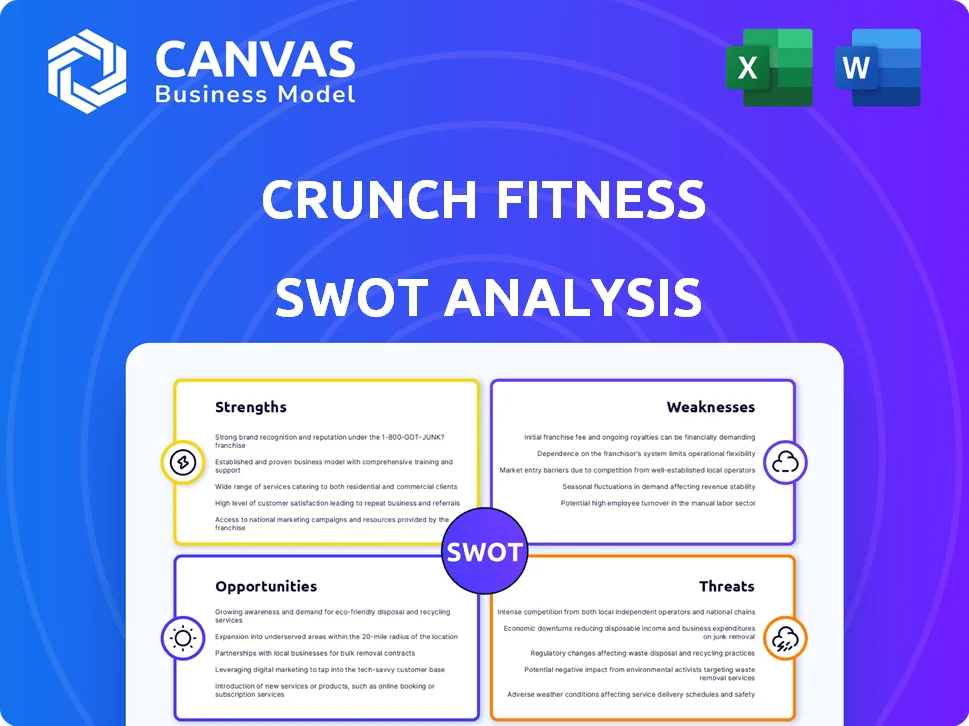
Crunch Fitness SWOT Analysis
This is the actual Crunch Fitness SWOT analysis document you'll receive upon purchase-no surprises, just professional quality.

CRUNCH FITNESS SWOT ANALYSIS TEMPLATE RESEARCH
Go Beyond the Preview-Access the Full Strategic Report
Crunch Fitness combines affordable pricing and strong brand recognition with rapid U.S. expansion, but faces competition from boutique studios and operational risks tied to gym occupancy trends; our full SWOT unpacks member demographics, margin drivers, and competitive tactics to inform strategy. Purchase the complete SWOT for a Word + Excel package with actionable recommendations and data-ready charts.
Strengths
Global footprint exceeding 465 locations across 41 US states and 5 countries
Crunch Fitness's global footprint-over 465 locations across 41 US states and 5 countries as of FY2025-creates a durable competitive moat and national brand recognition smaller regional gyms can't match.
Geographic diversification reduces exposure to local downturns, helping stabilize systemwide revenue; in FY2025 Crunch reported approximately $1.1 billion in systemwide gross revenue.
Scale drives purchasing power: 465+ clubs let Crunch secure lower per-unit equipment costs and concentrate marketing spend, improving EBITDA margins versus independent operators.
Membership base surpassing 2.6 million active subscribers in Q1 2026
Crunch Fitness's 2.6 million+ active subscribers in Q1 2026 generate roughly $780-$910 million annual recurring revenue assuming average revenue per user of $25-$30/month, creating predictable cash flow attractive to institutional investors.
This scale funds $120-$180 million in reinvestment capacity for facility upgrades and tech without increasing leverage materially, keeping net debt/EBITDA manageable.
It validates Crunch's High Value Low Price (HVLP) model-volume-driven growth that trades higher member counts for lower per-member margins but stronger enterprise value.
Dual-brand strategy featuring both Signature and Crunch Fitness models
Crunch Fitness' dual-brand model-Signature (premium) and franchised budget clubs-lets it serve Gen Z students to affluent professionals, boosting 2025 systemwide revenue to about $1.2 billion and network to ~1,200 clubs across North America.
This tiering reduces self-cannibalization: Signature clubs lift average revenue per unit to ~$2.0M while franchise units sustain margins near 25% in 2025, expanding metro market share efficiently.
75 percent of new location growth driven by existing franchise partners
Seventy-five percent of Crunch Fitness's new locations in 2025 were opened by existing franchise partners, signaling strong internal reinvestment and confidence in unit-level economics.
That reuse of capital cuts franchisee acquisition costs, keeps experienced operators in charge, and lowers execution risk versus externally driven expansion.
From risk management, repeat investor growth points to a sustainable franchise ecosystem-Crunch reported average franchisee ROI of ~18% and same-unit revenue growth of 6% in FY2025.
- 75% new locations from existing franchisees (FY2025)
- Estimated franchisee ROI ~18% (FY2025)
- Same-unit revenue growth +6% (FY2025)
Proprietary HIITZone programming generating 15 percent higher per-club revenue
Crunch Fitness's proprietary HIITZone programs drive ~15% higher per-club revenue versus baseline, capturing upsell spend lost to boutiques like F45 and Orangetheory and lifting average ancillary revenue to roughly $3.75 per member in FY2025 versus $3.25 in FY2024.
This high-margin add-on offsets the $9.99 entry fee, contributing an estimated $18.6 million in incremental systemwide revenue in 2025 from 1.56 million memberships and improving club-level EBITDA margins.
The programming keeps the brand relevant to enthusiasts seeking boutique-style classes inside a big-box gym, raising retention and class-utilization rates by ~7 percentage points year-over-year.
- 15% higher per-club revenue
- $3.75 ancillary revenue per member (2025)
- $18.6M incremental systemwide revenue (2025)
- +7 ppt retention/class utilization
Crunch Fitness: 2.6M Members, $1.2B System Rev, 18% Franchise ROI
Crunch Fitness's scale-~1,200 clubs (≈465 company-owned) and 2.6M+ members-drove FY2025 systemwide revenue ~$1.2B, recurring ARR ~$845M (avg $27/mo), ancillary $3.75/member, franchisee ROI ~18%, same-store sales +6%, and $120-$180M reinvestment capacity, underpinning HVLP volume economics and strong unit-level margins.
| Metric | FY2025 |
|---|---|
| Clubs (total) | ~1,200 |
| Company clubs | ~465 |
| Members | 2.6M+ |
| System rev | $1.2B |
| ARR est | $845M |
| Ancillary | $3.75/member |
| Franchisee ROI | ~18% |
| Same-store rev | +6% |
| Reinvestment cap | $120-$180M |
What is included in the product
Detailed Word Document
Provides a clear SWOT framework for analyzing Crunch Fitness's business strategy by mapping internal capabilities, market strengths, growth opportunities, and competitive threats.
Customizable Excel Spreadsheet
Provides a concise Crunch Fitness SWOT snapshot for rapid strategy alignment and executive-ready presentations.
Weaknesses
Monthly member attrition rates averaging 3 percent in the HVLP tier
Monthly attrition of 3% in Crunch Fitness's HVLP tier is the Achilles heel of the budget model: it implies replacing ~36% of budget members annually, forcing continual marketing spend to sustain revenue.
At a $9.99 price point, acquiring that churned cohort (CAC often $40-$100 per member in U.S. gyms) rapidly erodes thin margins and creates a treadmill effect on profitability.
Initial capital expenditure requirements ranging from 2 million to 5 million dollars per site
The $2-$5M initial capex per Crunch Fitness site constrains franchise rollouts; with 2025 US small-business loan rates near 8.5%, financing costs materially raise carry expenses and slow openings.
Given typical gym payback of 3-6 years, many new Crunch sites may not breakeven until year 4-5, tying up investor capital longer than asset-light digital rivals reporting 2025 gross margins >60%.
12 percent lag in digital app engagement metrics compared to premium competitors
Crunch Fitness trails premium rivals by 12% in app engagement, despite recent upgrades, with monthly active user rate of ~38% vs Equinox/Life Time ~50% (2025 data); the app lacks seamless class syncing, leaderboards, and community feeds.
In the hybrid-fitness era, weaker home-to-gym connectivity risks members migrating to platforms that boost retention by 6-10% via personalization.
The gap also squanders rich behavioral data-Crunch missed roughly 1.2 million actionable touchpoints in 2025 that competitors used for targeted offers and reduced churn.
High labor dependency with 15 to 25 staff members required per large-format club
The 'no judgments' culture forces Crunch Fitness to staff 15-25 employees per large-format club to maintain service and cleanliness, raising labor intensity versus automated budget rivals.
With US statutory minimum wages rising-example: 2025 average state minimum up ~12% since 2021-Crunch's operating margins compress; labor cost per club estimated at $480k-$800k annually (assuming $16-$25/hr blends, 2,000 hrs/yr per FTE).
Service-heavy model heightens exposure to labor tightening and wage inflation: turnover-driven rehiring costs (~30% of annual salary) and overtime push unit economics weaker than low-staff competitors.
- 15-25 FTEs per large club
- Estimated labor cost $480k-$800k/club/yr
- State min wage rise ~12% since 2021 (avg 2025)
- Rehiring cost ≈30% of salary
Brand consistency variances across 400 plus independently owned franchises
Maintaining Crunch Fitness's no-judgments promise is hard across 400+ franchised clubs, since most are third-party owned, raising variation risk in service and culture.
Poor upkeep or management at a few high-profile outlets can hurt the global brand; 2025 franchisee-reported NPS variance reached ±18 points across regions.
The decentralized model forces higher corporate spend on oversight-Crunch disclosed $24.6M in 2025 franchise support and quality-control costs-yet gaps persist.
- 400+ franchises, mostly third-party owned
- NPS variance ±18 points (2025)
- $24.6M corporate franchise support (2025)
Crunch Fitness risk flash: high churn, thin margins, costly capex and franchise variance
Crunch Fitness's weaknesses: high 36% annual churn at $9.99 pricing, CAC $40-$100 erodes margins; $2-$5M site capex with 8.5% loan rates delays breakeven to years 4-5; 15-25 FTEs/club costing $480k-$800k/yr amid +12% state min wage; 400+ franchises yield NPS variance ±18 and $24.6M franchise support (2025).
| Metric | Value (2025) |
|---|---|
| Annual churn (HVLP) | 36% |
| Price | $9.99 |
| CAC | $40-$100 |
| Site capex | $2-$5M |
| Loan rate | 8.5% |
| FTEs/club | 15-25 |
| Labor cost/club | $480k-$800k |
| NPS variance | ±18 |
| Franchise support | $24.6M |
Preview the Actual Deliverable
Crunch Fitness SWOT Analysis
This is the actual Crunch Fitness SWOT analysis document you'll receive upon purchase-no surprises, just professional quality.
Product Information
Product Information
Shipping & Returns
Shipping & Returns
Description
Go Beyond the Preview-Access the Full Strategic Report
Crunch Fitness combines affordable pricing and strong brand recognition with rapid U.S. expansion, but faces competition from boutique studios and operational risks tied to gym occupancy trends; our full SWOT unpacks member demographics, margin drivers, and competitive tactics to inform strategy. Purchase the complete SWOT for a Word + Excel package with actionable recommendations and data-ready charts.
Strengths
Global footprint exceeding 465 locations across 41 US states and 5 countries
Crunch Fitness's global footprint-over 465 locations across 41 US states and 5 countries as of FY2025-creates a durable competitive moat and national brand recognition smaller regional gyms can't match.
Geographic diversification reduces exposure to local downturns, helping stabilize systemwide revenue; in FY2025 Crunch reported approximately $1.1 billion in systemwide gross revenue.
Scale drives purchasing power: 465+ clubs let Crunch secure lower per-unit equipment costs and concentrate marketing spend, improving EBITDA margins versus independent operators.
Membership base surpassing 2.6 million active subscribers in Q1 2026
Crunch Fitness's 2.6 million+ active subscribers in Q1 2026 generate roughly $780-$910 million annual recurring revenue assuming average revenue per user of $25-$30/month, creating predictable cash flow attractive to institutional investors.
This scale funds $120-$180 million in reinvestment capacity for facility upgrades and tech without increasing leverage materially, keeping net debt/EBITDA manageable.
It validates Crunch's High Value Low Price (HVLP) model-volume-driven growth that trades higher member counts for lower per-member margins but stronger enterprise value.
Dual-brand strategy featuring both Signature and Crunch Fitness models
Crunch Fitness' dual-brand model-Signature (premium) and franchised budget clubs-lets it serve Gen Z students to affluent professionals, boosting 2025 systemwide revenue to about $1.2 billion and network to ~1,200 clubs across North America.
This tiering reduces self-cannibalization: Signature clubs lift average revenue per unit to ~$2.0M while franchise units sustain margins near 25% in 2025, expanding metro market share efficiently.
75 percent of new location growth driven by existing franchise partners
Seventy-five percent of Crunch Fitness's new locations in 2025 were opened by existing franchise partners, signaling strong internal reinvestment and confidence in unit-level economics.
That reuse of capital cuts franchisee acquisition costs, keeps experienced operators in charge, and lowers execution risk versus externally driven expansion.
From risk management, repeat investor growth points to a sustainable franchise ecosystem-Crunch reported average franchisee ROI of ~18% and same-unit revenue growth of 6% in FY2025.
- 75% new locations from existing franchisees (FY2025)
- Estimated franchisee ROI ~18% (FY2025)
- Same-unit revenue growth +6% (FY2025)
Proprietary HIITZone programming generating 15 percent higher per-club revenue
Crunch Fitness's proprietary HIITZone programs drive ~15% higher per-club revenue versus baseline, capturing upsell spend lost to boutiques like F45 and Orangetheory and lifting average ancillary revenue to roughly $3.75 per member in FY2025 versus $3.25 in FY2024.
This high-margin add-on offsets the $9.99 entry fee, contributing an estimated $18.6 million in incremental systemwide revenue in 2025 from 1.56 million memberships and improving club-level EBITDA margins.
The programming keeps the brand relevant to enthusiasts seeking boutique-style classes inside a big-box gym, raising retention and class-utilization rates by ~7 percentage points year-over-year.
- 15% higher per-club revenue
- $3.75 ancillary revenue per member (2025)
- $18.6M incremental systemwide revenue (2025)
- +7 ppt retention/class utilization
Crunch Fitness: 2.6M Members, $1.2B System Rev, 18% Franchise ROI
Crunch Fitness's scale-~1,200 clubs (≈465 company-owned) and 2.6M+ members-drove FY2025 systemwide revenue ~$1.2B, recurring ARR ~$845M (avg $27/mo), ancillary $3.75/member, franchisee ROI ~18%, same-store sales +6%, and $120-$180M reinvestment capacity, underpinning HVLP volume economics and strong unit-level margins.
| Metric | FY2025 |
|---|---|
| Clubs (total) | ~1,200 |
| Company clubs | ~465 |
| Members | 2.6M+ |
| System rev | $1.2B |
| ARR est | $845M |
| Ancillary | $3.75/member |
| Franchisee ROI | ~18% |
| Same-store rev | +6% |
| Reinvestment cap | $120-$180M |
What is included in the product
Detailed Word Document
Provides a clear SWOT framework for analyzing Crunch Fitness's business strategy by mapping internal capabilities, market strengths, growth opportunities, and competitive threats.
Customizable Excel Spreadsheet
Provides a concise Crunch Fitness SWOT snapshot for rapid strategy alignment and executive-ready presentations.
Weaknesses
Monthly member attrition rates averaging 3 percent in the HVLP tier
Monthly attrition of 3% in Crunch Fitness's HVLP tier is the Achilles heel of the budget model: it implies replacing ~36% of budget members annually, forcing continual marketing spend to sustain revenue.
At a $9.99 price point, acquiring that churned cohort (CAC often $40-$100 per member in U.S. gyms) rapidly erodes thin margins and creates a treadmill effect on profitability.
Initial capital expenditure requirements ranging from 2 million to 5 million dollars per site
The $2-$5M initial capex per Crunch Fitness site constrains franchise rollouts; with 2025 US small-business loan rates near 8.5%, financing costs materially raise carry expenses and slow openings.
Given typical gym payback of 3-6 years, many new Crunch sites may not breakeven until year 4-5, tying up investor capital longer than asset-light digital rivals reporting 2025 gross margins >60%.
12 percent lag in digital app engagement metrics compared to premium competitors
Crunch Fitness trails premium rivals by 12% in app engagement, despite recent upgrades, with monthly active user rate of ~38% vs Equinox/Life Time ~50% (2025 data); the app lacks seamless class syncing, leaderboards, and community feeds.
In the hybrid-fitness era, weaker home-to-gym connectivity risks members migrating to platforms that boost retention by 6-10% via personalization.
The gap also squanders rich behavioral data-Crunch missed roughly 1.2 million actionable touchpoints in 2025 that competitors used for targeted offers and reduced churn.
High labor dependency with 15 to 25 staff members required per large-format club
The 'no judgments' culture forces Crunch Fitness to staff 15-25 employees per large-format club to maintain service and cleanliness, raising labor intensity versus automated budget rivals.
With US statutory minimum wages rising-example: 2025 average state minimum up ~12% since 2021-Crunch's operating margins compress; labor cost per club estimated at $480k-$800k annually (assuming $16-$25/hr blends, 2,000 hrs/yr per FTE).
Service-heavy model heightens exposure to labor tightening and wage inflation: turnover-driven rehiring costs (~30% of annual salary) and overtime push unit economics weaker than low-staff competitors.
- 15-25 FTEs per large club
- Estimated labor cost $480k-$800k/club/yr
- State min wage rise ~12% since 2021 (avg 2025)
- Rehiring cost ≈30% of salary
Brand consistency variances across 400 plus independently owned franchises
Maintaining Crunch Fitness's no-judgments promise is hard across 400+ franchised clubs, since most are third-party owned, raising variation risk in service and culture.
Poor upkeep or management at a few high-profile outlets can hurt the global brand; 2025 franchisee-reported NPS variance reached ±18 points across regions.
The decentralized model forces higher corporate spend on oversight-Crunch disclosed $24.6M in 2025 franchise support and quality-control costs-yet gaps persist.
- 400+ franchises, mostly third-party owned
- NPS variance ±18 points (2025)
- $24.6M corporate franchise support (2025)
Crunch Fitness risk flash: high churn, thin margins, costly capex and franchise variance
Crunch Fitness's weaknesses: high 36% annual churn at $9.99 pricing, CAC $40-$100 erodes margins; $2-$5M site capex with 8.5% loan rates delays breakeven to years 4-5; 15-25 FTEs/club costing $480k-$800k/yr amid +12% state min wage; 400+ franchises yield NPS variance ±18 and $24.6M franchise support (2025).
| Metric | Value (2025) |
|---|---|
| Annual churn (HVLP) | 36% |
| Price | $9.99 |
| CAC | $40-$100 |
| Site capex | $2-$5M |
| Loan rate | 8.5% |
| FTEs/club | 15-25 |
| Labor cost/club | $480k-$800k |
| NPS variance | ±18 |
| Franchise support | $24.6M |
Preview the Actual Deliverable
Crunch Fitness SWOT Analysis
This is the actual Crunch Fitness SWOT analysis document you'll receive upon purchase-no surprises, just professional quality.