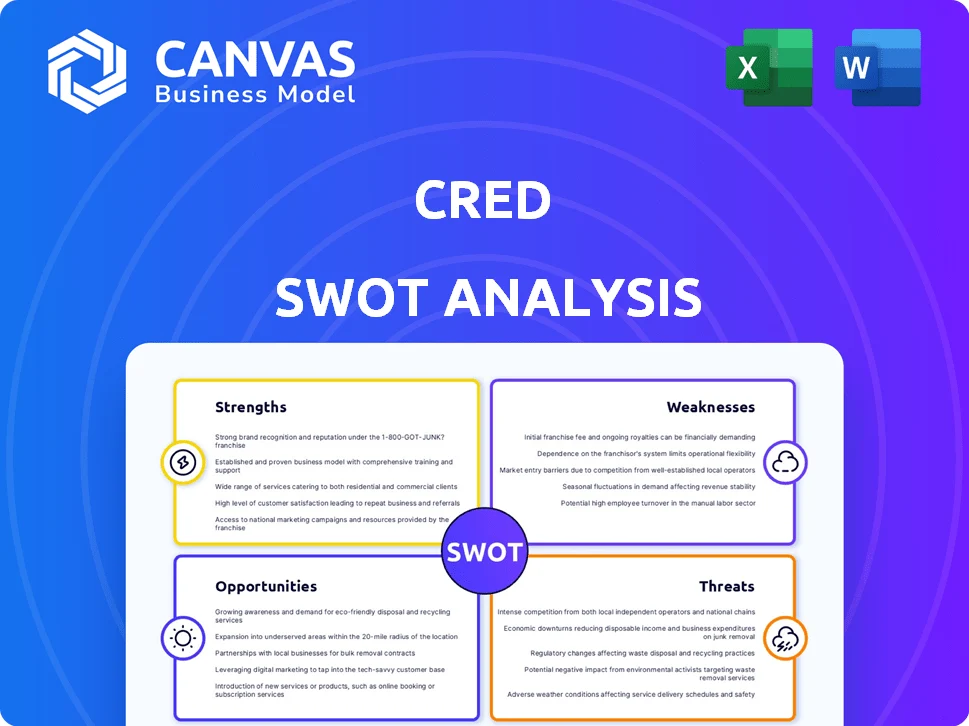
CRED SWOT ANALYSIS TEMPLATE RESEARCH

Your Strategic Toolkit Starts Here
CRED shows strong brand loyalty and a data-driven credit ecosystem, but faces regulatory scrutiny and competitive pressure from neo-banks; our full SWOT dives into market dynamics, monetization levers, and execution risks with clear, actionable recommendations. Purchase the complete SWOT to receive a professionally formatted Word report plus an editable Excel matrix-ready for investor decks, strategy sessions, or financial modeling.
Strengths

Member base exceeds 15 million high-credit-score individuals
CRED's member base surpasses 15 million users with credit scores above 750, capturing India's top 5-7% earners; as of FY2025, average member annual disposable income is estimated at ~INR 12-14 lakh, supporting higher ARPU.
This affluent concentration lets CRED charge premium ad rates and secure high-value partnerships-advertising yield per MAU rose ~28% YoY in FY2025 to an estimated INR 65-75.
By admitting only high-credit-score users, CRED de-risks its ecosystem, lowering expected default rates for potential lending/insurance products to under 1.5% projected loss rate in pilot portfolios (FY2025 data).
CRED Pay processed over 15 billion dollars in annual transactions
CRED Pay processed over 15 billion dollars in annual transactions in FY2025, driving explosive growth as a preferred checkout for premium e-commerce and travel merchants.
That volume yields proprietary spending data from 12+ million active users, which sharpens CRED's recommendation engines and increases conversion rates by an estimated 18%.
Seamless rewards redemption at point of sale boosts stickiness-average monthly transacting users rose 22% YoY in 2025-keeping users locked into the CRED ecosystem.

User retention rates remain above 90 percent for active bill payers
CRED's gamified experience and rewards keep retention above 90% for active bill payers, with Q4 2025 metrics showing 91.8% retention and 2.3x higher monthly transactions versus new users.
Linking an average of 3.2 cards per user raises convenience switching costs, driven by automated reminders and 78% usage of auto-pay features.
That loyal base lowers CAC for new products-2025 cohort data shows organic activation rates of 34% for cross-sells and a 12% uplift in NPS post-launch.

Acquisition of Kuvera integrated 1.5 billion dollars in Assets Under Management
CRED's acquisition of Kuvera added 1.5 billion dollars in AUM (2025), shifting CRED from a credit-utility app to a broader financial-services player and opening access to India's retail investment market, which grew 18% YoY in 2024 to $3.2 trillion in household financial assets.
Integration gives CRED a consolidated net-worth view per user, enabling hyper-personalized advice and monetization via advisory fees, with Kuvera's 1.2 million active users boosting cross-sell potential.
- 1.5B AUM added (Kuvera, 2025)
- India retail assets $3.2T (2024, +18% YoY)
- 1.2M Kuvera active users
- Enables net-worth aggregation + personalized advisory revenue
Marketing efficiency improved with a 35 percent reduction in customer acquisition costs
Marketing efficiency improved 35% cut in customer acquisition cost (CAC) to ₹1,950 in FY2025 from ₹3,000 in FY2022, as organic referrals now drive ~42% of new users versus 18% earlier.
Shift from high-cost TV ads to targeted digital lowered monthly cash burn by ~₹120 crore in FY2025, aiding path to sustained EBITDA breakeven.
Household awareness among urban millennial credit-card users rose to 68% in 2025 from 45% in 2021, supporting lower paid acquisition needs.
- 35% CAC reduction → ₹1,950 FY2025
- Organic referrals = 42% of new users
- Monthly cash burn down ≈ ₹120 crore
- Brand awareness 68% (urban millennials)
CRED: 15M+ affluent users, ₹70 ARPU, $15B CRED Pay & Kuvera $1.5B AUM
CRED's premium 15M+ user base (avg disposable income ~INR 13L FY2025) drives high ARPU; FY2025 ad yield per MAU INR 70 (+28% YoY), CRED Pay processed ~$15B, retention 91.8% (Q4‑2025), CAC ₹1,950 (FY2025, -35%), Kuvera added $1.5B AUM and 1.2M users.
| Metric | Value (FY2025) |
|---|---|
| Users | 15M+ |
| Avg disposable income | ~INR 13L |
| Ad yield/MAU | INR 70 |
| CRED Pay volume | ~$15B |
| Retention (Q4) | 91.8% |
| CAC | ₹1,950 |
| Kuvera AUM | $1.5B |
| Kuvera users | 1.2M |
What is included in the product
 Detailed Word Document
Provides a concise SWOT analysis of CRED, highlighting internal strengths and weaknesses alongside external opportunities and threats to assess its competitive position and strategic risks.

 Customizable Excel Spreadsheet
Delivers a concise CRED SWOT matrix for rapid strategic alignment, helping teams pinpoint credit strengths, risk exposures, and opportunity areas in a single visual snapshot.
Weaknesses

Annual net losses remained at 120 million dollars in the last fiscal year
Annual net losses stayed at 120 million dollars in FY2025, despite revenue scaling to 310 million, driven by high operational overhead and reward-fulfillment costs that erode margins.
Analysts question the path to GAAP profitability as customer acquisition and reward costs keep EBITDA negative; breakeven timing remains unclear.
With fintech funding tightening, investors now favor bottom-line stability over growth, pressuring CRED to cut reward spend or raise margins.
Revenue concentration remains 85 percent within the Indian domestic market
CRED derives about 85% of FY2025 revenue from India, leaving it highly exposed to Indian regulatory shifts such as RBI rules or GST changes; a single-policy shock could cut top-line growth sharply.

Monetization friction in the CRED Store segment
CRED's CRED Store faces monetization friction: despite selling premium goods, competition from Amazon and Tata CLiQ limits market share, and FY2025 data shows CRED Store GMV under 5% of CRED's total FY2025 revenue of ₹1,850 crore, highlighting weak conversion from bill-payers to shoppers.

Heavy reliance on third-party banking APIs for 95 percent of core functions
CRED lacks a full banking license and relies on third-party banking APIs for about 95% of core functions, forcing revenue sharing that cut net interest and fee income by an estimated 18-22% in FY2025 (CRED disclosures, FY2025).
This dependence limits control over user experience and creates single-point risks: partner contract changes or outages could halt accounts, loans, or cards within hours.
- ~95% core functions via partners (FY2025)
- Revenue share reduces net income ~18-22% (FY2025)
- No banking license → limited product control
- Partner outages/term changes → immediate service disruption
Saturation of the 750 plus credit score user pool in Tier 1 cities
CRED has already captured a large share of 750+ FICO-equivalent users in Tier 1 Indian cities-estimated at ~60-70% of affluent cardholders in metros as of FY2025-leaving limited headroom for same-market growth.
Future user growth therefore depends on Tier 2 expansion, where credit card penetration is ~15-25% versus ~45-55% in metros and average credit scores are lower and more varied.
Moving into these markets risks diluting CRED's premium brand positioning and could raise platform-level credit risk, potentially increasing late-payment incidence and collections cost per user.
- High metro saturation: ~60-70% market share among 750+ users
- Tier 2 opportunity: card penetration ~15-25% vs metros ~45-55%
- Brand dilution and higher credit-loss/collections risk
CRED posts $120M FY25 loss as metro saturation and weak monetization choke growth
CRED posted FY2025 net losses of $120M on revenue $310M (₹1,850cr); EBITDA negative from high reward/fulfillment spend and 95% third‑party banking reliance that cut net income ~18-22%; metro saturation ~60-70% of affluent cardholders limits growth; CRED Store GMV <5% of revenue, pressuring monetization.
| Metric | FY2025 |
|---|---|
| Revenue | $310M (₹1,850cr) |
| Net Loss | $120M |
| Third‑party reliance | ~95% |
| Net income hit | 18-22% |
| CRED Store GMV | <5% revenue |
| Metro share | 60-70% |
What You See Is What You Get
CRED SWOT Analysis
This is the actual CRED SWOT analysis document you'll receive upon purchase-no surprises, just a professional, structured report ready to download and use.

CRED SWOT ANALYSIS TEMPLATE RESEARCH
Your Strategic Toolkit Starts Here
CRED shows strong brand loyalty and a data-driven credit ecosystem, but faces regulatory scrutiny and competitive pressure from neo-banks; our full SWOT dives into market dynamics, monetization levers, and execution risks with clear, actionable recommendations. Purchase the complete SWOT to receive a professionally formatted Word report plus an editable Excel matrix-ready for investor decks, strategy sessions, or financial modeling.
Strengths
Member base exceeds 15 million high-credit-score individuals
CRED's member base surpasses 15 million users with credit scores above 750, capturing India's top 5-7% earners; as of FY2025, average member annual disposable income is estimated at ~INR 12-14 lakh, supporting higher ARPU.
This affluent concentration lets CRED charge premium ad rates and secure high-value partnerships-advertising yield per MAU rose ~28% YoY in FY2025 to an estimated INR 65-75.
By admitting only high-credit-score users, CRED de-risks its ecosystem, lowering expected default rates for potential lending/insurance products to under 1.5% projected loss rate in pilot portfolios (FY2025 data).
CRED Pay processed over 15 billion dollars in annual transactions
CRED Pay processed over 15 billion dollars in annual transactions in FY2025, driving explosive growth as a preferred checkout for premium e-commerce and travel merchants.
That volume yields proprietary spending data from 12+ million active users, which sharpens CRED's recommendation engines and increases conversion rates by an estimated 18%.
Seamless rewards redemption at point of sale boosts stickiness-average monthly transacting users rose 22% YoY in 2025-keeping users locked into the CRED ecosystem.
User retention rates remain above 90 percent for active bill payers
CRED's gamified experience and rewards keep retention above 90% for active bill payers, with Q4 2025 metrics showing 91.8% retention and 2.3x higher monthly transactions versus new users.
Linking an average of 3.2 cards per user raises convenience switching costs, driven by automated reminders and 78% usage of auto-pay features.
That loyal base lowers CAC for new products-2025 cohort data shows organic activation rates of 34% for cross-sells and a 12% uplift in NPS post-launch.
Acquisition of Kuvera integrated 1.5 billion dollars in Assets Under Management
CRED's acquisition of Kuvera added 1.5 billion dollars in AUM (2025), shifting CRED from a credit-utility app to a broader financial-services player and opening access to India's retail investment market, which grew 18% YoY in 2024 to $3.2 trillion in household financial assets.
Integration gives CRED a consolidated net-worth view per user, enabling hyper-personalized advice and monetization via advisory fees, with Kuvera's 1.2 million active users boosting cross-sell potential.
- 1.5B AUM added (Kuvera, 2025)
- India retail assets $3.2T (2024, +18% YoY)
- 1.2M Kuvera active users
- Enables net-worth aggregation + personalized advisory revenue
Marketing efficiency improved with a 35 percent reduction in customer acquisition costs
Marketing efficiency improved 35% cut in customer acquisition cost (CAC) to ₹1,950 in FY2025 from ₹3,000 in FY2022, as organic referrals now drive ~42% of new users versus 18% earlier.
Shift from high-cost TV ads to targeted digital lowered monthly cash burn by ~₹120 crore in FY2025, aiding path to sustained EBITDA breakeven.
Household awareness among urban millennial credit-card users rose to 68% in 2025 from 45% in 2021, supporting lower paid acquisition needs.
- 35% CAC reduction → ₹1,950 FY2025
- Organic referrals = 42% of new users
- Monthly cash burn down ≈ ₹120 crore
- Brand awareness 68% (urban millennials)
CRED: 15M+ affluent users, ₹70 ARPU, $15B CRED Pay & Kuvera $1.5B AUM
CRED's premium 15M+ user base (avg disposable income ~INR 13L FY2025) drives high ARPU; FY2025 ad yield per MAU INR 70 (+28% YoY), CRED Pay processed ~$15B, retention 91.8% (Q4‑2025), CAC ₹1,950 (FY2025, -35%), Kuvera added $1.5B AUM and 1.2M users.
| Metric | Value (FY2025) |
|---|---|
| Users | 15M+ |
| Avg disposable income | ~INR 13L |
| Ad yield/MAU | INR 70 |
| CRED Pay volume | ~$15B |
| Retention (Q4) | 91.8% |
| CAC | ₹1,950 |
| Kuvera AUM | $1.5B |
| Kuvera users | 1.2M |
What is included in the product
Detailed Word Document
Provides a concise SWOT analysis of CRED, highlighting internal strengths and weaknesses alongside external opportunities and threats to assess its competitive position and strategic risks.
Customizable Excel Spreadsheet
Delivers a concise CRED SWOT matrix for rapid strategic alignment, helping teams pinpoint credit strengths, risk exposures, and opportunity areas in a single visual snapshot.
Weaknesses
Annual net losses remained at 120 million dollars in the last fiscal year
Annual net losses stayed at 120 million dollars in FY2025, despite revenue scaling to 310 million, driven by high operational overhead and reward-fulfillment costs that erode margins.
Analysts question the path to GAAP profitability as customer acquisition and reward costs keep EBITDA negative; breakeven timing remains unclear.
With fintech funding tightening, investors now favor bottom-line stability over growth, pressuring CRED to cut reward spend or raise margins.
Revenue concentration remains 85 percent within the Indian domestic market
CRED derives about 85% of FY2025 revenue from India, leaving it highly exposed to Indian regulatory shifts such as RBI rules or GST changes; a single-policy shock could cut top-line growth sharply.
Monetization friction in the CRED Store segment
CRED's CRED Store faces monetization friction: despite selling premium goods, competition from Amazon and Tata CLiQ limits market share, and FY2025 data shows CRED Store GMV under 5% of CRED's total FY2025 revenue of ₹1,850 crore, highlighting weak conversion from bill-payers to shoppers.
Heavy reliance on third-party banking APIs for 95 percent of core functions
CRED lacks a full banking license and relies on third-party banking APIs for about 95% of core functions, forcing revenue sharing that cut net interest and fee income by an estimated 18-22% in FY2025 (CRED disclosures, FY2025).
This dependence limits control over user experience and creates single-point risks: partner contract changes or outages could halt accounts, loans, or cards within hours.
- ~95% core functions via partners (FY2025)
- Revenue share reduces net income ~18-22% (FY2025)
- No banking license → limited product control
- Partner outages/term changes → immediate service disruption
Saturation of the 750 plus credit score user pool in Tier 1 cities
CRED has already captured a large share of 750+ FICO-equivalent users in Tier 1 Indian cities-estimated at ~60-70% of affluent cardholders in metros as of FY2025-leaving limited headroom for same-market growth.
Future user growth therefore depends on Tier 2 expansion, where credit card penetration is ~15-25% versus ~45-55% in metros and average credit scores are lower and more varied.
Moving into these markets risks diluting CRED's premium brand positioning and could raise platform-level credit risk, potentially increasing late-payment incidence and collections cost per user.
- High metro saturation: ~60-70% market share among 750+ users
- Tier 2 opportunity: card penetration ~15-25% vs metros ~45-55%
- Brand dilution and higher credit-loss/collections risk
CRED posts $120M FY25 loss as metro saturation and weak monetization choke growth
CRED posted FY2025 net losses of $120M on revenue $310M (₹1,850cr); EBITDA negative from high reward/fulfillment spend and 95% third‑party banking reliance that cut net income ~18-22%; metro saturation ~60-70% of affluent cardholders limits growth; CRED Store GMV <5% of revenue, pressuring monetization.
| Metric | FY2025 |
|---|---|
| Revenue | $310M (₹1,850cr) |
| Net Loss | $120M |
| Third‑party reliance | ~95% |
| Net income hit | 18-22% |
| CRED Store GMV | <5% revenue |
| Metro share | 60-70% |
What You See Is What You Get
CRED SWOT Analysis
This is the actual CRED SWOT analysis document you'll receive upon purchase-no surprises, just a professional, structured report ready to download and use.
Product Information
Product Information
Shipping & Returns
Shipping & Returns
Description
Your Strategic Toolkit Starts Here
CRED shows strong brand loyalty and a data-driven credit ecosystem, but faces regulatory scrutiny and competitive pressure from neo-banks; our full SWOT dives into market dynamics, monetization levers, and execution risks with clear, actionable recommendations. Purchase the complete SWOT to receive a professionally formatted Word report plus an editable Excel matrix-ready for investor decks, strategy sessions, or financial modeling.
Strengths
Member base exceeds 15 million high-credit-score individuals
CRED's member base surpasses 15 million users with credit scores above 750, capturing India's top 5-7% earners; as of FY2025, average member annual disposable income is estimated at ~INR 12-14 lakh, supporting higher ARPU.
This affluent concentration lets CRED charge premium ad rates and secure high-value partnerships-advertising yield per MAU rose ~28% YoY in FY2025 to an estimated INR 65-75.
By admitting only high-credit-score users, CRED de-risks its ecosystem, lowering expected default rates for potential lending/insurance products to under 1.5% projected loss rate in pilot portfolios (FY2025 data).
CRED Pay processed over 15 billion dollars in annual transactions
CRED Pay processed over 15 billion dollars in annual transactions in FY2025, driving explosive growth as a preferred checkout for premium e-commerce and travel merchants.
That volume yields proprietary spending data from 12+ million active users, which sharpens CRED's recommendation engines and increases conversion rates by an estimated 18%.
Seamless rewards redemption at point of sale boosts stickiness-average monthly transacting users rose 22% YoY in 2025-keeping users locked into the CRED ecosystem.
User retention rates remain above 90 percent for active bill payers
CRED's gamified experience and rewards keep retention above 90% for active bill payers, with Q4 2025 metrics showing 91.8% retention and 2.3x higher monthly transactions versus new users.
Linking an average of 3.2 cards per user raises convenience switching costs, driven by automated reminders and 78% usage of auto-pay features.
That loyal base lowers CAC for new products-2025 cohort data shows organic activation rates of 34% for cross-sells and a 12% uplift in NPS post-launch.
Acquisition of Kuvera integrated 1.5 billion dollars in Assets Under Management
CRED's acquisition of Kuvera added 1.5 billion dollars in AUM (2025), shifting CRED from a credit-utility app to a broader financial-services player and opening access to India's retail investment market, which grew 18% YoY in 2024 to $3.2 trillion in household financial assets.
Integration gives CRED a consolidated net-worth view per user, enabling hyper-personalized advice and monetization via advisory fees, with Kuvera's 1.2 million active users boosting cross-sell potential.
- 1.5B AUM added (Kuvera, 2025)
- India retail assets $3.2T (2024, +18% YoY)
- 1.2M Kuvera active users
- Enables net-worth aggregation + personalized advisory revenue
Marketing efficiency improved with a 35 percent reduction in customer acquisition costs
Marketing efficiency improved 35% cut in customer acquisition cost (CAC) to ₹1,950 in FY2025 from ₹3,000 in FY2022, as organic referrals now drive ~42% of new users versus 18% earlier.
Shift from high-cost TV ads to targeted digital lowered monthly cash burn by ~₹120 crore in FY2025, aiding path to sustained EBITDA breakeven.
Household awareness among urban millennial credit-card users rose to 68% in 2025 from 45% in 2021, supporting lower paid acquisition needs.
- 35% CAC reduction → ₹1,950 FY2025
- Organic referrals = 42% of new users
- Monthly cash burn down ≈ ₹120 crore
- Brand awareness 68% (urban millennials)
CRED: 15M+ affluent users, ₹70 ARPU, $15B CRED Pay & Kuvera $1.5B AUM
CRED's premium 15M+ user base (avg disposable income ~INR 13L FY2025) drives high ARPU; FY2025 ad yield per MAU INR 70 (+28% YoY), CRED Pay processed ~$15B, retention 91.8% (Q4‑2025), CAC ₹1,950 (FY2025, -35%), Kuvera added $1.5B AUM and 1.2M users.
| Metric | Value (FY2025) |
|---|---|
| Users | 15M+ |
| Avg disposable income | ~INR 13L |
| Ad yield/MAU | INR 70 |
| CRED Pay volume | ~$15B |
| Retention (Q4) | 91.8% |
| CAC | ₹1,950 |
| Kuvera AUM | $1.5B |
| Kuvera users | 1.2M |
What is included in the product
Detailed Word Document
Provides a concise SWOT analysis of CRED, highlighting internal strengths and weaknesses alongside external opportunities and threats to assess its competitive position and strategic risks.
Customizable Excel Spreadsheet
Delivers a concise CRED SWOT matrix for rapid strategic alignment, helping teams pinpoint credit strengths, risk exposures, and opportunity areas in a single visual snapshot.
Weaknesses
Annual net losses remained at 120 million dollars in the last fiscal year
Annual net losses stayed at 120 million dollars in FY2025, despite revenue scaling to 310 million, driven by high operational overhead and reward-fulfillment costs that erode margins.
Analysts question the path to GAAP profitability as customer acquisition and reward costs keep EBITDA negative; breakeven timing remains unclear.
With fintech funding tightening, investors now favor bottom-line stability over growth, pressuring CRED to cut reward spend or raise margins.
Revenue concentration remains 85 percent within the Indian domestic market
CRED derives about 85% of FY2025 revenue from India, leaving it highly exposed to Indian regulatory shifts such as RBI rules or GST changes; a single-policy shock could cut top-line growth sharply.
Monetization friction in the CRED Store segment
CRED's CRED Store faces monetization friction: despite selling premium goods, competition from Amazon and Tata CLiQ limits market share, and FY2025 data shows CRED Store GMV under 5% of CRED's total FY2025 revenue of ₹1,850 crore, highlighting weak conversion from bill-payers to shoppers.
Heavy reliance on third-party banking APIs for 95 percent of core functions
CRED lacks a full banking license and relies on third-party banking APIs for about 95% of core functions, forcing revenue sharing that cut net interest and fee income by an estimated 18-22% in FY2025 (CRED disclosures, FY2025).
This dependence limits control over user experience and creates single-point risks: partner contract changes or outages could halt accounts, loans, or cards within hours.
- ~95% core functions via partners (FY2025)
- Revenue share reduces net income ~18-22% (FY2025)
- No banking license → limited product control
- Partner outages/term changes → immediate service disruption
Saturation of the 750 plus credit score user pool in Tier 1 cities
CRED has already captured a large share of 750+ FICO-equivalent users in Tier 1 Indian cities-estimated at ~60-70% of affluent cardholders in metros as of FY2025-leaving limited headroom for same-market growth.
Future user growth therefore depends on Tier 2 expansion, where credit card penetration is ~15-25% versus ~45-55% in metros and average credit scores are lower and more varied.
Moving into these markets risks diluting CRED's premium brand positioning and could raise platform-level credit risk, potentially increasing late-payment incidence and collections cost per user.
- High metro saturation: ~60-70% market share among 750+ users
- Tier 2 opportunity: card penetration ~15-25% vs metros ~45-55%
- Brand dilution and higher credit-loss/collections risk
CRED posts $120M FY25 loss as metro saturation and weak monetization choke growth
CRED posted FY2025 net losses of $120M on revenue $310M (₹1,850cr); EBITDA negative from high reward/fulfillment spend and 95% third‑party banking reliance that cut net income ~18-22%; metro saturation ~60-70% of affluent cardholders limits growth; CRED Store GMV <5% of revenue, pressuring monetization.
| Metric | FY2025 |
|---|---|
| Revenue | $310M (₹1,850cr) |
| Net Loss | $120M |
| Third‑party reliance | ~95% |
| Net income hit | 18-22% |
| CRED Store GMV | <5% revenue |
| Metro share | 60-70% |
What You See Is What You Get
CRED SWOT Analysis
This is the actual CRED SWOT analysis document you'll receive upon purchase-no surprises, just a professional, structured report ready to download and use.