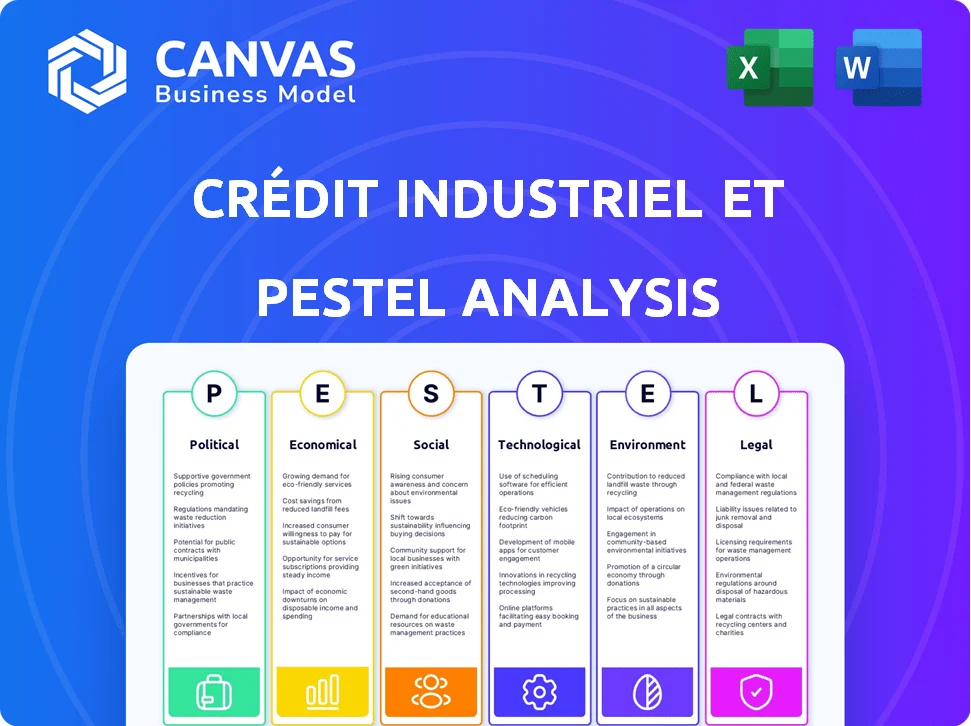
CRÉDIT INDUSTRIEL ET COMMERCIAL PESTLE ANALYSIS TEMPLATE RESEARCH
What is included in the product
 Detailed Word Document
Unpacks how external factors impact Crédit Industriel et Commercial. Detailed insights on Political, Economic, Social, etc.

 Customizable Excel Spreadsheet
Helps support discussions on external risk and market positioning during planning sessions.
What You See Is What You Get
Crédit Industriel et Commercial PESTLE Analysis
What you’re previewing here is the actual file—fully formatted and professionally structured. This Crédit Industriel et Commercial PESTLE analysis details political, economic, social, technological, legal, and environmental factors. It’s meticulously crafted and ready for your use. Download this comprehensive document instantly after purchase. Enjoy!

PESTLE Analysis Template

Your Competitive Advantage Starts with This Report
Navigate the complexities facing Crédit Industriel et Commercial with clarity. Our PESTLE analysis dissects the political, economic, social, technological, legal, and environmental factors impacting the bank's trajectory. Discover crucial insights into market trends and potential challenges. This analysis empowers you to refine your strategies and capitalize on opportunities. Download the full report now for actionable intelligence and strategic advantages.
Political factors

Political Stability and Government Policy
Political stability significantly impacts CIC's operations. Instability in France could hinder economic growth and bank credit. The government supports financial innovation, fostering fintech growth. France's GDP growth for 2024 is projected at 0.8%. Regulatory support aids CIC's strategic initiatives.
European Union Influence
As a subsidiary of Crédit Mutuel Alliance Fédérale, Crédit Industriel et Commercial (CIC) is heavily influenced by European Union regulations. The implementation of directives like CRR3/CRD6 and the Digital Operational Resilience Act (DORA) directly affects CIC's operational frameworks. These regulations dictate capital adequacy, risk management, and cybersecurity protocols. In 2024, banks in the EU are facing increased scrutiny regarding their resilience to cyber threats, as evidenced by the ongoing implementation of DORA.

Regulatory Bodies
The Autorité de contrôle prudentiel et de résolution (ACPR) and the European Central Bank (ECB) oversee Crédit Industriel et Commercial (CIC). The ACPR, part of the Banque de France, handles prudential supervision and licensing. The ECB supervises significant credit institutions via the Single Supervisory Mechanism (SSM). In 2024, the ECB's supervisory priorities included addressing risks related to digital transformation and climate change. These bodies ensure financial stability and compliance.

Geopolitical Risks
Geopolitical risks, including global conflicts, significantly affect the banking sector and economic stability. These tensions can create market uncertainty, which often diminishes investor confidence. For example, in 2024, global conflicts led to a 15% decrease in international investment. This uncertainty can also delay the recovery of lending volumes, as businesses become hesitant.
- 2024: International investment dropped by 15% due to global conflicts.
- 2025 (Projected): Lending volumes may see a slower recovery due to ongoing geopolitical instability.
Government Support and Fiscal Policy
Government fiscal policies and potential austerity measures significantly influence economic growth, which directly affects banking sector performance. The phasing out of COVID-19 and energy-related support has increased corporate bankruptcies. These changes create uncertainty for banks like Crédit Industriel et Commercial (CIC). For example, in 2024, France's budget deficit was projected at 5.6% of GDP.
- Fiscal policy shifts can lead to higher interest rates, impacting lending.
- Increased bankruptcies may raise non-performing loans for CIC.
- Economic instability can reduce investment and consumer spending.
Navigating Political & Economic Waters
Political stability, or the lack of it, has direct effects on CIC's operations. Government regulations and financial policies are important for bank activities.
Geopolitical tensions can cause investor hesitancy. Fiscal shifts in France influence CIC.
Regulatory bodies such as ACPR and ECB oversee financial stability in the EU.
| Factor | Impact | 2024 Data/Projections |
|---|---|---|
| Political Stability | Affects economic growth and bank credit. | France GDP growth: 0.8% (projected). |
| Government Regulations | Impacts compliance and operational frameworks. | CRR3/CRD6, DORA implementation. |
| Geopolitical Risks | Influences market confidence and lending volumes. | International investment decrease: 15%. |
Economic factors

Economic Growth Rate
France's economic growth is anticipated to be moderate in 2025. This could affect Crédit Industriel et Commercial's (CIC) credit origination and overall revenue. Slow growth might also widen the profitability gap between French and other European banks. The French economy is expected to grow by 1% in 2025, according to the latest forecasts.
Interest Rate Environment
Changes in interest rates heavily influence Crédit Industriel et Commercial's (CIC) financial performance. Rising rates can boost net interest margins, which is crucial for profitability. However, French retail banking networks face margin pressure. In 2024, the European Central Bank (ECB) held rates steady. This affects CIC's lending and deposit rates.

Inflation and Monetary Policy
Inflation in France is projected to decrease to below 2% by 2025. The Banque de France has started lowering interest rates, with the aim to stimulate economic activity. This monetary easing should make borrowing cheaper for businesses and consumers. Consequently, it is anticipated that loan production will increase, according to recent financial forecasts.

Credit Quality and Non-Performing Loans (NPLs)
Credit quality at Crédit Industriel et Commercial (CIC) faces challenges. While fixed-rate mortgages offer some stability, rising Non-Performing Loans (NPLs) are anticipated. This increase stems from worsening conditions in commercial and consumer lending. Corporate failures are also expected to contribute to the rise in NPLs.
- In 2024, NPLs in the Eurozone rose, with projections of further increases in 2025.
- Commercial real estate and SME lending are areas of particular concern.
- CIC's exposure to these sectors could lead to higher NPL ratios.
Household and Corporate Indebtedness
High corporate indebtedness and rising default rates are under scrutiny by regulators. Economic uncertainty and confidence levels greatly influence household and SME investment. The Federal Reserve's actions, like maintaining interest rates, impact debt servicing costs. These factors affect economic growth and financial stability.
- Corporate debt-to-GDP ratios are at elevated levels.
- Household debt service ratios are sensitive to interest rate changes.
- SME investment plans are often postponed during economic downturns.
France's 2025 Outlook: Growth, Rates, and Inflation
Economic growth in France is expected to be around 1% in 2025, impacting Crédit Industriel et Commercial's (CIC) revenue and credit. Interest rates influence CIC's profitability, as the European Central Bank (ECB) actions affect lending and deposit rates. Inflation is projected to be below 2% by 2025, potentially boosting loan production, according to forecasts.
| Economic Indicator | 2024 | 2025 (Projected) |
|---|---|---|
| GDP Growth (France) | 0.8% | 1.0% |
| Inflation Rate (France) | 2.9% | 1.8% |
| ECB Interest Rate | 4.5% (as of June 2024) | Forecasted to Decrease |
Sociological factors

Customer Behavior and Preferences
French consumers often favor well-known brands and traditional banks, valuing stability. A 2024 survey indicated that 65% of French adults still trust established financial institutions. Conversely, younger, tech-driven users are pushing for digital banking, with 40% using mobile banking apps. This demographic seeks features like budgeting tools, as seen in a 2025 study, with a 50% increase in usage compared to 2023.
Financial Inclusion and Education
Crédit Industriel et Commercial (CIC) leverages its extensive regional network and digital tools to offer financial services to a broad customer base, focusing on financial inclusion. In 2024, approximately 98% of French adults have a bank account. CIC is actively involved in financial literacy programs. These initiatives aim to help individuals, including those from vulnerable groups, understand and manage their finances effectively.

Demographic Trends
Demographic shifts significantly affect economic growth. An aging population and changing workforce dynamics influence financial product demand. For example, France's over-65 population is projected to reach 23.2% by 2030, impacting CIC's services. This aging trend drives demand for retirement and wealth management products.

Social Inequality and Solidarity
Crédit Industriel et Commercial (CIC), part of Crédit Mutuel Alliance Fédérale, prioritizes social responsibility. Their strategic plan includes a 'societal dividend' to tackle climate change and social inequalities. This commitment is a response to growing societal demands. Social inequality in France is a significant concern. The bank's actions reflect a focus on territorial solidarity.
- Crédit Mutuel Alliance Fédérale allocated €300 million to social and environmental projects in 2023.
- France's Gini coefficient (measuring inequality) was around 0.29 in 2024.
- The societal dividend helps address issues like access to finance.
Employment Trends
The banking sector in France, including Crédit Industriel et Commercial (CIC), is a major employer, focusing on integrating young professionals. Unemployment rates influence credit demand and asset quality, crucial for CIC's financial stability. The youth unemployment rate in France was around 17.3% in early 2024, potentially affecting loan repayment. CIC's initiatives, like partnerships, are vital for mitigating these risks.
- CIC actively participates in programs supporting job creation, particularly for youth, to reduce unemployment's impact.
- Unemployment spikes can lead to a rise in non-performing loans, thus impacting CIC's financial health.
- The bank's strategic workforce planning and training programs are key in adapting to employment shifts.
French Banking: Trends & Data
French societal trends show trust in established banks. Digital banking is growing among younger users. Aging demographics affect financial product demand, like retirement plans. Social responsibility is a key focus, tackling inequality.
| Sociological Factor | Impact on CIC | 2024/2025 Data |
|---|---|---|
| Consumer Trust | Influences customer loyalty and product adoption. | 65% of French adults trust established financial institutions. |
| Digital Adoption | Drives the need for digital banking solutions. | 40% use mobile banking apps, with a 50% increase in budgeting tools usage by 2025. |
| Demographic Shifts | Affects demand for retirement and wealth management products. | Over-65 population projected to reach 23.2% by 2030. |
| Social Responsibility | Enhances brand image and addresses societal concerns. | €300 million allocated to social and environmental projects in 2023; Gini coefficient around 0.29 in 2024. Youth unemployment was approximately 17.3% in early 2024. |
Original: $10.00
-65%$10.00
$3.50CRÉDIT INDUSTRIEL ET COMMERCIAL PESTLE ANALYSIS TEMPLATE RESEARCH
What is included in the product
Detailed Word Document
Unpacks how external factors impact Crédit Industriel et Commercial. Detailed insights on Political, Economic, Social, etc.
Customizable Excel Spreadsheet
Helps support discussions on external risk and market positioning during planning sessions.
What You See Is What You Get
Crédit Industriel et Commercial PESTLE Analysis
What you’re previewing here is the actual file—fully formatted and professionally structured. This Crédit Industriel et Commercial PESTLE analysis details political, economic, social, technological, legal, and environmental factors. It’s meticulously crafted and ready for your use. Download this comprehensive document instantly after purchase. Enjoy!
PESTLE Analysis Template
Your Competitive Advantage Starts with This Report
Navigate the complexities facing Crédit Industriel et Commercial with clarity. Our PESTLE analysis dissects the political, economic, social, technological, legal, and environmental factors impacting the bank's trajectory. Discover crucial insights into market trends and potential challenges. This analysis empowers you to refine your strategies and capitalize on opportunities. Download the full report now for actionable intelligence and strategic advantages.
Political factors
Political Stability and Government Policy
Political stability significantly impacts CIC's operations. Instability in France could hinder economic growth and bank credit. The government supports financial innovation, fostering fintech growth. France's GDP growth for 2024 is projected at 0.8%. Regulatory support aids CIC's strategic initiatives.
European Union Influence
As a subsidiary of Crédit Mutuel Alliance Fédérale, Crédit Industriel et Commercial (CIC) is heavily influenced by European Union regulations. The implementation of directives like CRR3/CRD6 and the Digital Operational Resilience Act (DORA) directly affects CIC's operational frameworks. These regulations dictate capital adequacy, risk management, and cybersecurity protocols. In 2024, banks in the EU are facing increased scrutiny regarding their resilience to cyber threats, as evidenced by the ongoing implementation of DORA.
Regulatory Bodies
The Autorité de contrôle prudentiel et de résolution (ACPR) and the European Central Bank (ECB) oversee Crédit Industriel et Commercial (CIC). The ACPR, part of the Banque de France, handles prudential supervision and licensing. The ECB supervises significant credit institutions via the Single Supervisory Mechanism (SSM). In 2024, the ECB's supervisory priorities included addressing risks related to digital transformation and climate change. These bodies ensure financial stability and compliance.
Geopolitical Risks
Geopolitical risks, including global conflicts, significantly affect the banking sector and economic stability. These tensions can create market uncertainty, which often diminishes investor confidence. For example, in 2024, global conflicts led to a 15% decrease in international investment. This uncertainty can also delay the recovery of lending volumes, as businesses become hesitant.
- 2024: International investment dropped by 15% due to global conflicts.
- 2025 (Projected): Lending volumes may see a slower recovery due to ongoing geopolitical instability.
Government Support and Fiscal Policy
Government fiscal policies and potential austerity measures significantly influence economic growth, which directly affects banking sector performance. The phasing out of COVID-19 and energy-related support has increased corporate bankruptcies. These changes create uncertainty for banks like Crédit Industriel et Commercial (CIC). For example, in 2024, France's budget deficit was projected at 5.6% of GDP.
- Fiscal policy shifts can lead to higher interest rates, impacting lending.
- Increased bankruptcies may raise non-performing loans for CIC.
- Economic instability can reduce investment and consumer spending.
Navigating Political & Economic Waters
Political stability, or the lack of it, has direct effects on CIC's operations. Government regulations and financial policies are important for bank activities.
Geopolitical tensions can cause investor hesitancy. Fiscal shifts in France influence CIC.
Regulatory bodies such as ACPR and ECB oversee financial stability in the EU.
| Factor | Impact | 2024 Data/Projections |
|---|---|---|
| Political Stability | Affects economic growth and bank credit. | France GDP growth: 0.8% (projected). |
| Government Regulations | Impacts compliance and operational frameworks. | CRR3/CRD6, DORA implementation. |
| Geopolitical Risks | Influences market confidence and lending volumes. | International investment decrease: 15%. |
Economic factors
Economic Growth Rate
France's economic growth is anticipated to be moderate in 2025. This could affect Crédit Industriel et Commercial's (CIC) credit origination and overall revenue. Slow growth might also widen the profitability gap between French and other European banks. The French economy is expected to grow by 1% in 2025, according to the latest forecasts.
Interest Rate Environment
Changes in interest rates heavily influence Crédit Industriel et Commercial's (CIC) financial performance. Rising rates can boost net interest margins, which is crucial for profitability. However, French retail banking networks face margin pressure. In 2024, the European Central Bank (ECB) held rates steady. This affects CIC's lending and deposit rates.
Inflation and Monetary Policy
Inflation in France is projected to decrease to below 2% by 2025. The Banque de France has started lowering interest rates, with the aim to stimulate economic activity. This monetary easing should make borrowing cheaper for businesses and consumers. Consequently, it is anticipated that loan production will increase, according to recent financial forecasts.
Credit Quality and Non-Performing Loans (NPLs)
Credit quality at Crédit Industriel et Commercial (CIC) faces challenges. While fixed-rate mortgages offer some stability, rising Non-Performing Loans (NPLs) are anticipated. This increase stems from worsening conditions in commercial and consumer lending. Corporate failures are also expected to contribute to the rise in NPLs.
- In 2024, NPLs in the Eurozone rose, with projections of further increases in 2025.
- Commercial real estate and SME lending are areas of particular concern.
- CIC's exposure to these sectors could lead to higher NPL ratios.
Household and Corporate Indebtedness
High corporate indebtedness and rising default rates are under scrutiny by regulators. Economic uncertainty and confidence levels greatly influence household and SME investment. The Federal Reserve's actions, like maintaining interest rates, impact debt servicing costs. These factors affect economic growth and financial stability.
- Corporate debt-to-GDP ratios are at elevated levels.
- Household debt service ratios are sensitive to interest rate changes.
- SME investment plans are often postponed during economic downturns.
France's 2025 Outlook: Growth, Rates, and Inflation
Economic growth in France is expected to be around 1% in 2025, impacting Crédit Industriel et Commercial's (CIC) revenue and credit. Interest rates influence CIC's profitability, as the European Central Bank (ECB) actions affect lending and deposit rates. Inflation is projected to be below 2% by 2025, potentially boosting loan production, according to forecasts.
| Economic Indicator | 2024 | 2025 (Projected) |
|---|---|---|
| GDP Growth (France) | 0.8% | 1.0% |
| Inflation Rate (France) | 2.9% | 1.8% |
| ECB Interest Rate | 4.5% (as of June 2024) | Forecasted to Decrease |
Sociological factors
Customer Behavior and Preferences
French consumers often favor well-known brands and traditional banks, valuing stability. A 2024 survey indicated that 65% of French adults still trust established financial institutions. Conversely, younger, tech-driven users are pushing for digital banking, with 40% using mobile banking apps. This demographic seeks features like budgeting tools, as seen in a 2025 study, with a 50% increase in usage compared to 2023.
Financial Inclusion and Education
Crédit Industriel et Commercial (CIC) leverages its extensive regional network and digital tools to offer financial services to a broad customer base, focusing on financial inclusion. In 2024, approximately 98% of French adults have a bank account. CIC is actively involved in financial literacy programs. These initiatives aim to help individuals, including those from vulnerable groups, understand and manage their finances effectively.
Demographic Trends
Demographic shifts significantly affect economic growth. An aging population and changing workforce dynamics influence financial product demand. For example, France's over-65 population is projected to reach 23.2% by 2030, impacting CIC's services. This aging trend drives demand for retirement and wealth management products.
Social Inequality and Solidarity
Crédit Industriel et Commercial (CIC), part of Crédit Mutuel Alliance Fédérale, prioritizes social responsibility. Their strategic plan includes a 'societal dividend' to tackle climate change and social inequalities. This commitment is a response to growing societal demands. Social inequality in France is a significant concern. The bank's actions reflect a focus on territorial solidarity.
- Crédit Mutuel Alliance Fédérale allocated €300 million to social and environmental projects in 2023.
- France's Gini coefficient (measuring inequality) was around 0.29 in 2024.
- The societal dividend helps address issues like access to finance.
Employment Trends
The banking sector in France, including Crédit Industriel et Commercial (CIC), is a major employer, focusing on integrating young professionals. Unemployment rates influence credit demand and asset quality, crucial for CIC's financial stability. The youth unemployment rate in France was around 17.3% in early 2024, potentially affecting loan repayment. CIC's initiatives, like partnerships, are vital for mitigating these risks.
- CIC actively participates in programs supporting job creation, particularly for youth, to reduce unemployment's impact.
- Unemployment spikes can lead to a rise in non-performing loans, thus impacting CIC's financial health.
- The bank's strategic workforce planning and training programs are key in adapting to employment shifts.
French Banking: Trends & Data
French societal trends show trust in established banks. Digital banking is growing among younger users. Aging demographics affect financial product demand, like retirement plans. Social responsibility is a key focus, tackling inequality.
| Sociological Factor | Impact on CIC | 2024/2025 Data |
|---|---|---|
| Consumer Trust | Influences customer loyalty and product adoption. | 65% of French adults trust established financial institutions. |
| Digital Adoption | Drives the need for digital banking solutions. | 40% use mobile banking apps, with a 50% increase in budgeting tools usage by 2025. |
| Demographic Shifts | Affects demand for retirement and wealth management products. | Over-65 population projected to reach 23.2% by 2030. |
| Social Responsibility | Enhances brand image and addresses societal concerns. | €300 million allocated to social and environmental projects in 2023; Gini coefficient around 0.29 in 2024. Youth unemployment was approximately 17.3% in early 2024. |
Product Information
Product Information
Shipping & Returns
Shipping & Returns
Description
What is included in the product
Detailed Word Document
Unpacks how external factors impact Crédit Industriel et Commercial. Detailed insights on Political, Economic, Social, etc.
Customizable Excel Spreadsheet
Helps support discussions on external risk and market positioning during planning sessions.
What You See Is What You Get
Crédit Industriel et Commercial PESTLE Analysis
What you’re previewing here is the actual file—fully formatted and professionally structured. This Crédit Industriel et Commercial PESTLE analysis details political, economic, social, technological, legal, and environmental factors. It’s meticulously crafted and ready for your use. Download this comprehensive document instantly after purchase. Enjoy!
PESTLE Analysis Template
Your Competitive Advantage Starts with This Report
Navigate the complexities facing Crédit Industriel et Commercial with clarity. Our PESTLE analysis dissects the political, economic, social, technological, legal, and environmental factors impacting the bank's trajectory. Discover crucial insights into market trends and potential challenges. This analysis empowers you to refine your strategies and capitalize on opportunities. Download the full report now for actionable intelligence and strategic advantages.
Political factors
Political Stability and Government Policy
Political stability significantly impacts CIC's operations. Instability in France could hinder economic growth and bank credit. The government supports financial innovation, fostering fintech growth. France's GDP growth for 2024 is projected at 0.8%. Regulatory support aids CIC's strategic initiatives.
European Union Influence
As a subsidiary of Crédit Mutuel Alliance Fédérale, Crédit Industriel et Commercial (CIC) is heavily influenced by European Union regulations. The implementation of directives like CRR3/CRD6 and the Digital Operational Resilience Act (DORA) directly affects CIC's operational frameworks. These regulations dictate capital adequacy, risk management, and cybersecurity protocols. In 2024, banks in the EU are facing increased scrutiny regarding their resilience to cyber threats, as evidenced by the ongoing implementation of DORA.
Regulatory Bodies
The Autorité de contrôle prudentiel et de résolution (ACPR) and the European Central Bank (ECB) oversee Crédit Industriel et Commercial (CIC). The ACPR, part of the Banque de France, handles prudential supervision and licensing. The ECB supervises significant credit institutions via the Single Supervisory Mechanism (SSM). In 2024, the ECB's supervisory priorities included addressing risks related to digital transformation and climate change. These bodies ensure financial stability and compliance.
Geopolitical Risks
Geopolitical risks, including global conflicts, significantly affect the banking sector and economic stability. These tensions can create market uncertainty, which often diminishes investor confidence. For example, in 2024, global conflicts led to a 15% decrease in international investment. This uncertainty can also delay the recovery of lending volumes, as businesses become hesitant.
- 2024: International investment dropped by 15% due to global conflicts.
- 2025 (Projected): Lending volumes may see a slower recovery due to ongoing geopolitical instability.
Government Support and Fiscal Policy
Government fiscal policies and potential austerity measures significantly influence economic growth, which directly affects banking sector performance. The phasing out of COVID-19 and energy-related support has increased corporate bankruptcies. These changes create uncertainty for banks like Crédit Industriel et Commercial (CIC). For example, in 2024, France's budget deficit was projected at 5.6% of GDP.
- Fiscal policy shifts can lead to higher interest rates, impacting lending.
- Increased bankruptcies may raise non-performing loans for CIC.
- Economic instability can reduce investment and consumer spending.
Navigating Political & Economic Waters
Political stability, or the lack of it, has direct effects on CIC's operations. Government regulations and financial policies are important for bank activities.
Geopolitical tensions can cause investor hesitancy. Fiscal shifts in France influence CIC.
Regulatory bodies such as ACPR and ECB oversee financial stability in the EU.
| Factor | Impact | 2024 Data/Projections |
|---|---|---|
| Political Stability | Affects economic growth and bank credit. | France GDP growth: 0.8% (projected). |
| Government Regulations | Impacts compliance and operational frameworks. | CRR3/CRD6, DORA implementation. |
| Geopolitical Risks | Influences market confidence and lending volumes. | International investment decrease: 15%. |
Economic factors
Economic Growth Rate
France's economic growth is anticipated to be moderate in 2025. This could affect Crédit Industriel et Commercial's (CIC) credit origination and overall revenue. Slow growth might also widen the profitability gap between French and other European banks. The French economy is expected to grow by 1% in 2025, according to the latest forecasts.
Interest Rate Environment
Changes in interest rates heavily influence Crédit Industriel et Commercial's (CIC) financial performance. Rising rates can boost net interest margins, which is crucial for profitability. However, French retail banking networks face margin pressure. In 2024, the European Central Bank (ECB) held rates steady. This affects CIC's lending and deposit rates.
Inflation and Monetary Policy
Inflation in France is projected to decrease to below 2% by 2025. The Banque de France has started lowering interest rates, with the aim to stimulate economic activity. This monetary easing should make borrowing cheaper for businesses and consumers. Consequently, it is anticipated that loan production will increase, according to recent financial forecasts.
Credit Quality and Non-Performing Loans (NPLs)
Credit quality at Crédit Industriel et Commercial (CIC) faces challenges. While fixed-rate mortgages offer some stability, rising Non-Performing Loans (NPLs) are anticipated. This increase stems from worsening conditions in commercial and consumer lending. Corporate failures are also expected to contribute to the rise in NPLs.
- In 2024, NPLs in the Eurozone rose, with projections of further increases in 2025.
- Commercial real estate and SME lending are areas of particular concern.
- CIC's exposure to these sectors could lead to higher NPL ratios.
Household and Corporate Indebtedness
High corporate indebtedness and rising default rates are under scrutiny by regulators. Economic uncertainty and confidence levels greatly influence household and SME investment. The Federal Reserve's actions, like maintaining interest rates, impact debt servicing costs. These factors affect economic growth and financial stability.
- Corporate debt-to-GDP ratios are at elevated levels.
- Household debt service ratios are sensitive to interest rate changes.
- SME investment plans are often postponed during economic downturns.
France's 2025 Outlook: Growth, Rates, and Inflation
Economic growth in France is expected to be around 1% in 2025, impacting Crédit Industriel et Commercial's (CIC) revenue and credit. Interest rates influence CIC's profitability, as the European Central Bank (ECB) actions affect lending and deposit rates. Inflation is projected to be below 2% by 2025, potentially boosting loan production, according to forecasts.
| Economic Indicator | 2024 | 2025 (Projected) |
|---|---|---|
| GDP Growth (France) | 0.8% | 1.0% |
| Inflation Rate (France) | 2.9% | 1.8% |
| ECB Interest Rate | 4.5% (as of June 2024) | Forecasted to Decrease |
Sociological factors
Customer Behavior and Preferences
French consumers often favor well-known brands and traditional banks, valuing stability. A 2024 survey indicated that 65% of French adults still trust established financial institutions. Conversely, younger, tech-driven users are pushing for digital banking, with 40% using mobile banking apps. This demographic seeks features like budgeting tools, as seen in a 2025 study, with a 50% increase in usage compared to 2023.
Financial Inclusion and Education
Crédit Industriel et Commercial (CIC) leverages its extensive regional network and digital tools to offer financial services to a broad customer base, focusing on financial inclusion. In 2024, approximately 98% of French adults have a bank account. CIC is actively involved in financial literacy programs. These initiatives aim to help individuals, including those from vulnerable groups, understand and manage their finances effectively.
Demographic Trends
Demographic shifts significantly affect economic growth. An aging population and changing workforce dynamics influence financial product demand. For example, France's over-65 population is projected to reach 23.2% by 2030, impacting CIC's services. This aging trend drives demand for retirement and wealth management products.
Social Inequality and Solidarity
Crédit Industriel et Commercial (CIC), part of Crédit Mutuel Alliance Fédérale, prioritizes social responsibility. Their strategic plan includes a 'societal dividend' to tackle climate change and social inequalities. This commitment is a response to growing societal demands. Social inequality in France is a significant concern. The bank's actions reflect a focus on territorial solidarity.
- Crédit Mutuel Alliance Fédérale allocated €300 million to social and environmental projects in 2023.
- France's Gini coefficient (measuring inequality) was around 0.29 in 2024.
- The societal dividend helps address issues like access to finance.
Employment Trends
The banking sector in France, including Crédit Industriel et Commercial (CIC), is a major employer, focusing on integrating young professionals. Unemployment rates influence credit demand and asset quality, crucial for CIC's financial stability. The youth unemployment rate in France was around 17.3% in early 2024, potentially affecting loan repayment. CIC's initiatives, like partnerships, are vital for mitigating these risks.
- CIC actively participates in programs supporting job creation, particularly for youth, to reduce unemployment's impact.
- Unemployment spikes can lead to a rise in non-performing loans, thus impacting CIC's financial health.
- The bank's strategic workforce planning and training programs are key in adapting to employment shifts.
French Banking: Trends & Data
French societal trends show trust in established banks. Digital banking is growing among younger users. Aging demographics affect financial product demand, like retirement plans. Social responsibility is a key focus, tackling inequality.
| Sociological Factor | Impact on CIC | 2024/2025 Data |
|---|---|---|
| Consumer Trust | Influences customer loyalty and product adoption. | 65% of French adults trust established financial institutions. |
| Digital Adoption | Drives the need for digital banking solutions. | 40% use mobile banking apps, with a 50% increase in budgeting tools usage by 2025. |
| Demographic Shifts | Affects demand for retirement and wealth management products. | Over-65 population projected to reach 23.2% by 2030. |
| Social Responsibility | Enhances brand image and addresses societal concerns. | €300 million allocated to social and environmental projects in 2023; Gini coefficient around 0.29 in 2024. Youth unemployment was approximately 17.3% in early 2024. |