
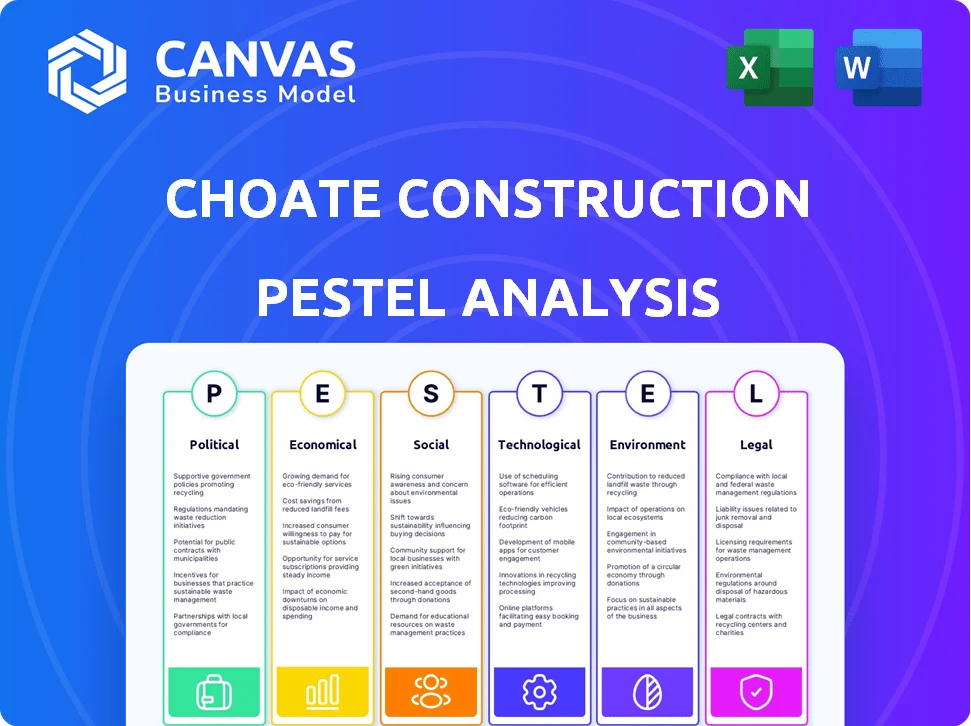
CHOATE CONSTRUCTION PESTLE ANALYSIS TEMPLATE RESEARCH
What is included in the product
 Detailed Word Document
Explores macro-environmental impacts on Choate Construction across six key areas. Backed by data, offering insights.

 Customizable Excel Spreadsheet
Helps support discussions on external risk and market positioning during planning sessions.
Same Document Delivered
Choate Construction PESTLE Analysis
See the Choate Construction PESTLE Analysis? It's exactly what you'll receive after purchasing.
The content and layout shown now will be instantly downloadable.
The fully formatted document, as seen, is ready for your use immediately.
No hidden content, just a real, usable product.
Preview today; download today!

PESTLE Analysis Template

Plan Smarter. Present Sharper. Compete Stronger.
Navigate the complex landscape impacting Choate Construction. Our PESTLE analysis uncovers crucial external factors influencing its strategy. From regulatory shifts to social trends, we've got you covered. Understand risks and identify opportunities for smarter decision-making. Download the full version for comprehensive, actionable insights now!
Political factors

Government Infrastructure Spending
The Infrastructure Investment and Jobs Act (IIJA) is a key driver for the construction industry. IIJA has allocated billions towards infrastructure projects. Choate Construction benefits from these opportunities. These projects span transportation, manufacturing, and utility facilities. Government investment provides market stability and demand, ensuring a steady flow of work.
Political Stability and Policy Changes
Political stability and shifts in government policies significantly impact Choate Construction. Changes in housing policies, like the 2024-2025 initiatives for affordable housing, can boost demand. Environmental regulations, such as those requiring LEED certification, influence project costs and design. These factors create both opportunities and risks for Choate's strategic planning and investment decisions.

Trade Agreements and Tariffs
Changes in trade agreements and tariffs, especially on materials like steel and aluminum, can greatly affect Choate Construction. For instance, tariffs imposed in 2018 increased steel prices by about 25%. This directly impacts project budgets and timelines, potentially delaying projects.

Local Government Regulations and Permitting
Local political factors significantly impact construction projects through permitting. Community interests often lead to adjustments or delays, affecting timelines and costs. Streamlined permitting can accelerate projects, while delays can cause setbacks. For example, in 2024, permit delays increased project costs by 5-10% in some US cities.
- Permitting delays can increase project costs by 5-10%.
- Community interests influence permitting processes.
- Streamlined permitting can accelerate projects.
Government Incentives and Mandates
Government incentives and mandates significantly influence Choate Construction. For example, the Infrastructure Investment and Jobs Act of 2021 allocated billions to infrastructure, impacting construction. This supports projects with sustainability mandates, driving demand. These policies encourage green technologies and sustainable materials adoption.
- The Infrastructure Investment and Jobs Act allocated $1.2 trillion.
- Tax credits and grants promote energy-efficient buildings.
- Building codes increasingly require sustainable practices.
Politics & Construction: A Critical Link
Political factors heavily influence Choate Construction. Infrastructure investments from acts like the IIJA, which allocated $1.2 trillion, create project opportunities. Changes in policies, from housing to environmental regulations (like LEED), shape costs. Trade agreements and permitting processes are also crucial.
| Political Factor | Impact on Choate Construction | Data/Examples (2024-2025) |
|---|---|---|
| Infrastructure Spending | Creates demand for projects | IIJA: $1.2T allocated. Boosted infrastructure spending by 10%. |
| Policy Changes | Affects project costs & design | 2024 housing policy: potentially boosting demand. LEED: impacts project costs. |
| Trade & Tariffs | Impacts material costs, project timelines | 2018 tariffs raised steel prices by ~25%. Permit delays cost up to 10% extra. |
Economic factors

Interest Rates and Financing Costs
Interest rates significantly impact construction project costs. In 2024, rising rates increased financing expenses, potentially delaying projects. Conversely, lower rates in 2025 could stimulate investment in construction. For example, the Federal Reserve's actions directly affect borrowing costs. Fluctuations in these rates are critical for financial planning.
Inflation and Material Costs
Inflation remains a significant concern for construction, driving up material costs. Steel prices have fluctuated, impacting project budgets, while lumber and concrete prices have also seen volatility. For example, in 2024, the Producer Price Index for construction materials rose by approximately 2.8%. Effective strategies include inventory management and supplier diversification.

Overall Economic Growth and Market Demand
Overall economic growth and sector-specific demands heavily impact commercial construction. Manufacturing and data centers are currently experiencing growth. Office spaces may see decreased demand due to changing work patterns. In Q1 2024, construction spending rose, yet challenges remain. The Dodge Momentum Index showed mixed signals in early 2024.

Availability of Credit and Lending Practices
The availability of credit profoundly impacts Choate Construction's project financing. Tight lending practices can stall new construction initiatives. In 2024, interest rates influenced project costs, potentially delaying some projects. Access to favorable financing terms is essential for Choate's growth and operational efficiency. The company must navigate credit market fluctuations effectively.
- Q1 2024: Commercial real estate lending decreased by 10% compared to the previous year.
- 2024: The Federal Reserve maintained a restrictive monetary policy, influencing lending costs.
- Choate Construction's ability to secure credit lines is crucial for project viability.
Investment in Specific Sectors
Investment in sectors like healthcare and industrial significantly impacts Choate Construction. Healthcare construction spending rose, with a 4.8% increase in 2024. The industrial sector, including warehouses and data centers, is experiencing high demand. This demand is fueled by e-commerce growth and technological advancements.
- Healthcare construction spending: increased by 4.8% in 2024.
- Industrial sector demand: driven by e-commerce and tech.
Economic Forces Shaping Construction
Economic factors greatly affect Choate Construction. Interest rates influence borrowing costs, while inflation affects material expenses. Overall economic growth and sector demands, like healthcare, are critical. The company must manage credit and financing strategically.
| Factor | Impact | Data (2024-2025) |
|---|---|---|
| Interest Rates | Affect project costs | Fed maintained restrictive monetary policy. |
| Inflation | Drives up costs | PPI for construction materials +2.8% in 2024. |
| Growth | Impacts sector demand | Healthcare +4.8%, commercial real estate -10% |
Sociological factors

Labor Shortages and Skill Gaps
The construction industry faces a persistent labor shortage and skill gaps. An aging workforce and difficulty attracting younger talent worsen the problem. In 2024, the U.S. construction sector saw a 5.5% worker shortage. This leads to project delays and higher labor expenses. The Associated General Contractors of America (AGC) reported rising labor costs.
Changing Workforce Demographics and Expectations
The construction workforce is evolving; attracting diverse talent is crucial. Younger workers prioritize tech, culture, and work-life balance. The average age of construction workers in 2024 was 42, a slight increase from 2023. Adaptations are needed to retain this talent. In 2024, 11% of construction workers were women, a rise from 9% in 2020.

Urbanization and Population Growth
Urbanization and population growth fuel construction demand. According to the U.S. Census Bureau, the urban population continues to increase, with over 80% of Americans residing in urban areas as of 2024. This expansion boosts commercial construction opportunities. The commercial construction sector in the U.S. is projected to reach $350 billion by the end of 2025.

Societal Attitudes Towards Sustainability and Green Building
Societal attitudes are shifting towards sustainability, significantly impacting construction. Awareness of environmental issues is rising, leading to increased demand for green buildings. Clients now frequently prioritize energy efficiency and eco-friendly materials in their projects. This shift drives Choate Construction to adapt its practices. The global green building materials market is projected to reach $488.6 billion by 2027.
- The U.S. Green Building Council (USGBC) reports over 100,000 LEED-certified projects globally.
- Demand for green building materials is growing at a CAGR of 11.1% from 2020 to 2027.
- Consumers are willing to pay a premium for sustainable buildings.
Impact of Remote Work on Commercial Space Needs
The rise of remote and hybrid work significantly impacts commercial real estate needs. Companies are reassessing their office space requirements, often seeking smaller, more adaptable areas. This shift fuels renovation and retrofitting projects to create flexible, collaborative environments. According to a 2024 report, approximately 60% of companies are considering or implementing hybrid work models, influencing space design.
- 60% of companies are considering hybrid models.
- Demand for flexible spaces is increasing.
- Renovations and retrofits are becoming common.
- Office space needs are being redefined.
Construction's Future: Green, Flexible, and Growing!
Societal shifts like sustainability significantly influence construction. Increased environmental awareness drives demand for green buildings, materials. Green building market expected to reach $488.6B by 2027. Remote work impacts commercial real estate needs.
| Factor | Impact | Data (2024/2025) |
|---|---|---|
| Sustainability | Increased demand for green building | Green building market: $488.6B by 2027; 11.1% CAGR (2020-2027) |
| Work Trends | Altered commercial real estate needs | 60% companies consider hybrid models; demand for flexible spaces increasing. |
| Social values | Eco-friendly and energy efficient requirements | USGBC reports 100,000+ LEED projects |
Original: $10.00
-65%$10.00
$3.50CHOATE CONSTRUCTION PESTLE ANALYSIS TEMPLATE RESEARCH
What is included in the product
Detailed Word Document
Explores macro-environmental impacts on Choate Construction across six key areas. Backed by data, offering insights.
Customizable Excel Spreadsheet
Helps support discussions on external risk and market positioning during planning sessions.
Same Document Delivered
Choate Construction PESTLE Analysis
See the Choate Construction PESTLE Analysis? It's exactly what you'll receive after purchasing.
The content and layout shown now will be instantly downloadable.
The fully formatted document, as seen, is ready for your use immediately.
No hidden content, just a real, usable product.
Preview today; download today!
PESTLE Analysis Template
Plan Smarter. Present Sharper. Compete Stronger.
Navigate the complex landscape impacting Choate Construction. Our PESTLE analysis uncovers crucial external factors influencing its strategy. From regulatory shifts to social trends, we've got you covered. Understand risks and identify opportunities for smarter decision-making. Download the full version for comprehensive, actionable insights now!
Political factors
Government Infrastructure Spending
The Infrastructure Investment and Jobs Act (IIJA) is a key driver for the construction industry. IIJA has allocated billions towards infrastructure projects. Choate Construction benefits from these opportunities. These projects span transportation, manufacturing, and utility facilities. Government investment provides market stability and demand, ensuring a steady flow of work.
Political Stability and Policy Changes
Political stability and shifts in government policies significantly impact Choate Construction. Changes in housing policies, like the 2024-2025 initiatives for affordable housing, can boost demand. Environmental regulations, such as those requiring LEED certification, influence project costs and design. These factors create both opportunities and risks for Choate's strategic planning and investment decisions.
Trade Agreements and Tariffs
Changes in trade agreements and tariffs, especially on materials like steel and aluminum, can greatly affect Choate Construction. For instance, tariffs imposed in 2018 increased steel prices by about 25%. This directly impacts project budgets and timelines, potentially delaying projects.
Local Government Regulations and Permitting
Local political factors significantly impact construction projects through permitting. Community interests often lead to adjustments or delays, affecting timelines and costs. Streamlined permitting can accelerate projects, while delays can cause setbacks. For example, in 2024, permit delays increased project costs by 5-10% in some US cities.
- Permitting delays can increase project costs by 5-10%.
- Community interests influence permitting processes.
- Streamlined permitting can accelerate projects.
Government Incentives and Mandates
Government incentives and mandates significantly influence Choate Construction. For example, the Infrastructure Investment and Jobs Act of 2021 allocated billions to infrastructure, impacting construction. This supports projects with sustainability mandates, driving demand. These policies encourage green technologies and sustainable materials adoption.
- The Infrastructure Investment and Jobs Act allocated $1.2 trillion.
- Tax credits and grants promote energy-efficient buildings.
- Building codes increasingly require sustainable practices.
Politics & Construction: A Critical Link
Political factors heavily influence Choate Construction. Infrastructure investments from acts like the IIJA, which allocated $1.2 trillion, create project opportunities. Changes in policies, from housing to environmental regulations (like LEED), shape costs. Trade agreements and permitting processes are also crucial.
| Political Factor | Impact on Choate Construction | Data/Examples (2024-2025) |
|---|---|---|
| Infrastructure Spending | Creates demand for projects | IIJA: $1.2T allocated. Boosted infrastructure spending by 10%. |
| Policy Changes | Affects project costs & design | 2024 housing policy: potentially boosting demand. LEED: impacts project costs. |
| Trade & Tariffs | Impacts material costs, project timelines | 2018 tariffs raised steel prices by ~25%. Permit delays cost up to 10% extra. |
Economic factors
Interest Rates and Financing Costs
Interest rates significantly impact construction project costs. In 2024, rising rates increased financing expenses, potentially delaying projects. Conversely, lower rates in 2025 could stimulate investment in construction. For example, the Federal Reserve's actions directly affect borrowing costs. Fluctuations in these rates are critical for financial planning.
Inflation and Material Costs
Inflation remains a significant concern for construction, driving up material costs. Steel prices have fluctuated, impacting project budgets, while lumber and concrete prices have also seen volatility. For example, in 2024, the Producer Price Index for construction materials rose by approximately 2.8%. Effective strategies include inventory management and supplier diversification.
Overall Economic Growth and Market Demand
Overall economic growth and sector-specific demands heavily impact commercial construction. Manufacturing and data centers are currently experiencing growth. Office spaces may see decreased demand due to changing work patterns. In Q1 2024, construction spending rose, yet challenges remain. The Dodge Momentum Index showed mixed signals in early 2024.
Availability of Credit and Lending Practices
The availability of credit profoundly impacts Choate Construction's project financing. Tight lending practices can stall new construction initiatives. In 2024, interest rates influenced project costs, potentially delaying some projects. Access to favorable financing terms is essential for Choate's growth and operational efficiency. The company must navigate credit market fluctuations effectively.
- Q1 2024: Commercial real estate lending decreased by 10% compared to the previous year.
- 2024: The Federal Reserve maintained a restrictive monetary policy, influencing lending costs.
- Choate Construction's ability to secure credit lines is crucial for project viability.
Investment in Specific Sectors
Investment in sectors like healthcare and industrial significantly impacts Choate Construction. Healthcare construction spending rose, with a 4.8% increase in 2024. The industrial sector, including warehouses and data centers, is experiencing high demand. This demand is fueled by e-commerce growth and technological advancements.
- Healthcare construction spending: increased by 4.8% in 2024.
- Industrial sector demand: driven by e-commerce and tech.
Economic Forces Shaping Construction
Economic factors greatly affect Choate Construction. Interest rates influence borrowing costs, while inflation affects material expenses. Overall economic growth and sector demands, like healthcare, are critical. The company must manage credit and financing strategically.
| Factor | Impact | Data (2024-2025) |
|---|---|---|
| Interest Rates | Affect project costs | Fed maintained restrictive monetary policy. |
| Inflation | Drives up costs | PPI for construction materials +2.8% in 2024. |
| Growth | Impacts sector demand | Healthcare +4.8%, commercial real estate -10% |
Sociological factors
Labor Shortages and Skill Gaps
The construction industry faces a persistent labor shortage and skill gaps. An aging workforce and difficulty attracting younger talent worsen the problem. In 2024, the U.S. construction sector saw a 5.5% worker shortage. This leads to project delays and higher labor expenses. The Associated General Contractors of America (AGC) reported rising labor costs.
Changing Workforce Demographics and Expectations
The construction workforce is evolving; attracting diverse talent is crucial. Younger workers prioritize tech, culture, and work-life balance. The average age of construction workers in 2024 was 42, a slight increase from 2023. Adaptations are needed to retain this talent. In 2024, 11% of construction workers were women, a rise from 9% in 2020.
Urbanization and Population Growth
Urbanization and population growth fuel construction demand. According to the U.S. Census Bureau, the urban population continues to increase, with over 80% of Americans residing in urban areas as of 2024. This expansion boosts commercial construction opportunities. The commercial construction sector in the U.S. is projected to reach $350 billion by the end of 2025.
Societal Attitudes Towards Sustainability and Green Building
Societal attitudes are shifting towards sustainability, significantly impacting construction. Awareness of environmental issues is rising, leading to increased demand for green buildings. Clients now frequently prioritize energy efficiency and eco-friendly materials in their projects. This shift drives Choate Construction to adapt its practices. The global green building materials market is projected to reach $488.6 billion by 2027.
- The U.S. Green Building Council (USGBC) reports over 100,000 LEED-certified projects globally.
- Demand for green building materials is growing at a CAGR of 11.1% from 2020 to 2027.
- Consumers are willing to pay a premium for sustainable buildings.
Impact of Remote Work on Commercial Space Needs
The rise of remote and hybrid work significantly impacts commercial real estate needs. Companies are reassessing their office space requirements, often seeking smaller, more adaptable areas. This shift fuels renovation and retrofitting projects to create flexible, collaborative environments. According to a 2024 report, approximately 60% of companies are considering or implementing hybrid work models, influencing space design.
- 60% of companies are considering hybrid models.
- Demand for flexible spaces is increasing.
- Renovations and retrofits are becoming common.
- Office space needs are being redefined.
Construction's Future: Green, Flexible, and Growing!
Societal shifts like sustainability significantly influence construction. Increased environmental awareness drives demand for green buildings, materials. Green building market expected to reach $488.6B by 2027. Remote work impacts commercial real estate needs.
| Factor | Impact | Data (2024/2025) |
|---|---|---|
| Sustainability | Increased demand for green building | Green building market: $488.6B by 2027; 11.1% CAGR (2020-2027) |
| Work Trends | Altered commercial real estate needs | 60% companies consider hybrid models; demand for flexible spaces increasing. |
| Social values | Eco-friendly and energy efficient requirements | USGBC reports 100,000+ LEED projects |
Product Information
Product Information
Shipping & Returns
Shipping & Returns
Description
What is included in the product
Detailed Word Document
Explores macro-environmental impacts on Choate Construction across six key areas. Backed by data, offering insights.
Customizable Excel Spreadsheet
Helps support discussions on external risk and market positioning during planning sessions.
Same Document Delivered
Choate Construction PESTLE Analysis
See the Choate Construction PESTLE Analysis? It's exactly what you'll receive after purchasing.
The content and layout shown now will be instantly downloadable.
The fully formatted document, as seen, is ready for your use immediately.
No hidden content, just a real, usable product.
Preview today; download today!
PESTLE Analysis Template
Plan Smarter. Present Sharper. Compete Stronger.
Navigate the complex landscape impacting Choate Construction. Our PESTLE analysis uncovers crucial external factors influencing its strategy. From regulatory shifts to social trends, we've got you covered. Understand risks and identify opportunities for smarter decision-making. Download the full version for comprehensive, actionable insights now!
Political factors
Government Infrastructure Spending
The Infrastructure Investment and Jobs Act (IIJA) is a key driver for the construction industry. IIJA has allocated billions towards infrastructure projects. Choate Construction benefits from these opportunities. These projects span transportation, manufacturing, and utility facilities. Government investment provides market stability and demand, ensuring a steady flow of work.
Political Stability and Policy Changes
Political stability and shifts in government policies significantly impact Choate Construction. Changes in housing policies, like the 2024-2025 initiatives for affordable housing, can boost demand. Environmental regulations, such as those requiring LEED certification, influence project costs and design. These factors create both opportunities and risks for Choate's strategic planning and investment decisions.
Trade Agreements and Tariffs
Changes in trade agreements and tariffs, especially on materials like steel and aluminum, can greatly affect Choate Construction. For instance, tariffs imposed in 2018 increased steel prices by about 25%. This directly impacts project budgets and timelines, potentially delaying projects.
Local Government Regulations and Permitting
Local political factors significantly impact construction projects through permitting. Community interests often lead to adjustments or delays, affecting timelines and costs. Streamlined permitting can accelerate projects, while delays can cause setbacks. For example, in 2024, permit delays increased project costs by 5-10% in some US cities.
- Permitting delays can increase project costs by 5-10%.
- Community interests influence permitting processes.
- Streamlined permitting can accelerate projects.
Government Incentives and Mandates
Government incentives and mandates significantly influence Choate Construction. For example, the Infrastructure Investment and Jobs Act of 2021 allocated billions to infrastructure, impacting construction. This supports projects with sustainability mandates, driving demand. These policies encourage green technologies and sustainable materials adoption.
- The Infrastructure Investment and Jobs Act allocated $1.2 trillion.
- Tax credits and grants promote energy-efficient buildings.
- Building codes increasingly require sustainable practices.
Politics & Construction: A Critical Link
Political factors heavily influence Choate Construction. Infrastructure investments from acts like the IIJA, which allocated $1.2 trillion, create project opportunities. Changes in policies, from housing to environmental regulations (like LEED), shape costs. Trade agreements and permitting processes are also crucial.
| Political Factor | Impact on Choate Construction | Data/Examples (2024-2025) |
|---|---|---|
| Infrastructure Spending | Creates demand for projects | IIJA: $1.2T allocated. Boosted infrastructure spending by 10%. |
| Policy Changes | Affects project costs & design | 2024 housing policy: potentially boosting demand. LEED: impacts project costs. |
| Trade & Tariffs | Impacts material costs, project timelines | 2018 tariffs raised steel prices by ~25%. Permit delays cost up to 10% extra. |
Economic factors
Interest Rates and Financing Costs
Interest rates significantly impact construction project costs. In 2024, rising rates increased financing expenses, potentially delaying projects. Conversely, lower rates in 2025 could stimulate investment in construction. For example, the Federal Reserve's actions directly affect borrowing costs. Fluctuations in these rates are critical for financial planning.
Inflation and Material Costs
Inflation remains a significant concern for construction, driving up material costs. Steel prices have fluctuated, impacting project budgets, while lumber and concrete prices have also seen volatility. For example, in 2024, the Producer Price Index for construction materials rose by approximately 2.8%. Effective strategies include inventory management and supplier diversification.
Overall Economic Growth and Market Demand
Overall economic growth and sector-specific demands heavily impact commercial construction. Manufacturing and data centers are currently experiencing growth. Office spaces may see decreased demand due to changing work patterns. In Q1 2024, construction spending rose, yet challenges remain. The Dodge Momentum Index showed mixed signals in early 2024.
Availability of Credit and Lending Practices
The availability of credit profoundly impacts Choate Construction's project financing. Tight lending practices can stall new construction initiatives. In 2024, interest rates influenced project costs, potentially delaying some projects. Access to favorable financing terms is essential for Choate's growth and operational efficiency. The company must navigate credit market fluctuations effectively.
- Q1 2024: Commercial real estate lending decreased by 10% compared to the previous year.
- 2024: The Federal Reserve maintained a restrictive monetary policy, influencing lending costs.
- Choate Construction's ability to secure credit lines is crucial for project viability.
Investment in Specific Sectors
Investment in sectors like healthcare and industrial significantly impacts Choate Construction. Healthcare construction spending rose, with a 4.8% increase in 2024. The industrial sector, including warehouses and data centers, is experiencing high demand. This demand is fueled by e-commerce growth and technological advancements.
- Healthcare construction spending: increased by 4.8% in 2024.
- Industrial sector demand: driven by e-commerce and tech.
Economic Forces Shaping Construction
Economic factors greatly affect Choate Construction. Interest rates influence borrowing costs, while inflation affects material expenses. Overall economic growth and sector demands, like healthcare, are critical. The company must manage credit and financing strategically.
| Factor | Impact | Data (2024-2025) |
|---|---|---|
| Interest Rates | Affect project costs | Fed maintained restrictive monetary policy. |
| Inflation | Drives up costs | PPI for construction materials +2.8% in 2024. |
| Growth | Impacts sector demand | Healthcare +4.8%, commercial real estate -10% |
Sociological factors
Labor Shortages and Skill Gaps
The construction industry faces a persistent labor shortage and skill gaps. An aging workforce and difficulty attracting younger talent worsen the problem. In 2024, the U.S. construction sector saw a 5.5% worker shortage. This leads to project delays and higher labor expenses. The Associated General Contractors of America (AGC) reported rising labor costs.
Changing Workforce Demographics and Expectations
The construction workforce is evolving; attracting diverse talent is crucial. Younger workers prioritize tech, culture, and work-life balance. The average age of construction workers in 2024 was 42, a slight increase from 2023. Adaptations are needed to retain this talent. In 2024, 11% of construction workers were women, a rise from 9% in 2020.
Urbanization and Population Growth
Urbanization and population growth fuel construction demand. According to the U.S. Census Bureau, the urban population continues to increase, with over 80% of Americans residing in urban areas as of 2024. This expansion boosts commercial construction opportunities. The commercial construction sector in the U.S. is projected to reach $350 billion by the end of 2025.
Societal Attitudes Towards Sustainability and Green Building
Societal attitudes are shifting towards sustainability, significantly impacting construction. Awareness of environmental issues is rising, leading to increased demand for green buildings. Clients now frequently prioritize energy efficiency and eco-friendly materials in their projects. This shift drives Choate Construction to adapt its practices. The global green building materials market is projected to reach $488.6 billion by 2027.
- The U.S. Green Building Council (USGBC) reports over 100,000 LEED-certified projects globally.
- Demand for green building materials is growing at a CAGR of 11.1% from 2020 to 2027.
- Consumers are willing to pay a premium for sustainable buildings.
Impact of Remote Work on Commercial Space Needs
The rise of remote and hybrid work significantly impacts commercial real estate needs. Companies are reassessing their office space requirements, often seeking smaller, more adaptable areas. This shift fuels renovation and retrofitting projects to create flexible, collaborative environments. According to a 2024 report, approximately 60% of companies are considering or implementing hybrid work models, influencing space design.
- 60% of companies are considering hybrid models.
- Demand for flexible spaces is increasing.
- Renovations and retrofits are becoming common.
- Office space needs are being redefined.
Construction's Future: Green, Flexible, and Growing!
Societal shifts like sustainability significantly influence construction. Increased environmental awareness drives demand for green buildings, materials. Green building market expected to reach $488.6B by 2027. Remote work impacts commercial real estate needs.
| Factor | Impact | Data (2024/2025) |
|---|---|---|
| Sustainability | Increased demand for green building | Green building market: $488.6B by 2027; 11.1% CAGR (2020-2027) |
| Work Trends | Altered commercial real estate needs | 60% companies consider hybrid models; demand for flexible spaces increasing. |
| Social values | Eco-friendly and energy efficient requirements | USGBC reports 100,000+ LEED projects |


