
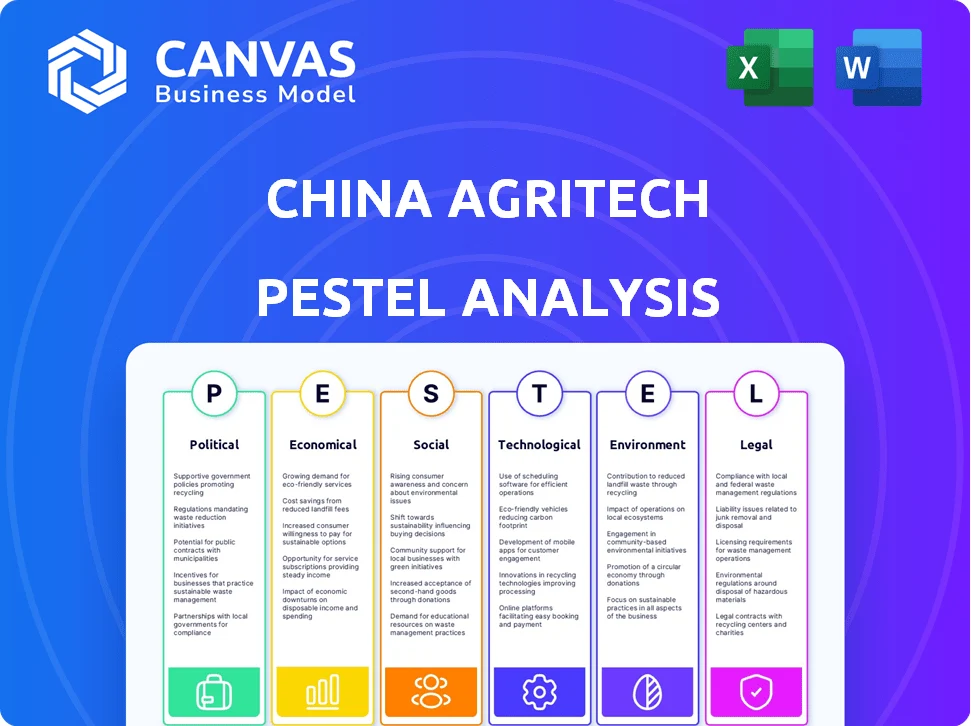
CHINA AGRITECH PESTLE ANALYSIS TEMPLATE RESEARCH
What is included in the product
 Detailed Word Document
The China Agritech PESTLE examines how macro factors impact the industry. The analysis includes Political, Economic, Social, Technological, Environmental, and Legal.

 Customizable Excel Spreadsheet
Provides a concise version that can be dropped into PowerPoints or used in group planning sessions.
Same Document Delivered
China Agritech PESTLE Analysis
What you’re previewing here is the actual file—fully formatted and professionally structured. This China Agritech PESTLE analysis is thoroughly researched. See the political, economic, social, tech, legal & environmental factors influencing the industry? You’ll get the complete analysis! No surprises—just valuable insights.

PESTLE Analysis Template

Your Shortcut to Market Insight Starts Here
Navigate the complexities of China's agritech sector with our PESTLE Analysis. Uncover how political policies, economic shifts, and technological advancements influence China Agritech. This crucial analysis helps you understand the opportunities and threats impacting their future.
Discover critical market trends and gain a competitive advantage by understanding the complete external landscape. The insights from our PESTLE report will give you the insights you need to make data-driven choices.
This professionally prepared PESTLE Analysis will support business plans or analysis needs for immediate use, it is perfectly designed for those looking to assess China Agritech. Acquire the complete version right now!
Political factors

Government Support for Agriculture
The Chinese government's focus on food security and rural revitalization significantly impacts the agricultural sector. This commitment is evident through strategic plans and substantial subsidies, aiming to modernize farming. For instance, in 2024, agricultural subsidies reached approximately $180 billion. These initiatives aim to boost domestic production.
Food Security as a National Priority
Food security is a top priority for China's government, aiming to feed its vast population. This influences policies supporting grain production and higher yields. China aims to cut reliance on imported agricultural goods. In 2024, China's grain output reached 695 million tons, demonstrating its commitment.

Rural Revitalization and Development Plans
China's rural revitalization strategy, as outlined in the "No. 1 central document" for 2024, focuses on modernizing agriculture and reducing urban-rural gaps. The government invested over 1.6 trillion yuan in rural infrastructure in 2023. This includes funding for irrigation, roads, and digital infrastructure to support agricultural production and rural economic growth. These initiatives aim to boost farmer incomes and ensure food security.

Regulatory Environment for Agribusiness
China's government heavily regulates agribusiness, overseeing seeds, pesticides, and food safety. Compliance is crucial for companies in this sector. The Ministry of Agriculture and Rural Affairs (MARA) enforces these rules. In 2024, MARA inspected over 1.2 million agricultural production units. These regulations impact market access and operational costs.
- MARA inspected over 1.2 million agricultural production units in 2024.
- Pesticide sales in China reached $6.8 billion in 2023.
Geopolitical Influences on Trade
Geopolitical tensions significantly influence China's agritech sector, affecting trade of inputs and outputs. China's focus is on strengthening ties with non-Western partners to ensure supply chain stability. The US-China trade war has led to increased tariffs on agricultural goods. China's agricultural imports from the US decreased by 30% in 2024. This shift underscores the sector's vulnerability to global political dynamics.
- China's agricultural imports from the US decreased by 30% in 2024 due to trade tensions.
- China is increasing trade with non-Western partners to secure supply chains.
China's Agritech: Politics, Trade, and Production
China’s agritech sector faces significant political influences. Government subsidies reached $180 billion in 2024, boosting domestic production and food security. Geopolitical tensions also play a major role, affecting trade. Agricultural imports from the US decreased by 30% in 2024 due to the US-China trade war.
| Factor | Impact | Data |
|---|---|---|
| Food Security | Prioritizes domestic production | 2024 grain output: 695 million tons |
| Rural Revitalization | Supports modernization and infrastructure | Rural infrastructure investment in 2023: 1.6 trillion yuan |
| Regulation | Controls market access and operational costs | MARA inspected over 1.2 million units in 2024 |
Economic factors

Growing Domestic Demand for Food
China's massive population, exceeding 1.4 billion in 2024, drives significant food demand. Rising incomes and evolving diets boost consumption of higher-value agricultural goods. This supports robust demand for fertilizers and other agritech inputs, fostering growth in the sector. In 2023, China's agricultural output value reached $1.3 trillion.
Rising Production Costs
China's agritech sector grapples with increasing production costs. Labor expenses and raw materials, vital for fertilizers, are on the rise. This impacts agribusiness profitability, potentially squeezing margins. In 2024, fertilizer prices rose, affecting farmers' bottom lines. The cost of agricultural inputs has increased by 8%.

Government Subsidies and Financial Support
China's government offers extensive subsidies to its agricultural sector, including direct payments, tax breaks, and reduced interest rates on loans. In 2024, agricultural subsidies totaled approximately RMB 1.5 trillion, aimed at boosting output and modernizing farming. These measures increase farmers' purchasing power, driving demand for agritech products. Government support also focuses on sustainable practices, with significant investment in green technologies.

Shift Towards High-Value Agriculture
China's agricultural sector is evolving, with a notable shift towards high-value products like fruits, vegetables, and livestock. This trend is fueled by rising incomes and changing consumer preferences. Consequently, demand for specific fertilizers and advanced agricultural technologies is increasing. This transformation impacts investment opportunities and strategic planning within the agritech industry.
- In 2024, the value of China's fruit and vegetable production reached approximately $200 billion.
- Livestock production value is projected to exceed $300 billion by 2025.
- Demand for precision farming technologies is expected to grow by 15% annually through 2025.
Investment in Agricultural Infrastructure
China's substantial investment in agricultural infrastructure is a key economic factor. This includes irrigation, transport, and digital systems. Such improvements boost agricultural modernization and efficiency for businesses. For example, in 2024, investments in rural infrastructure reached over $500 billion. These investments have a direct impact on agricultural output and operational costs.
- 2024 Rural infrastructure investment: over $500 billion.
- Impact on agricultural output and operational costs.
- Modernization and efficiency gains for agribusinesses.
China's Agritech Surge: $1.3T Output & 15% Growth
China's large population and rising incomes drive high food demand, boosting agritech product consumption; the 2023 agricultural output was valued at $1.3T.
Increasing labor and raw material costs for fertilizers affect agribusiness profits and margins, with fertilizer prices increasing in 2024.
Government agricultural subsidies, which reached RMB 1.5T in 2024, and infrastructure investments totaling over $500B in 2024 drive agritech demand.
The shift to high-value products and demand for advanced technologies impacts investment and planning, particularly with an expected 15% annual growth through 2025 for precision farming.
| Economic Factor | Description | Impact on Agritech |
|---|---|---|
| Population and Income | China's population exceeds 1.4B; rising incomes. | Increased demand for diverse agricultural goods. |
| Production Costs | Rising labor, raw material costs. | Pressure on agribusiness profitability. |
| Government Support | Subsidies and infrastructure investments. | Boosts farmer purchasing power; encourages tech adoption. |
| Market Trends | Shift toward high-value products. | Increased demand for specialized agritech and tech |
| 2023 Ag Output | $1.3 Trillion | Provides strong baseline for agricultural market |
Sociological factors

Aging Rural Population and Labor Shortages
China's rural regions grapple with an aging populace and a dwindling farming workforce, as younger individuals seek opportunities in cities. This demographic shift intensifies the demand for labor-saving technologies in agriculture. In 2024, the average age of farmers in China was approximately 55 years old, reflecting this trend. The shrinking labor pool necessitates enhanced efficiency to maintain agricultural output. The government has been investing heavily in agritech solutions, with spending expected to reach $25 billion by 2025, to address the labor shortage.
Increasing Awareness of Food Safety and Quality
Chinese consumers are highly concerned about food safety and quality, fueling the demand for sustainably produced and traceable agricultural products. This shift is significantly influencing farming practices. In 2024, the market for organic food in China reached $15 billion.

Urbanization and Land Use Changes
China's rapid urbanization is transforming agricultural land into urban spaces. This conversion reduces arable land, impacting agritech. In 2023, urban areas expanded, affecting farmland availability. This shift stresses the need for higher crop yields. The government supports tech to boost productivity on the remaining land.

Rural-Urban Income Disparity
Rural-urban income disparity continues to be a significant sociological factor in China, influencing the agritech sector. While the government has implemented policies to boost rural incomes, the gap persists, affecting farmers' ability to invest in advanced agricultural technologies. This disparity impacts the adoption and utilization of agritech solutions, influencing production efficiency and market competitiveness. As of 2024, the per capita disposable income in urban areas was approximately 4.7 times that of rural areas.
- Income gap impacts investment in technology.
- Urban-rural income ratio is about 4.7:1 (2024).
- Agritech adoption is influenced by income levels.
Adoption of Modern Farming Practices
Modern farming methods are increasingly popular in China, driven by government support and the promise of higher profits. Extension services and demonstration projects play a key role in educating farmers about new techniques. This shift is crucial for boosting agricultural output and meeting the needs of a growing population. These practices are vital for sustainable development in the agricultural sector.
- In 2024, the Chinese government invested over $10 billion in agricultural technology and extension services.
- Adoption rates of precision farming technologies have increased by 15% among Chinese farmers since 2023.
- Studies show that farmers using modern techniques have seen up to a 20% increase in crop yields.
China's Agritech Boom: Aging Farmers & Food Safety
China's aging farming population (avg. 55 years in 2024) drives demand for agritech, aiming to address the labor shortage. Consumers' food safety concerns boost demand for sustainable products (organic food market $15B in 2024). The urban-rural income gap (4.7:1 in 2024) influences tech adoption.
| Factor | Impact | Data (2024/2025) |
|---|---|---|
| Aging Farmers | Labor shortage; need for efficiency. | Govt. agritech spending: $25B (2025). |
| Food Safety | Demand for sustainable practices. | Organic food market: $15B (2024). |
| Income Disparity | Affects tech investment. | Urban:Rural income 4.7:1 (2024). |
Original: $10.00
-65%$10.00
$3.50CHINA AGRITECH PESTLE ANALYSIS TEMPLATE RESEARCH
What is included in the product
Detailed Word Document
The China Agritech PESTLE examines how macro factors impact the industry. The analysis includes Political, Economic, Social, Technological, Environmental, and Legal.
Customizable Excel Spreadsheet
Provides a concise version that can be dropped into PowerPoints or used in group planning sessions.
Same Document Delivered
China Agritech PESTLE Analysis
What you’re previewing here is the actual file—fully formatted and professionally structured. This China Agritech PESTLE analysis is thoroughly researched. See the political, economic, social, tech, legal & environmental factors influencing the industry? You’ll get the complete analysis! No surprises—just valuable insights.
PESTLE Analysis Template
Your Shortcut to Market Insight Starts Here
Navigate the complexities of China's agritech sector with our PESTLE Analysis. Uncover how political policies, economic shifts, and technological advancements influence China Agritech. This crucial analysis helps you understand the opportunities and threats impacting their future.
Discover critical market trends and gain a competitive advantage by understanding the complete external landscape. The insights from our PESTLE report will give you the insights you need to make data-driven choices.
This professionally prepared PESTLE Analysis will support business plans or analysis needs for immediate use, it is perfectly designed for those looking to assess China Agritech. Acquire the complete version right now!
Political factors
Government Support for Agriculture
The Chinese government's focus on food security and rural revitalization significantly impacts the agricultural sector. This commitment is evident through strategic plans and substantial subsidies, aiming to modernize farming. For instance, in 2024, agricultural subsidies reached approximately $180 billion. These initiatives aim to boost domestic production.
Food Security as a National Priority
Food security is a top priority for China's government, aiming to feed its vast population. This influences policies supporting grain production and higher yields. China aims to cut reliance on imported agricultural goods. In 2024, China's grain output reached 695 million tons, demonstrating its commitment.
Rural Revitalization and Development Plans
China's rural revitalization strategy, as outlined in the "No. 1 central document" for 2024, focuses on modernizing agriculture and reducing urban-rural gaps. The government invested over 1.6 trillion yuan in rural infrastructure in 2023. This includes funding for irrigation, roads, and digital infrastructure to support agricultural production and rural economic growth. These initiatives aim to boost farmer incomes and ensure food security.
Regulatory Environment for Agribusiness
China's government heavily regulates agribusiness, overseeing seeds, pesticides, and food safety. Compliance is crucial for companies in this sector. The Ministry of Agriculture and Rural Affairs (MARA) enforces these rules. In 2024, MARA inspected over 1.2 million agricultural production units. These regulations impact market access and operational costs.
- MARA inspected over 1.2 million agricultural production units in 2024.
- Pesticide sales in China reached $6.8 billion in 2023.
Geopolitical Influences on Trade
Geopolitical tensions significantly influence China's agritech sector, affecting trade of inputs and outputs. China's focus is on strengthening ties with non-Western partners to ensure supply chain stability. The US-China trade war has led to increased tariffs on agricultural goods. China's agricultural imports from the US decreased by 30% in 2024. This shift underscores the sector's vulnerability to global political dynamics.
- China's agricultural imports from the US decreased by 30% in 2024 due to trade tensions.
- China is increasing trade with non-Western partners to secure supply chains.
China's Agritech: Politics, Trade, and Production
China’s agritech sector faces significant political influences. Government subsidies reached $180 billion in 2024, boosting domestic production and food security. Geopolitical tensions also play a major role, affecting trade. Agricultural imports from the US decreased by 30% in 2024 due to the US-China trade war.
| Factor | Impact | Data |
|---|---|---|
| Food Security | Prioritizes domestic production | 2024 grain output: 695 million tons |
| Rural Revitalization | Supports modernization and infrastructure | Rural infrastructure investment in 2023: 1.6 trillion yuan |
| Regulation | Controls market access and operational costs | MARA inspected over 1.2 million units in 2024 |
Economic factors
Growing Domestic Demand for Food
China's massive population, exceeding 1.4 billion in 2024, drives significant food demand. Rising incomes and evolving diets boost consumption of higher-value agricultural goods. This supports robust demand for fertilizers and other agritech inputs, fostering growth in the sector. In 2023, China's agricultural output value reached $1.3 trillion.
Rising Production Costs
China's agritech sector grapples with increasing production costs. Labor expenses and raw materials, vital for fertilizers, are on the rise. This impacts agribusiness profitability, potentially squeezing margins. In 2024, fertilizer prices rose, affecting farmers' bottom lines. The cost of agricultural inputs has increased by 8%.
Government Subsidies and Financial Support
China's government offers extensive subsidies to its agricultural sector, including direct payments, tax breaks, and reduced interest rates on loans. In 2024, agricultural subsidies totaled approximately RMB 1.5 trillion, aimed at boosting output and modernizing farming. These measures increase farmers' purchasing power, driving demand for agritech products. Government support also focuses on sustainable practices, with significant investment in green technologies.
Shift Towards High-Value Agriculture
China's agricultural sector is evolving, with a notable shift towards high-value products like fruits, vegetables, and livestock. This trend is fueled by rising incomes and changing consumer preferences. Consequently, demand for specific fertilizers and advanced agricultural technologies is increasing. This transformation impacts investment opportunities and strategic planning within the agritech industry.
- In 2024, the value of China's fruit and vegetable production reached approximately $200 billion.
- Livestock production value is projected to exceed $300 billion by 2025.
- Demand for precision farming technologies is expected to grow by 15% annually through 2025.
Investment in Agricultural Infrastructure
China's substantial investment in agricultural infrastructure is a key economic factor. This includes irrigation, transport, and digital systems. Such improvements boost agricultural modernization and efficiency for businesses. For example, in 2024, investments in rural infrastructure reached over $500 billion. These investments have a direct impact on agricultural output and operational costs.
- 2024 Rural infrastructure investment: over $500 billion.
- Impact on agricultural output and operational costs.
- Modernization and efficiency gains for agribusinesses.
China's Agritech Surge: $1.3T Output & 15% Growth
China's large population and rising incomes drive high food demand, boosting agritech product consumption; the 2023 agricultural output was valued at $1.3T.
Increasing labor and raw material costs for fertilizers affect agribusiness profits and margins, with fertilizer prices increasing in 2024.
Government agricultural subsidies, which reached RMB 1.5T in 2024, and infrastructure investments totaling over $500B in 2024 drive agritech demand.
The shift to high-value products and demand for advanced technologies impacts investment and planning, particularly with an expected 15% annual growth through 2025 for precision farming.
| Economic Factor | Description | Impact on Agritech |
|---|---|---|
| Population and Income | China's population exceeds 1.4B; rising incomes. | Increased demand for diverse agricultural goods. |
| Production Costs | Rising labor, raw material costs. | Pressure on agribusiness profitability. |
| Government Support | Subsidies and infrastructure investments. | Boosts farmer purchasing power; encourages tech adoption. |
| Market Trends | Shift toward high-value products. | Increased demand for specialized agritech and tech |
| 2023 Ag Output | $1.3 Trillion | Provides strong baseline for agricultural market |
Sociological factors
Aging Rural Population and Labor Shortages
China's rural regions grapple with an aging populace and a dwindling farming workforce, as younger individuals seek opportunities in cities. This demographic shift intensifies the demand for labor-saving technologies in agriculture. In 2024, the average age of farmers in China was approximately 55 years old, reflecting this trend. The shrinking labor pool necessitates enhanced efficiency to maintain agricultural output. The government has been investing heavily in agritech solutions, with spending expected to reach $25 billion by 2025, to address the labor shortage.
Increasing Awareness of Food Safety and Quality
Chinese consumers are highly concerned about food safety and quality, fueling the demand for sustainably produced and traceable agricultural products. This shift is significantly influencing farming practices. In 2024, the market for organic food in China reached $15 billion.
Urbanization and Land Use Changes
China's rapid urbanization is transforming agricultural land into urban spaces. This conversion reduces arable land, impacting agritech. In 2023, urban areas expanded, affecting farmland availability. This shift stresses the need for higher crop yields. The government supports tech to boost productivity on the remaining land.
Rural-Urban Income Disparity
Rural-urban income disparity continues to be a significant sociological factor in China, influencing the agritech sector. While the government has implemented policies to boost rural incomes, the gap persists, affecting farmers' ability to invest in advanced agricultural technologies. This disparity impacts the adoption and utilization of agritech solutions, influencing production efficiency and market competitiveness. As of 2024, the per capita disposable income in urban areas was approximately 4.7 times that of rural areas.
- Income gap impacts investment in technology.
- Urban-rural income ratio is about 4.7:1 (2024).
- Agritech adoption is influenced by income levels.
Adoption of Modern Farming Practices
Modern farming methods are increasingly popular in China, driven by government support and the promise of higher profits. Extension services and demonstration projects play a key role in educating farmers about new techniques. This shift is crucial for boosting agricultural output and meeting the needs of a growing population. These practices are vital for sustainable development in the agricultural sector.
- In 2024, the Chinese government invested over $10 billion in agricultural technology and extension services.
- Adoption rates of precision farming technologies have increased by 15% among Chinese farmers since 2023.
- Studies show that farmers using modern techniques have seen up to a 20% increase in crop yields.
China's Agritech Boom: Aging Farmers & Food Safety
China's aging farming population (avg. 55 years in 2024) drives demand for agritech, aiming to address the labor shortage. Consumers' food safety concerns boost demand for sustainable products (organic food market $15B in 2024). The urban-rural income gap (4.7:1 in 2024) influences tech adoption.
| Factor | Impact | Data (2024/2025) |
|---|---|---|
| Aging Farmers | Labor shortage; need for efficiency. | Govt. agritech spending: $25B (2025). |
| Food Safety | Demand for sustainable practices. | Organic food market: $15B (2024). |
| Income Disparity | Affects tech investment. | Urban:Rural income 4.7:1 (2024). |
Product Information
Product Information
Shipping & Returns
Shipping & Returns
Description
What is included in the product
Detailed Word Document
The China Agritech PESTLE examines how macro factors impact the industry. The analysis includes Political, Economic, Social, Technological, Environmental, and Legal.
Customizable Excel Spreadsheet
Provides a concise version that can be dropped into PowerPoints or used in group planning sessions.
Same Document Delivered
China Agritech PESTLE Analysis
What you’re previewing here is the actual file—fully formatted and professionally structured. This China Agritech PESTLE analysis is thoroughly researched. See the political, economic, social, tech, legal & environmental factors influencing the industry? You’ll get the complete analysis! No surprises—just valuable insights.
PESTLE Analysis Template
Your Shortcut to Market Insight Starts Here
Navigate the complexities of China's agritech sector with our PESTLE Analysis. Uncover how political policies, economic shifts, and technological advancements influence China Agritech. This crucial analysis helps you understand the opportunities and threats impacting their future.
Discover critical market trends and gain a competitive advantage by understanding the complete external landscape. The insights from our PESTLE report will give you the insights you need to make data-driven choices.
This professionally prepared PESTLE Analysis will support business plans or analysis needs for immediate use, it is perfectly designed for those looking to assess China Agritech. Acquire the complete version right now!
Political factors
Government Support for Agriculture
The Chinese government's focus on food security and rural revitalization significantly impacts the agricultural sector. This commitment is evident through strategic plans and substantial subsidies, aiming to modernize farming. For instance, in 2024, agricultural subsidies reached approximately $180 billion. These initiatives aim to boost domestic production.
Food Security as a National Priority
Food security is a top priority for China's government, aiming to feed its vast population. This influences policies supporting grain production and higher yields. China aims to cut reliance on imported agricultural goods. In 2024, China's grain output reached 695 million tons, demonstrating its commitment.
Rural Revitalization and Development Plans
China's rural revitalization strategy, as outlined in the "No. 1 central document" for 2024, focuses on modernizing agriculture and reducing urban-rural gaps. The government invested over 1.6 trillion yuan in rural infrastructure in 2023. This includes funding for irrigation, roads, and digital infrastructure to support agricultural production and rural economic growth. These initiatives aim to boost farmer incomes and ensure food security.
Regulatory Environment for Agribusiness
China's government heavily regulates agribusiness, overseeing seeds, pesticides, and food safety. Compliance is crucial for companies in this sector. The Ministry of Agriculture and Rural Affairs (MARA) enforces these rules. In 2024, MARA inspected over 1.2 million agricultural production units. These regulations impact market access and operational costs.
- MARA inspected over 1.2 million agricultural production units in 2024.
- Pesticide sales in China reached $6.8 billion in 2023.
Geopolitical Influences on Trade
Geopolitical tensions significantly influence China's agritech sector, affecting trade of inputs and outputs. China's focus is on strengthening ties with non-Western partners to ensure supply chain stability. The US-China trade war has led to increased tariffs on agricultural goods. China's agricultural imports from the US decreased by 30% in 2024. This shift underscores the sector's vulnerability to global political dynamics.
- China's agricultural imports from the US decreased by 30% in 2024 due to trade tensions.
- China is increasing trade with non-Western partners to secure supply chains.
China's Agritech: Politics, Trade, and Production
China’s agritech sector faces significant political influences. Government subsidies reached $180 billion in 2024, boosting domestic production and food security. Geopolitical tensions also play a major role, affecting trade. Agricultural imports from the US decreased by 30% in 2024 due to the US-China trade war.
| Factor | Impact | Data |
|---|---|---|
| Food Security | Prioritizes domestic production | 2024 grain output: 695 million tons |
| Rural Revitalization | Supports modernization and infrastructure | Rural infrastructure investment in 2023: 1.6 trillion yuan |
| Regulation | Controls market access and operational costs | MARA inspected over 1.2 million units in 2024 |
Economic factors
Growing Domestic Demand for Food
China's massive population, exceeding 1.4 billion in 2024, drives significant food demand. Rising incomes and evolving diets boost consumption of higher-value agricultural goods. This supports robust demand for fertilizers and other agritech inputs, fostering growth in the sector. In 2023, China's agricultural output value reached $1.3 trillion.
Rising Production Costs
China's agritech sector grapples with increasing production costs. Labor expenses and raw materials, vital for fertilizers, are on the rise. This impacts agribusiness profitability, potentially squeezing margins. In 2024, fertilizer prices rose, affecting farmers' bottom lines. The cost of agricultural inputs has increased by 8%.
Government Subsidies and Financial Support
China's government offers extensive subsidies to its agricultural sector, including direct payments, tax breaks, and reduced interest rates on loans. In 2024, agricultural subsidies totaled approximately RMB 1.5 trillion, aimed at boosting output and modernizing farming. These measures increase farmers' purchasing power, driving demand for agritech products. Government support also focuses on sustainable practices, with significant investment in green technologies.
Shift Towards High-Value Agriculture
China's agricultural sector is evolving, with a notable shift towards high-value products like fruits, vegetables, and livestock. This trend is fueled by rising incomes and changing consumer preferences. Consequently, demand for specific fertilizers and advanced agricultural technologies is increasing. This transformation impacts investment opportunities and strategic planning within the agritech industry.
- In 2024, the value of China's fruit and vegetable production reached approximately $200 billion.
- Livestock production value is projected to exceed $300 billion by 2025.
- Demand for precision farming technologies is expected to grow by 15% annually through 2025.
Investment in Agricultural Infrastructure
China's substantial investment in agricultural infrastructure is a key economic factor. This includes irrigation, transport, and digital systems. Such improvements boost agricultural modernization and efficiency for businesses. For example, in 2024, investments in rural infrastructure reached over $500 billion. These investments have a direct impact on agricultural output and operational costs.
- 2024 Rural infrastructure investment: over $500 billion.
- Impact on agricultural output and operational costs.
- Modernization and efficiency gains for agribusinesses.
China's Agritech Surge: $1.3T Output & 15% Growth
China's large population and rising incomes drive high food demand, boosting agritech product consumption; the 2023 agricultural output was valued at $1.3T.
Increasing labor and raw material costs for fertilizers affect agribusiness profits and margins, with fertilizer prices increasing in 2024.
Government agricultural subsidies, which reached RMB 1.5T in 2024, and infrastructure investments totaling over $500B in 2024 drive agritech demand.
The shift to high-value products and demand for advanced technologies impacts investment and planning, particularly with an expected 15% annual growth through 2025 for precision farming.
| Economic Factor | Description | Impact on Agritech |
|---|---|---|
| Population and Income | China's population exceeds 1.4B; rising incomes. | Increased demand for diverse agricultural goods. |
| Production Costs | Rising labor, raw material costs. | Pressure on agribusiness profitability. |
| Government Support | Subsidies and infrastructure investments. | Boosts farmer purchasing power; encourages tech adoption. |
| Market Trends | Shift toward high-value products. | Increased demand for specialized agritech and tech |
| 2023 Ag Output | $1.3 Trillion | Provides strong baseline for agricultural market |
Sociological factors
Aging Rural Population and Labor Shortages
China's rural regions grapple with an aging populace and a dwindling farming workforce, as younger individuals seek opportunities in cities. This demographic shift intensifies the demand for labor-saving technologies in agriculture. In 2024, the average age of farmers in China was approximately 55 years old, reflecting this trend. The shrinking labor pool necessitates enhanced efficiency to maintain agricultural output. The government has been investing heavily in agritech solutions, with spending expected to reach $25 billion by 2025, to address the labor shortage.
Increasing Awareness of Food Safety and Quality
Chinese consumers are highly concerned about food safety and quality, fueling the demand for sustainably produced and traceable agricultural products. This shift is significantly influencing farming practices. In 2024, the market for organic food in China reached $15 billion.
Urbanization and Land Use Changes
China's rapid urbanization is transforming agricultural land into urban spaces. This conversion reduces arable land, impacting agritech. In 2023, urban areas expanded, affecting farmland availability. This shift stresses the need for higher crop yields. The government supports tech to boost productivity on the remaining land.
Rural-Urban Income Disparity
Rural-urban income disparity continues to be a significant sociological factor in China, influencing the agritech sector. While the government has implemented policies to boost rural incomes, the gap persists, affecting farmers' ability to invest in advanced agricultural technologies. This disparity impacts the adoption and utilization of agritech solutions, influencing production efficiency and market competitiveness. As of 2024, the per capita disposable income in urban areas was approximately 4.7 times that of rural areas.
- Income gap impacts investment in technology.
- Urban-rural income ratio is about 4.7:1 (2024).
- Agritech adoption is influenced by income levels.
Adoption of Modern Farming Practices
Modern farming methods are increasingly popular in China, driven by government support and the promise of higher profits. Extension services and demonstration projects play a key role in educating farmers about new techniques. This shift is crucial for boosting agricultural output and meeting the needs of a growing population. These practices are vital for sustainable development in the agricultural sector.
- In 2024, the Chinese government invested over $10 billion in agricultural technology and extension services.
- Adoption rates of precision farming technologies have increased by 15% among Chinese farmers since 2023.
- Studies show that farmers using modern techniques have seen up to a 20% increase in crop yields.
China's Agritech Boom: Aging Farmers & Food Safety
China's aging farming population (avg. 55 years in 2024) drives demand for agritech, aiming to address the labor shortage. Consumers' food safety concerns boost demand for sustainable products (organic food market $15B in 2024). The urban-rural income gap (4.7:1 in 2024) influences tech adoption.
| Factor | Impact | Data (2024/2025) |
|---|---|---|
| Aging Farmers | Labor shortage; need for efficiency. | Govt. agritech spending: $25B (2025). |
| Food Safety | Demand for sustainable practices. | Organic food market: $15B (2024). |
| Income Disparity | Affects tech investment. | Urban:Rural income 4.7:1 (2024). |


