CFO PESTLE ANALYSIS TEMPLATE RESEARCH
What is included in the product
 Detailed Word Document
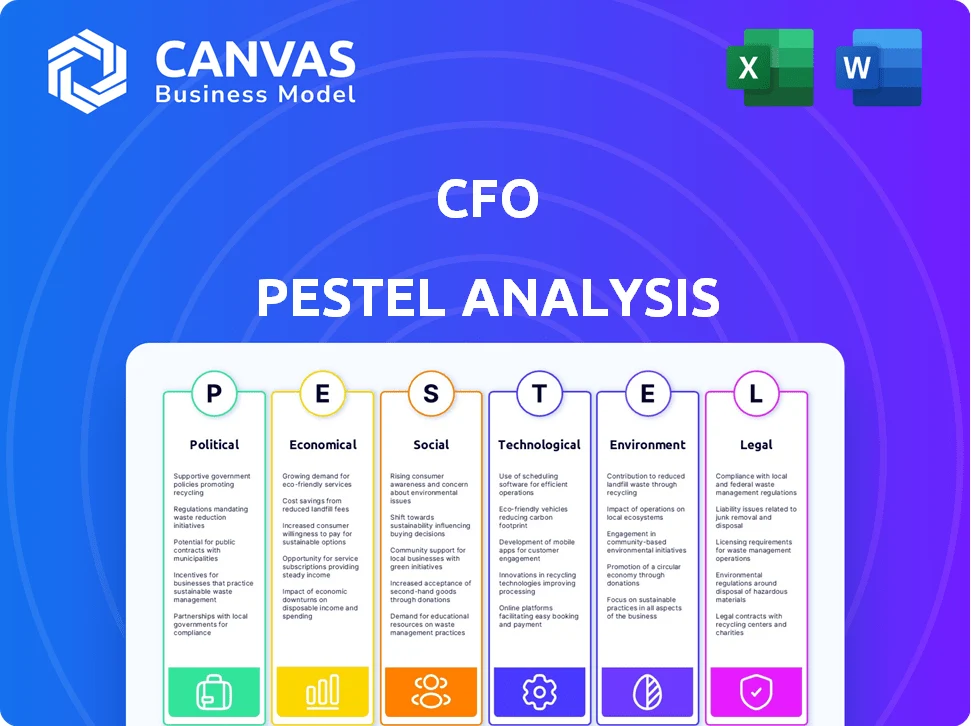
Assesses external factors impacting CFOs. It covers Political, Economic, Social, Technological, Environmental, and Legal dimensions.

 Customizable Excel Spreadsheet
Provides a concise version that can be dropped into PowerPoints or used in group planning sessions.
What You See Is What You Get
CFO PESTLE Analysis
This preview showcases the complete CFO PESTLE Analysis document. The download you receive will mirror the content and formatting exactly. No hidden sections or altered versions exist. You'll have immediate access to the file seen here. Purchase provides this ready-to-use, finalized analysis.

PESTLE Analysis Template

Your Shortcut to Market Insight Starts Here
Unlock vital insights with our CFO PESTLE Analysis. Explore how external factors influence financial strategies. Understand political landscapes, economic shifts, and technological advancements. Social trends and legal frameworks are also examined. Use this data to identify risks, and drive smarter decisions. Download the full report for actionable intelligence.
Political factors

Government Funding and Initiatives
Government funding heavily influences vocational training. CFOs must track government support for skills development. Initiatives like Portugal's investments in tech centers and schools show this impact. For example, in 2024, Portugal allocated €100 million for vocational training programs. This affects enrollment and expansion.
Policy Changes in Education and Training
Policy shifts in education, like Portugal's recent updates to upper secondary education and vocational pathways, directly impact CFOs. These changes alter course structures and content, requiring adaptation. Maintaining accreditation demands staying current with new curriculum requirements and assessment methods. In Portugal, the Ministry of Education has increased funding for vocational training by 15% in 2024.

Political Stability and Support for the Sector
A stable political landscape is crucial for vocational training CFOs. Consistent government support, like the $1.9 trillion American Rescue Plan Act of 2021, can ensure funding. Political shifts can disrupt these plans. For example, changes in the UK's apprenticeship levy could impact financial strategies.

Labor Market Regulations
Labor market regulations significantly impact CFO decisions. Governments set employment standards and skills recognition policies, influencing workforce training needs. Changes in minimum wage or mandatory training directly affect CFO offerings' relevance. These shifts alter operational costs and strategic workforce planning. For instance, in 2024, the U.S. saw minimum wage increases in several states, affecting business budgets.
- Minimum wage hikes in states like California and New York increase labor costs.
- Mandatory training programs mandated by new regulations add expenses.
- Skills recognition policies impact the value of specific CFO courses.
- Compliance with labor laws requires accurate financial forecasting.
International Cooperation and Mobility Policies
International cooperation and mobility policies are pivotal for CFOs, particularly those in educational institutions. These policies influence the ability to attract international students and participate in global projects. Government scholarships significantly affect international student enrollment rates. For instance, in 2024, the UK saw a 10% increase in international student applications following policy adjustments.
- Scholarships: 2024 data shows a 15% rise in international student acceptance with increased scholarship availability.
- Mobility: Policies affecting worker mobility can ease the hiring of specialized international staff.
- Cooperation: International project collaborations can boost research funding by up to 20%.
Political Shifts: CFO's Vocational Training Guide
Political factors heavily influence CFO decisions in vocational training. Government funding shifts, like the 2024 allocation of €100 million by Portugal, affect program budgets. Labor market regulations, such as U.S. minimum wage hikes, change operational costs.
International policies, e.g., UK’s 10% increase in international applications, impact student enrollment and workforce. Maintaining awareness of these political dynamics is key.
| Political Factor | Impact on CFO | 2024/2025 Data Point |
|---|---|---|
| Government Funding | Budget Planning | Portugal: €100M for Vocational Training |
| Labor Regulations | Cost Management | U.S. Minimum Wage Hikes |
| International Policies | Enrollment & Staffing | UK: 10% Rise in Student Apps |
Economic factors

Unemployment Rates and Job Market Demand
High unemployment boosts vocational training demand. Low unemployment shifts focus to upskilling. The labor market directly impacts CFO course offerings. In March 2024, the U.S. unemployment rate was 3.8%. Demand for AI skills is rising rapidly, influencing course content.
Economic Growth and Industry Needs
Economic growth fuels demand for skilled labor. CFOs must adapt training to align with industry needs. Industry 4.0 and tech advancements require specialized skills. The U.S. GDP grew by 3.3% in Q4 2023, signaling opportunities. Aligning programs with these trends is vital for success.

Funding and Investment in Training
Funding and investment in vocational training directly affect CFOs' budgets. Public and private investments in training programs, infrastructure, and scholarships are crucial. Economic stability typically boosts investment in education and training. In 2024, the U.S. government allocated over $2 billion for workforce development programs.

Cost of Education and Affordability
The cost of vocational training and its affordability are vital economic factors. Economic instability or rising living expenses can limit access to training, emphasizing the need for affordable options. In 2024, the average annual tuition for vocational schools was around $15,000, with significant variation. Scholarships and financial aid are crucial for accessibility.
- Average vocational school tuition: ~$15,000 annually in 2024.
- Impact of economic downturns on enrollment.
- Role of scholarships and financial aid.
Wage Levels and Earning Potential
Wage levels and earning potential are critical factors for CFOs. The appeal of vocational training hinges on the post-program earning prospects. To attract students, CFOs must ensure programs lead to jobs with competitive wages.
- In 2024, the median annual wage for skilled trade workers was around $50,000.
- Job growth in skilled trades is projected at 5-7% through 2030.
- High-demand fields offer starting salaries above $60,000.
- Programs should focus on sectors with strong wage growth, like renewable energy.
Skills Training: Economic Indicators & Outcomes
Economic shifts impact vocational training needs; the U.S. GDP grew 3.3% in Q4 2023. Training costs and affordability influence access; average tuition was ~$15,000 in 2024. Wage prospects are key; skilled trade workers had a median wage of ~$50,000 in 2024.
| Factor | Impact | 2024 Data |
|---|---|---|
| Unemployment Rate | Training Demand | 3.8% in March |
| GDP Growth | Skills Demand | 3.3% in Q4 2023 |
| Tuition Costs | Accessibility | ~$15,000 annually |
| Median Wage (Skilled Trades) | Program Appeal | ~$50,000 annually |
Sociological factors

Demographic Shifts and Aging Population
The global population is aging, with significant implications for the workforce and educational demands. In 2024, the median age in the U.S. was approximately 39 years, indicating an aging population. This demographic shift necessitates increased investment in reskilling and upskilling initiatives. These programs are crucial for older workers, and also shape the future of vocational training.
Changing Social Perceptions of Vocational Training
Societal attitudes towards vocational training are evolving. Enrollment in vocational programs is influenced by perceptions. A positive view of vocational education benefits CFOs. In 2024, the US saw a 10% rise in vocational program enrollment, indicating shifting societal views. This trend supports a skilled workforce.

Migration and Cultural Diversity
Immigration and cultural diversity necessitate language training and integration programs for the workforce. CFOs must adapt offerings and teaching methods to cater to a diverse student body. In 2024, the U.S. saw a 6.4% increase in foreign-born workers. This requires financial adjustments for training and inclusive practices.

Demand for Lifelong Learning and Upskilling
The growing emphasis on lifelong learning and upskilling profoundly influences the demand for adult education and short-term training programs, a trend CFOs must acknowledge. This shift is driven by rapid technological advancements and evolving job market requirements, compelling professionals to continuously update their skills. Financial leaders can respond strategically by investing in employee training initiatives or partnering with educational institutions to provide relevant courses. This focus ensures the workforce remains competitive and adaptable.
- The global corporate training market is projected to reach $408.6 billion by 2025.
- Companies that invest in training see a 24% higher profit margin.
- 77% of CFOs plan to increase their investment in employee training.
Work-Life Balance and Flexible Learning Needs
Societal shifts highlight work-life balance and the demand for flexible learning. CFOs must adjust delivery methods to accommodate students' preferences for online or blended learning. This adaptation is crucial for maintaining educational standards and accessibility. The global e-learning market is projected to reach $325 billion by 2025.
- Blended learning adoption increased by 30% in 2024.
- Online course enrollments rose 15% in Q1 2024.
- Companies offering flexible work schedules saw a 20% rise in employee satisfaction.
Reskilling Surge: Workforce Trends
An aging population needs workforce reskilling and upskilling. Evolving views of vocational education drive demand for skilled workers, with US vocational enrollment up 10% in 2024. Focus is needed on training and inclusion for a diverse, foreign-born workforce.
| Factor | Impact | 2024/2025 Data |
|---|---|---|
| Aging Population | Increased training needs | US median age: ~39 yrs |
| Vocational Training | Demand for skilled labor | Vocational enrollment up 10% (2024) |
| Diversity | Need for inclusion | US foreign-born workers up 6.4% (2024) |
Original: $10.00
-65%$10.00
$3.50CFO PESTLE ANALYSIS TEMPLATE RESEARCH
What is included in the product
Detailed Word Document
Assesses external factors impacting CFOs. It covers Political, Economic, Social, Technological, Environmental, and Legal dimensions.
Customizable Excel Spreadsheet
Provides a concise version that can be dropped into PowerPoints or used in group planning sessions.
What You See Is What You Get
CFO PESTLE Analysis
This preview showcases the complete CFO PESTLE Analysis document. The download you receive will mirror the content and formatting exactly. No hidden sections or altered versions exist. You'll have immediate access to the file seen here. Purchase provides this ready-to-use, finalized analysis.
PESTLE Analysis Template
Your Shortcut to Market Insight Starts Here
Unlock vital insights with our CFO PESTLE Analysis. Explore how external factors influence financial strategies. Understand political landscapes, economic shifts, and technological advancements. Social trends and legal frameworks are also examined. Use this data to identify risks, and drive smarter decisions. Download the full report for actionable intelligence.
Political factors
Government Funding and Initiatives
Government funding heavily influences vocational training. CFOs must track government support for skills development. Initiatives like Portugal's investments in tech centers and schools show this impact. For example, in 2024, Portugal allocated €100 million for vocational training programs. This affects enrollment and expansion.
Policy Changes in Education and Training
Policy shifts in education, like Portugal's recent updates to upper secondary education and vocational pathways, directly impact CFOs. These changes alter course structures and content, requiring adaptation. Maintaining accreditation demands staying current with new curriculum requirements and assessment methods. In Portugal, the Ministry of Education has increased funding for vocational training by 15% in 2024.
Political Stability and Support for the Sector
A stable political landscape is crucial for vocational training CFOs. Consistent government support, like the $1.9 trillion American Rescue Plan Act of 2021, can ensure funding. Political shifts can disrupt these plans. For example, changes in the UK's apprenticeship levy could impact financial strategies.
Labor Market Regulations
Labor market regulations significantly impact CFO decisions. Governments set employment standards and skills recognition policies, influencing workforce training needs. Changes in minimum wage or mandatory training directly affect CFO offerings' relevance. These shifts alter operational costs and strategic workforce planning. For instance, in 2024, the U.S. saw minimum wage increases in several states, affecting business budgets.
- Minimum wage hikes in states like California and New York increase labor costs.
- Mandatory training programs mandated by new regulations add expenses.
- Skills recognition policies impact the value of specific CFO courses.
- Compliance with labor laws requires accurate financial forecasting.
International Cooperation and Mobility Policies
International cooperation and mobility policies are pivotal for CFOs, particularly those in educational institutions. These policies influence the ability to attract international students and participate in global projects. Government scholarships significantly affect international student enrollment rates. For instance, in 2024, the UK saw a 10% increase in international student applications following policy adjustments.
- Scholarships: 2024 data shows a 15% rise in international student acceptance with increased scholarship availability.
- Mobility: Policies affecting worker mobility can ease the hiring of specialized international staff.
- Cooperation: International project collaborations can boost research funding by up to 20%.
Political Shifts: CFO's Vocational Training Guide
Political factors heavily influence CFO decisions in vocational training. Government funding shifts, like the 2024 allocation of €100 million by Portugal, affect program budgets. Labor market regulations, such as U.S. minimum wage hikes, change operational costs.
International policies, e.g., UK’s 10% increase in international applications, impact student enrollment and workforce. Maintaining awareness of these political dynamics is key.
| Political Factor | Impact on CFO | 2024/2025 Data Point |
|---|---|---|
| Government Funding | Budget Planning | Portugal: €100M for Vocational Training |
| Labor Regulations | Cost Management | U.S. Minimum Wage Hikes |
| International Policies | Enrollment & Staffing | UK: 10% Rise in Student Apps |
Economic factors
Unemployment Rates and Job Market Demand
High unemployment boosts vocational training demand. Low unemployment shifts focus to upskilling. The labor market directly impacts CFO course offerings. In March 2024, the U.S. unemployment rate was 3.8%. Demand for AI skills is rising rapidly, influencing course content.
Economic Growth and Industry Needs
Economic growth fuels demand for skilled labor. CFOs must adapt training to align with industry needs. Industry 4.0 and tech advancements require specialized skills. The U.S. GDP grew by 3.3% in Q4 2023, signaling opportunities. Aligning programs with these trends is vital for success.
Funding and Investment in Training
Funding and investment in vocational training directly affect CFOs' budgets. Public and private investments in training programs, infrastructure, and scholarships are crucial. Economic stability typically boosts investment in education and training. In 2024, the U.S. government allocated over $2 billion for workforce development programs.
Cost of Education and Affordability
The cost of vocational training and its affordability are vital economic factors. Economic instability or rising living expenses can limit access to training, emphasizing the need for affordable options. In 2024, the average annual tuition for vocational schools was around $15,000, with significant variation. Scholarships and financial aid are crucial for accessibility.
- Average vocational school tuition: ~$15,000 annually in 2024.
- Impact of economic downturns on enrollment.
- Role of scholarships and financial aid.
Wage Levels and Earning Potential
Wage levels and earning potential are critical factors for CFOs. The appeal of vocational training hinges on the post-program earning prospects. To attract students, CFOs must ensure programs lead to jobs with competitive wages.
- In 2024, the median annual wage for skilled trade workers was around $50,000.
- Job growth in skilled trades is projected at 5-7% through 2030.
- High-demand fields offer starting salaries above $60,000.
- Programs should focus on sectors with strong wage growth, like renewable energy.
Skills Training: Economic Indicators & Outcomes
Economic shifts impact vocational training needs; the U.S. GDP grew 3.3% in Q4 2023. Training costs and affordability influence access; average tuition was ~$15,000 in 2024. Wage prospects are key; skilled trade workers had a median wage of ~$50,000 in 2024.
| Factor | Impact | 2024 Data |
|---|---|---|
| Unemployment Rate | Training Demand | 3.8% in March |
| GDP Growth | Skills Demand | 3.3% in Q4 2023 |
| Tuition Costs | Accessibility | ~$15,000 annually |
| Median Wage (Skilled Trades) | Program Appeal | ~$50,000 annually |
Sociological factors
Demographic Shifts and Aging Population
The global population is aging, with significant implications for the workforce and educational demands. In 2024, the median age in the U.S. was approximately 39 years, indicating an aging population. This demographic shift necessitates increased investment in reskilling and upskilling initiatives. These programs are crucial for older workers, and also shape the future of vocational training.
Changing Social Perceptions of Vocational Training
Societal attitudes towards vocational training are evolving. Enrollment in vocational programs is influenced by perceptions. A positive view of vocational education benefits CFOs. In 2024, the US saw a 10% rise in vocational program enrollment, indicating shifting societal views. This trend supports a skilled workforce.
Migration and Cultural Diversity
Immigration and cultural diversity necessitate language training and integration programs for the workforce. CFOs must adapt offerings and teaching methods to cater to a diverse student body. In 2024, the U.S. saw a 6.4% increase in foreign-born workers. This requires financial adjustments for training and inclusive practices.
Demand for Lifelong Learning and Upskilling
The growing emphasis on lifelong learning and upskilling profoundly influences the demand for adult education and short-term training programs, a trend CFOs must acknowledge. This shift is driven by rapid technological advancements and evolving job market requirements, compelling professionals to continuously update their skills. Financial leaders can respond strategically by investing in employee training initiatives or partnering with educational institutions to provide relevant courses. This focus ensures the workforce remains competitive and adaptable.
- The global corporate training market is projected to reach $408.6 billion by 2025.
- Companies that invest in training see a 24% higher profit margin.
- 77% of CFOs plan to increase their investment in employee training.
Work-Life Balance and Flexible Learning Needs
Societal shifts highlight work-life balance and the demand for flexible learning. CFOs must adjust delivery methods to accommodate students' preferences for online or blended learning. This adaptation is crucial for maintaining educational standards and accessibility. The global e-learning market is projected to reach $325 billion by 2025.
- Blended learning adoption increased by 30% in 2024.
- Online course enrollments rose 15% in Q1 2024.
- Companies offering flexible work schedules saw a 20% rise in employee satisfaction.
Reskilling Surge: Workforce Trends
An aging population needs workforce reskilling and upskilling. Evolving views of vocational education drive demand for skilled workers, with US vocational enrollment up 10% in 2024. Focus is needed on training and inclusion for a diverse, foreign-born workforce.
| Factor | Impact | 2024/2025 Data |
|---|---|---|
| Aging Population | Increased training needs | US median age: ~39 yrs |
| Vocational Training | Demand for skilled labor | Vocational enrollment up 10% (2024) |
| Diversity | Need for inclusion | US foreign-born workers up 6.4% (2024) |
Product Information
Product Information
Shipping & Returns
Shipping & Returns
Description
What is included in the product
Detailed Word Document
Assesses external factors impacting CFOs. It covers Political, Economic, Social, Technological, Environmental, and Legal dimensions.
Customizable Excel Spreadsheet
Provides a concise version that can be dropped into PowerPoints or used in group planning sessions.
What You See Is What You Get
CFO PESTLE Analysis
This preview showcases the complete CFO PESTLE Analysis document. The download you receive will mirror the content and formatting exactly. No hidden sections or altered versions exist. You'll have immediate access to the file seen here. Purchase provides this ready-to-use, finalized analysis.
PESTLE Analysis Template
Your Shortcut to Market Insight Starts Here
Unlock vital insights with our CFO PESTLE Analysis. Explore how external factors influence financial strategies. Understand political landscapes, economic shifts, and technological advancements. Social trends and legal frameworks are also examined. Use this data to identify risks, and drive smarter decisions. Download the full report for actionable intelligence.
Political factors
Government Funding and Initiatives
Government funding heavily influences vocational training. CFOs must track government support for skills development. Initiatives like Portugal's investments in tech centers and schools show this impact. For example, in 2024, Portugal allocated €100 million for vocational training programs. This affects enrollment and expansion.
Policy Changes in Education and Training
Policy shifts in education, like Portugal's recent updates to upper secondary education and vocational pathways, directly impact CFOs. These changes alter course structures and content, requiring adaptation. Maintaining accreditation demands staying current with new curriculum requirements and assessment methods. In Portugal, the Ministry of Education has increased funding for vocational training by 15% in 2024.
Political Stability and Support for the Sector
A stable political landscape is crucial for vocational training CFOs. Consistent government support, like the $1.9 trillion American Rescue Plan Act of 2021, can ensure funding. Political shifts can disrupt these plans. For example, changes in the UK's apprenticeship levy could impact financial strategies.
Labor Market Regulations
Labor market regulations significantly impact CFO decisions. Governments set employment standards and skills recognition policies, influencing workforce training needs. Changes in minimum wage or mandatory training directly affect CFO offerings' relevance. These shifts alter operational costs and strategic workforce planning. For instance, in 2024, the U.S. saw minimum wage increases in several states, affecting business budgets.
- Minimum wage hikes in states like California and New York increase labor costs.
- Mandatory training programs mandated by new regulations add expenses.
- Skills recognition policies impact the value of specific CFO courses.
- Compliance with labor laws requires accurate financial forecasting.
International Cooperation and Mobility Policies
International cooperation and mobility policies are pivotal for CFOs, particularly those in educational institutions. These policies influence the ability to attract international students and participate in global projects. Government scholarships significantly affect international student enrollment rates. For instance, in 2024, the UK saw a 10% increase in international student applications following policy adjustments.
- Scholarships: 2024 data shows a 15% rise in international student acceptance with increased scholarship availability.
- Mobility: Policies affecting worker mobility can ease the hiring of specialized international staff.
- Cooperation: International project collaborations can boost research funding by up to 20%.
Political Shifts: CFO's Vocational Training Guide
Political factors heavily influence CFO decisions in vocational training. Government funding shifts, like the 2024 allocation of €100 million by Portugal, affect program budgets. Labor market regulations, such as U.S. minimum wage hikes, change operational costs.
International policies, e.g., UK’s 10% increase in international applications, impact student enrollment and workforce. Maintaining awareness of these political dynamics is key.
| Political Factor | Impact on CFO | 2024/2025 Data Point |
|---|---|---|
| Government Funding | Budget Planning | Portugal: €100M for Vocational Training |
| Labor Regulations | Cost Management | U.S. Minimum Wage Hikes |
| International Policies | Enrollment & Staffing | UK: 10% Rise in Student Apps |
Economic factors
Unemployment Rates and Job Market Demand
High unemployment boosts vocational training demand. Low unemployment shifts focus to upskilling. The labor market directly impacts CFO course offerings. In March 2024, the U.S. unemployment rate was 3.8%. Demand for AI skills is rising rapidly, influencing course content.
Economic Growth and Industry Needs
Economic growth fuels demand for skilled labor. CFOs must adapt training to align with industry needs. Industry 4.0 and tech advancements require specialized skills. The U.S. GDP grew by 3.3% in Q4 2023, signaling opportunities. Aligning programs with these trends is vital for success.
Funding and Investment in Training
Funding and investment in vocational training directly affect CFOs' budgets. Public and private investments in training programs, infrastructure, and scholarships are crucial. Economic stability typically boosts investment in education and training. In 2024, the U.S. government allocated over $2 billion for workforce development programs.
Cost of Education and Affordability
The cost of vocational training and its affordability are vital economic factors. Economic instability or rising living expenses can limit access to training, emphasizing the need for affordable options. In 2024, the average annual tuition for vocational schools was around $15,000, with significant variation. Scholarships and financial aid are crucial for accessibility.
- Average vocational school tuition: ~$15,000 annually in 2024.
- Impact of economic downturns on enrollment.
- Role of scholarships and financial aid.
Wage Levels and Earning Potential
Wage levels and earning potential are critical factors for CFOs. The appeal of vocational training hinges on the post-program earning prospects. To attract students, CFOs must ensure programs lead to jobs with competitive wages.
- In 2024, the median annual wage for skilled trade workers was around $50,000.
- Job growth in skilled trades is projected at 5-7% through 2030.
- High-demand fields offer starting salaries above $60,000.
- Programs should focus on sectors with strong wage growth, like renewable energy.
Skills Training: Economic Indicators & Outcomes
Economic shifts impact vocational training needs; the U.S. GDP grew 3.3% in Q4 2023. Training costs and affordability influence access; average tuition was ~$15,000 in 2024. Wage prospects are key; skilled trade workers had a median wage of ~$50,000 in 2024.
| Factor | Impact | 2024 Data |
|---|---|---|
| Unemployment Rate | Training Demand | 3.8% in March |
| GDP Growth | Skills Demand | 3.3% in Q4 2023 |
| Tuition Costs | Accessibility | ~$15,000 annually |
| Median Wage (Skilled Trades) | Program Appeal | ~$50,000 annually |
Sociological factors
Demographic Shifts and Aging Population
The global population is aging, with significant implications for the workforce and educational demands. In 2024, the median age in the U.S. was approximately 39 years, indicating an aging population. This demographic shift necessitates increased investment in reskilling and upskilling initiatives. These programs are crucial for older workers, and also shape the future of vocational training.
Changing Social Perceptions of Vocational Training
Societal attitudes towards vocational training are evolving. Enrollment in vocational programs is influenced by perceptions. A positive view of vocational education benefits CFOs. In 2024, the US saw a 10% rise in vocational program enrollment, indicating shifting societal views. This trend supports a skilled workforce.
Migration and Cultural Diversity
Immigration and cultural diversity necessitate language training and integration programs for the workforce. CFOs must adapt offerings and teaching methods to cater to a diverse student body. In 2024, the U.S. saw a 6.4% increase in foreign-born workers. This requires financial adjustments for training and inclusive practices.
Demand for Lifelong Learning and Upskilling
The growing emphasis on lifelong learning and upskilling profoundly influences the demand for adult education and short-term training programs, a trend CFOs must acknowledge. This shift is driven by rapid technological advancements and evolving job market requirements, compelling professionals to continuously update their skills. Financial leaders can respond strategically by investing in employee training initiatives or partnering with educational institutions to provide relevant courses. This focus ensures the workforce remains competitive and adaptable.
- The global corporate training market is projected to reach $408.6 billion by 2025.
- Companies that invest in training see a 24% higher profit margin.
- 77% of CFOs plan to increase their investment in employee training.
Work-Life Balance and Flexible Learning Needs
Societal shifts highlight work-life balance and the demand for flexible learning. CFOs must adjust delivery methods to accommodate students' preferences for online or blended learning. This adaptation is crucial for maintaining educational standards and accessibility. The global e-learning market is projected to reach $325 billion by 2025.
- Blended learning adoption increased by 30% in 2024.
- Online course enrollments rose 15% in Q1 2024.
- Companies offering flexible work schedules saw a 20% rise in employee satisfaction.
Reskilling Surge: Workforce Trends
An aging population needs workforce reskilling and upskilling. Evolving views of vocational education drive demand for skilled workers, with US vocational enrollment up 10% in 2024. Focus is needed on training and inclusion for a diverse, foreign-born workforce.
| Factor | Impact | 2024/2025 Data |
|---|---|---|
| Aging Population | Increased training needs | US median age: ~39 yrs |
| Vocational Training | Demand for skilled labor | Vocational enrollment up 10% (2024) |
| Diversity | Need for inclusion | US foreign-born workers up 6.4% (2024) |