CARD FACTORY PLC PESTLE ANALYSIS TEMPLATE RESEARCH
What is included in the product
 Detailed Word Document
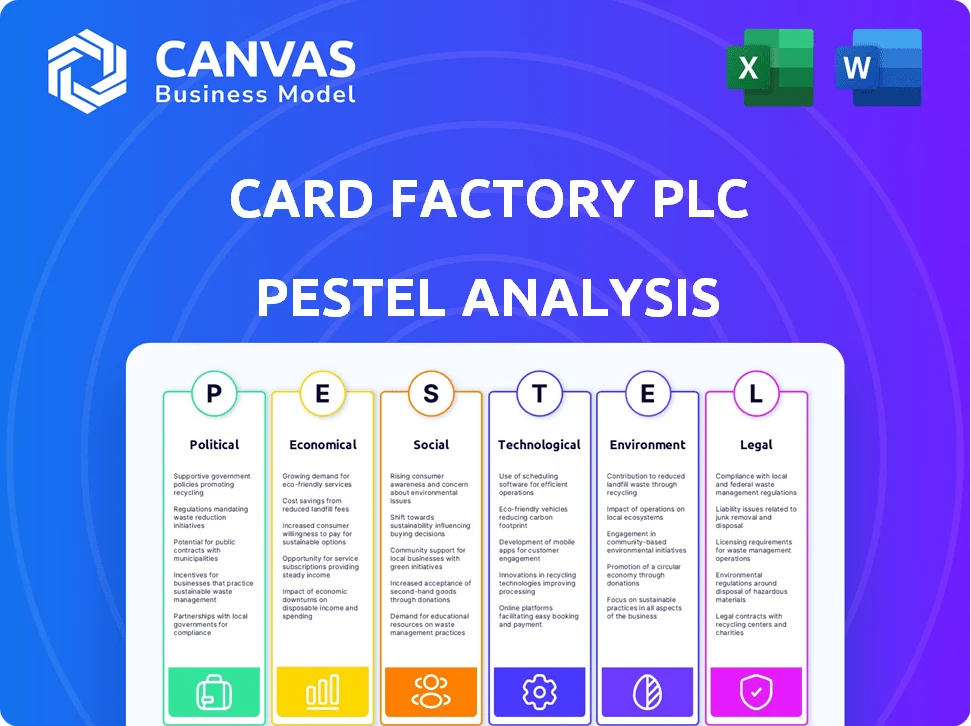
Explores how external factors impact Card Factory Plc across Political, Economic, Social, Technological, Environmental, and Legal aspects.

 Customizable Excel Spreadsheet
Helps support discussions on external risk and market positioning during planning sessions. Concise analysis sparks focused strategic conversations.
Full Version Awaits
Card Factory Plc PESTLE Analysis
See exactly what you'll get! This preview of the Card Factory Plc PESTLE Analysis is identical to the file you download. It's fully formatted and ready to go.

PESTLE Analysis Template

Skip the Research. Get the Strategy.
Our PESTLE Analysis dissects the external forces impacting Card Factory Plc. We explore crucial areas like evolving consumer preferences and shifting economic conditions. Examine how political regulations and technological advancements affect their business model. Understanding these elements is vital for strategic planning and risk assessment. The full version delivers comprehensive insights to guide your decision-making process. Unlock actionable intelligence now!
Political factors

Government policy and retail support
Government policies significantly shape Card Factory's operational landscape. Business rates relief directly affects costs. The UK's 2025/26 extension provides crucial support. The retail sector benefits from these measures. The company can adjust strategies based on policy shifts.
Employment law changes
Upcoming UK employment law changes impact retailers like Card Factory. Alterations to unfair dismissal rules and zero-hour contracts could raise labor costs. The UK's minimum wage increased to £11.44 per hour in April 2024, affecting staffing budgets. Retailers must adapt hiring and staffing to comply with these changes. This impacts operational costs and workforce management.

Political stability and consumer confidence
Political stability significantly impacts consumer confidence, which directly affects retail sales. For Card Factory, a stable political climate fosters predictability in consumer behavior, crucial for forecasting and inventory management. In the UK, political events like elections or policy shifts can cause economic uncertainty, influencing spending. Retail sales in the UK in 2024 saw fluctuations tied to political developments and consumer sentiment.

Trade policies and import costs
Card Factory, as a retailer, is exposed to trade policy shifts, which can impact import costs. For instance, the imposition of tariffs, like those seen during various trade disputes, directly raises the prices of imported goods. Geopolitical instability, such as conflicts or sanctions, can disrupt supply chains, leading to increased costs and delays. These factors necessitate careful monitoring and strategic planning to mitigate financial risks.
- In 2023, the U.S. imposed tariffs on $300 billion worth of Chinese goods.
- Supply chain disruptions have increased shipping costs by up to 50% in some sectors.
- Geopolitical tensions have caused significant fluctuations in currency exchange rates.
Regulatory burden on businesses
Card Factory faces a growing regulatory burden, impacting operations. New consumer protection laws and environmental regulations are increasing in complexity. These changes potentially raise costs for retailers. Compliance requires adjustments to business practices and systems.
- Increased costs for compliance.
- Changes in operational procedures.
- Potential fines for non-compliance.
- Need for legal and regulatory expertise.
Navigating Retail Realities: Costs and Confidence
Government policies, like business rates relief, heavily affect Card Factory's costs. UK employment laws and the minimum wage increases also influence labor expenses. Political stability significantly impacts consumer confidence and retail sales, creating a need for strategic responses.
| Factor | Impact | Data Point (UK) |
|---|---|---|
| Minimum Wage | Increased labor costs | £11.44/hr (Apr 2024) |
| Consumer Confidence | Affects sales | Retail sales saw fluctuations linked to developments in 2024 |
| Trade Policy | Influences import costs | U.S. tariffs on Chinese goods ($300B in 2023) |
Economic factors

Consumer spending and disposable income
Consumer spending is crucial for Card Factory. Real wage growth, inflation, and savings impact spending on cards and gifts. In the UK, consumer spending saw a slight increase in early 2024. Inflation rates, though falling, still affect purchasing power. The household savings ratio is currently around 4.2% (March 2024), showing a moderate level of financial stability.
Inflation and cost headwinds
Inflation poses a significant challenge, potentially eroding consumer spending and increasing Card Factory's operational expenses. The UK's inflation rate was 3.4% in February 2024, impacting costs. Card Factory must manage higher labor and material costs to protect profits. Rising prices could influence consumer behavior, affecting sales volumes. Effective cost control and pricing strategies are vital.

Interest rates and borrowing costs
Interest rate fluctuations directly impact Card Factory's borrowing expenses. Higher rates may increase the cost of inventory financing. In the UK, the Bank of England's base rate was 5.25% as of late 2024. This affects consumer credit availability, influencing discretionary spending. Card Factory's performance correlates with consumer confidence.

Retail sales performance
The UK retail sector's performance significantly influences Card Factory. Recent data indicates a mixed recovery, with challenges such as low consumer confidence and changing shopping behaviors. The British Retail Consortium (BRC) reported a 4.9% increase in total sales value in March 2024, showing some growth but still facing headwinds. These trends directly affect Card Factory's sales.
- March 2024: BRC reports a 4.9% increase in total sales value.
- Consumer confidence remains subdued, impacting spending.
- Shift to online shopping continues to affect foot traffic.
Competition and pricing
The retail market is highly competitive, especially online. Card Factory faces pricing pressures, needing to balance competitive prices with profitability. Maintaining margins is crucial for financial health. The online greeting card market's growth intensifies competition.
- Card Factory's revenue for the year ending January 31, 2024, was £463.6 million.
- Online sales are growing, with Moonpig reporting revenue of £367.5 million in the year ending April 30, 2024.
- Card Factory's gross profit margin was 59.8% in FY24.
Economic Realities Shaping Retail Performance
Economic factors greatly influence Card Factory's performance. Consumer spending is affected by inflation, which stood at 3.2% in March 2024, impacting purchasing power. Interest rate changes, with the Bank of England's base rate at 5.25% in late 2024, influence borrowing costs.
| Factor | Impact | 2024/2025 Data |
|---|---|---|
| Inflation | Erodes spending, raises costs | 3.2% (March 2024) |
| Interest Rates | Affects borrowing, credit | 5.25% (Late 2024) |
| Consumer Spending | Key for sales | Slight increase early 2024 |
Sociological factors

Consumer trends and preferences
Consumer preferences are shifting, with a rise in demand for personalized and eco-friendly products. Card Factory must respond to this by curating its product range. In 2024, the personalized gift market grew by 7%, highlighting this trend. Adapting marketing to reflect these changes is crucial for staying competitive.
Occasion-based purchasing habits
Card Factory's sales heavily rely on occasions like birthdays and Christmas. In 2024, the UK greeting card market was valued at approximately £1.4 billion, with seasonal events driving significant revenue. Effective inventory management and promotional strategies are crucial, especially around peak seasons. Seasonal sales account for a large percentage of Card Factory's annual revenue.

Shift towards online shopping
The increasing preference for online shopping significantly affects Card Factory. This shift reduces in-store foot traffic, posing a challenge for physical locations. However, it also opens doors for e-commerce expansion. Card Factory's online presence and omnichannel approach are key to adapting. In 2024, online retail sales reached $1.1 trillion in the U.S., up from $900 billion in 2023.

Changing demographics
Changing demographics significantly impact Card Factory's market. Different age groups have varying preferences for physical cards and gifts, influencing product demand. For instance, younger generations might favor digital options more. Card Factory must adapt its product range and marketing strategies.
- UK population aged 65+ is projected to reach 12.9 million by 2025.
- Online card sales in the UK grew by 15% in 2024.
Community engagement and loyalty
Community engagement and loyalty are crucial for Card Factory's physical stores. Building strong local ties through tailored offerings and community involvement boosts customer engagement. This approach fosters loyalty and strengthens brand perception within communities. Initiatives like supporting local events can enhance this. Recent data shows that stores with active community programs see a 10% rise in repeat customers.
- Local events and sponsorships.
- Tailored product selections.
- Feedback mechanisms for local preferences.
- Partnerships with local charities.
Market Dynamics: Adapting to Societal Shifts
Sociological factors profoundly shape Card Factory's market position. Shifting consumer preferences, like the 7% growth in personalized gifts in 2024, drive product curation and marketing strategies. The increasing adoption of online shopping, which grew to $1.1 trillion in the US by 2024, mandates e-commerce expansion. By 2025, the UK's 65+ population is projected at 12.9 million.
| Factor | Impact | 2024/2025 Data |
|---|---|---|
| Consumer Preferences | Demand for personalized, eco-friendly items | Personalized gifts grew by 7% in 2024 |
| Online Shopping | Reduced store traffic, increased e-commerce needs | Online retail sales reached $1.1T in 2024 |
| Demographics | Varying preferences across age groups | UK 65+ population projected to reach 12.9M by 2025 |
CARD FACTORY PLC PESTLE ANALYSIS TEMPLATE RESEARCH
What is included in the product
Detailed Word Document
Explores how external factors impact Card Factory Plc across Political, Economic, Social, Technological, Environmental, and Legal aspects.
Customizable Excel Spreadsheet
Helps support discussions on external risk and market positioning during planning sessions. Concise analysis sparks focused strategic conversations.
Full Version Awaits
Card Factory Plc PESTLE Analysis
See exactly what you'll get! This preview of the Card Factory Plc PESTLE Analysis is identical to the file you download. It's fully formatted and ready to go.
PESTLE Analysis Template
Skip the Research. Get the Strategy.
Our PESTLE Analysis dissects the external forces impacting Card Factory Plc. We explore crucial areas like evolving consumer preferences and shifting economic conditions. Examine how political regulations and technological advancements affect their business model. Understanding these elements is vital for strategic planning and risk assessment. The full version delivers comprehensive insights to guide your decision-making process. Unlock actionable intelligence now!
Political factors
Government policy and retail support
Government policies significantly shape Card Factory's operational landscape. Business rates relief directly affects costs. The UK's 2025/26 extension provides crucial support. The retail sector benefits from these measures. The company can adjust strategies based on policy shifts.
Employment law changes
Upcoming UK employment law changes impact retailers like Card Factory. Alterations to unfair dismissal rules and zero-hour contracts could raise labor costs. The UK's minimum wage increased to £11.44 per hour in April 2024, affecting staffing budgets. Retailers must adapt hiring and staffing to comply with these changes. This impacts operational costs and workforce management.
Political stability and consumer confidence
Political stability significantly impacts consumer confidence, which directly affects retail sales. For Card Factory, a stable political climate fosters predictability in consumer behavior, crucial for forecasting and inventory management. In the UK, political events like elections or policy shifts can cause economic uncertainty, influencing spending. Retail sales in the UK in 2024 saw fluctuations tied to political developments and consumer sentiment.
Trade policies and import costs
Card Factory, as a retailer, is exposed to trade policy shifts, which can impact import costs. For instance, the imposition of tariffs, like those seen during various trade disputes, directly raises the prices of imported goods. Geopolitical instability, such as conflicts or sanctions, can disrupt supply chains, leading to increased costs and delays. These factors necessitate careful monitoring and strategic planning to mitigate financial risks.
- In 2023, the U.S. imposed tariffs on $300 billion worth of Chinese goods.
- Supply chain disruptions have increased shipping costs by up to 50% in some sectors.
- Geopolitical tensions have caused significant fluctuations in currency exchange rates.
Regulatory burden on businesses
Card Factory faces a growing regulatory burden, impacting operations. New consumer protection laws and environmental regulations are increasing in complexity. These changes potentially raise costs for retailers. Compliance requires adjustments to business practices and systems.
- Increased costs for compliance.
- Changes in operational procedures.
- Potential fines for non-compliance.
- Need for legal and regulatory expertise.
Navigating Retail Realities: Costs and Confidence
Government policies, like business rates relief, heavily affect Card Factory's costs. UK employment laws and the minimum wage increases also influence labor expenses. Political stability significantly impacts consumer confidence and retail sales, creating a need for strategic responses.
| Factor | Impact | Data Point (UK) |
|---|---|---|
| Minimum Wage | Increased labor costs | £11.44/hr (Apr 2024) |
| Consumer Confidence | Affects sales | Retail sales saw fluctuations linked to developments in 2024 |
| Trade Policy | Influences import costs | U.S. tariffs on Chinese goods ($300B in 2023) |
Economic factors
Consumer spending and disposable income
Consumer spending is crucial for Card Factory. Real wage growth, inflation, and savings impact spending on cards and gifts. In the UK, consumer spending saw a slight increase in early 2024. Inflation rates, though falling, still affect purchasing power. The household savings ratio is currently around 4.2% (March 2024), showing a moderate level of financial stability.
Inflation and cost headwinds
Inflation poses a significant challenge, potentially eroding consumer spending and increasing Card Factory's operational expenses. The UK's inflation rate was 3.4% in February 2024, impacting costs. Card Factory must manage higher labor and material costs to protect profits. Rising prices could influence consumer behavior, affecting sales volumes. Effective cost control and pricing strategies are vital.
Interest rates and borrowing costs
Interest rate fluctuations directly impact Card Factory's borrowing expenses. Higher rates may increase the cost of inventory financing. In the UK, the Bank of England's base rate was 5.25% as of late 2024. This affects consumer credit availability, influencing discretionary spending. Card Factory's performance correlates with consumer confidence.
Retail sales performance
The UK retail sector's performance significantly influences Card Factory. Recent data indicates a mixed recovery, with challenges such as low consumer confidence and changing shopping behaviors. The British Retail Consortium (BRC) reported a 4.9% increase in total sales value in March 2024, showing some growth but still facing headwinds. These trends directly affect Card Factory's sales.
- March 2024: BRC reports a 4.9% increase in total sales value.
- Consumer confidence remains subdued, impacting spending.
- Shift to online shopping continues to affect foot traffic.
Competition and pricing
The retail market is highly competitive, especially online. Card Factory faces pricing pressures, needing to balance competitive prices with profitability. Maintaining margins is crucial for financial health. The online greeting card market's growth intensifies competition.
- Card Factory's revenue for the year ending January 31, 2024, was £463.6 million.
- Online sales are growing, with Moonpig reporting revenue of £367.5 million in the year ending April 30, 2024.
- Card Factory's gross profit margin was 59.8% in FY24.
Economic Realities Shaping Retail Performance
Economic factors greatly influence Card Factory's performance. Consumer spending is affected by inflation, which stood at 3.2% in March 2024, impacting purchasing power. Interest rate changes, with the Bank of England's base rate at 5.25% in late 2024, influence borrowing costs.
| Factor | Impact | 2024/2025 Data |
|---|---|---|
| Inflation | Erodes spending, raises costs | 3.2% (March 2024) |
| Interest Rates | Affects borrowing, credit | 5.25% (Late 2024) |
| Consumer Spending | Key for sales | Slight increase early 2024 |
Sociological factors
Consumer trends and preferences
Consumer preferences are shifting, with a rise in demand for personalized and eco-friendly products. Card Factory must respond to this by curating its product range. In 2024, the personalized gift market grew by 7%, highlighting this trend. Adapting marketing to reflect these changes is crucial for staying competitive.
Occasion-based purchasing habits
Card Factory's sales heavily rely on occasions like birthdays and Christmas. In 2024, the UK greeting card market was valued at approximately £1.4 billion, with seasonal events driving significant revenue. Effective inventory management and promotional strategies are crucial, especially around peak seasons. Seasonal sales account for a large percentage of Card Factory's annual revenue.
Shift towards online shopping
The increasing preference for online shopping significantly affects Card Factory. This shift reduces in-store foot traffic, posing a challenge for physical locations. However, it also opens doors for e-commerce expansion. Card Factory's online presence and omnichannel approach are key to adapting. In 2024, online retail sales reached $1.1 trillion in the U.S., up from $900 billion in 2023.
Changing demographics
Changing demographics significantly impact Card Factory's market. Different age groups have varying preferences for physical cards and gifts, influencing product demand. For instance, younger generations might favor digital options more. Card Factory must adapt its product range and marketing strategies.
- UK population aged 65+ is projected to reach 12.9 million by 2025.
- Online card sales in the UK grew by 15% in 2024.
Community engagement and loyalty
Community engagement and loyalty are crucial for Card Factory's physical stores. Building strong local ties through tailored offerings and community involvement boosts customer engagement. This approach fosters loyalty and strengthens brand perception within communities. Initiatives like supporting local events can enhance this. Recent data shows that stores with active community programs see a 10% rise in repeat customers.
- Local events and sponsorships.
- Tailored product selections.
- Feedback mechanisms for local preferences.
- Partnerships with local charities.
Market Dynamics: Adapting to Societal Shifts
Sociological factors profoundly shape Card Factory's market position. Shifting consumer preferences, like the 7% growth in personalized gifts in 2024, drive product curation and marketing strategies. The increasing adoption of online shopping, which grew to $1.1 trillion in the US by 2024, mandates e-commerce expansion. By 2025, the UK's 65+ population is projected at 12.9 million.
| Factor | Impact | 2024/2025 Data |
|---|---|---|
| Consumer Preferences | Demand for personalized, eco-friendly items | Personalized gifts grew by 7% in 2024 |
| Online Shopping | Reduced store traffic, increased e-commerce needs | Online retail sales reached $1.1T in 2024 |
| Demographics | Varying preferences across age groups | UK 65+ population projected to reach 12.9M by 2025 |
Product Information
Product Information
Shipping & Returns
Shipping & Returns
Description
What is included in the product
Detailed Word Document
Explores how external factors impact Card Factory Plc across Political, Economic, Social, Technological, Environmental, and Legal aspects.
Customizable Excel Spreadsheet
Helps support discussions on external risk and market positioning during planning sessions. Concise analysis sparks focused strategic conversations.
Full Version Awaits
Card Factory Plc PESTLE Analysis
See exactly what you'll get! This preview of the Card Factory Plc PESTLE Analysis is identical to the file you download. It's fully formatted and ready to go.
PESTLE Analysis Template
Skip the Research. Get the Strategy.
Our PESTLE Analysis dissects the external forces impacting Card Factory Plc. We explore crucial areas like evolving consumer preferences and shifting economic conditions. Examine how political regulations and technological advancements affect their business model. Understanding these elements is vital for strategic planning and risk assessment. The full version delivers comprehensive insights to guide your decision-making process. Unlock actionable intelligence now!
Political factors
Government policy and retail support
Government policies significantly shape Card Factory's operational landscape. Business rates relief directly affects costs. The UK's 2025/26 extension provides crucial support. The retail sector benefits from these measures. The company can adjust strategies based on policy shifts.
Employment law changes
Upcoming UK employment law changes impact retailers like Card Factory. Alterations to unfair dismissal rules and zero-hour contracts could raise labor costs. The UK's minimum wage increased to £11.44 per hour in April 2024, affecting staffing budgets. Retailers must adapt hiring and staffing to comply with these changes. This impacts operational costs and workforce management.
Political stability and consumer confidence
Political stability significantly impacts consumer confidence, which directly affects retail sales. For Card Factory, a stable political climate fosters predictability in consumer behavior, crucial for forecasting and inventory management. In the UK, political events like elections or policy shifts can cause economic uncertainty, influencing spending. Retail sales in the UK in 2024 saw fluctuations tied to political developments and consumer sentiment.
Trade policies and import costs
Card Factory, as a retailer, is exposed to trade policy shifts, which can impact import costs. For instance, the imposition of tariffs, like those seen during various trade disputes, directly raises the prices of imported goods. Geopolitical instability, such as conflicts or sanctions, can disrupt supply chains, leading to increased costs and delays. These factors necessitate careful monitoring and strategic planning to mitigate financial risks.
- In 2023, the U.S. imposed tariffs on $300 billion worth of Chinese goods.
- Supply chain disruptions have increased shipping costs by up to 50% in some sectors.
- Geopolitical tensions have caused significant fluctuations in currency exchange rates.
Regulatory burden on businesses
Card Factory faces a growing regulatory burden, impacting operations. New consumer protection laws and environmental regulations are increasing in complexity. These changes potentially raise costs for retailers. Compliance requires adjustments to business practices and systems.
- Increased costs for compliance.
- Changes in operational procedures.
- Potential fines for non-compliance.
- Need for legal and regulatory expertise.
Navigating Retail Realities: Costs and Confidence
Government policies, like business rates relief, heavily affect Card Factory's costs. UK employment laws and the minimum wage increases also influence labor expenses. Political stability significantly impacts consumer confidence and retail sales, creating a need for strategic responses.
| Factor | Impact | Data Point (UK) |
|---|---|---|
| Minimum Wage | Increased labor costs | £11.44/hr (Apr 2024) |
| Consumer Confidence | Affects sales | Retail sales saw fluctuations linked to developments in 2024 |
| Trade Policy | Influences import costs | U.S. tariffs on Chinese goods ($300B in 2023) |
Economic factors
Consumer spending and disposable income
Consumer spending is crucial for Card Factory. Real wage growth, inflation, and savings impact spending on cards and gifts. In the UK, consumer spending saw a slight increase in early 2024. Inflation rates, though falling, still affect purchasing power. The household savings ratio is currently around 4.2% (March 2024), showing a moderate level of financial stability.
Inflation and cost headwinds
Inflation poses a significant challenge, potentially eroding consumer spending and increasing Card Factory's operational expenses. The UK's inflation rate was 3.4% in February 2024, impacting costs. Card Factory must manage higher labor and material costs to protect profits. Rising prices could influence consumer behavior, affecting sales volumes. Effective cost control and pricing strategies are vital.
Interest rates and borrowing costs
Interest rate fluctuations directly impact Card Factory's borrowing expenses. Higher rates may increase the cost of inventory financing. In the UK, the Bank of England's base rate was 5.25% as of late 2024. This affects consumer credit availability, influencing discretionary spending. Card Factory's performance correlates with consumer confidence.
Retail sales performance
The UK retail sector's performance significantly influences Card Factory. Recent data indicates a mixed recovery, with challenges such as low consumer confidence and changing shopping behaviors. The British Retail Consortium (BRC) reported a 4.9% increase in total sales value in March 2024, showing some growth but still facing headwinds. These trends directly affect Card Factory's sales.
- March 2024: BRC reports a 4.9% increase in total sales value.
- Consumer confidence remains subdued, impacting spending.
- Shift to online shopping continues to affect foot traffic.
Competition and pricing
The retail market is highly competitive, especially online. Card Factory faces pricing pressures, needing to balance competitive prices with profitability. Maintaining margins is crucial for financial health. The online greeting card market's growth intensifies competition.
- Card Factory's revenue for the year ending January 31, 2024, was £463.6 million.
- Online sales are growing, with Moonpig reporting revenue of £367.5 million in the year ending April 30, 2024.
- Card Factory's gross profit margin was 59.8% in FY24.
Economic Realities Shaping Retail Performance
Economic factors greatly influence Card Factory's performance. Consumer spending is affected by inflation, which stood at 3.2% in March 2024, impacting purchasing power. Interest rate changes, with the Bank of England's base rate at 5.25% in late 2024, influence borrowing costs.
| Factor | Impact | 2024/2025 Data |
|---|---|---|
| Inflation | Erodes spending, raises costs | 3.2% (March 2024) |
| Interest Rates | Affects borrowing, credit | 5.25% (Late 2024) |
| Consumer Spending | Key for sales | Slight increase early 2024 |
Sociological factors
Consumer trends and preferences
Consumer preferences are shifting, with a rise in demand for personalized and eco-friendly products. Card Factory must respond to this by curating its product range. In 2024, the personalized gift market grew by 7%, highlighting this trend. Adapting marketing to reflect these changes is crucial for staying competitive.
Occasion-based purchasing habits
Card Factory's sales heavily rely on occasions like birthdays and Christmas. In 2024, the UK greeting card market was valued at approximately £1.4 billion, with seasonal events driving significant revenue. Effective inventory management and promotional strategies are crucial, especially around peak seasons. Seasonal sales account for a large percentage of Card Factory's annual revenue.
Shift towards online shopping
The increasing preference for online shopping significantly affects Card Factory. This shift reduces in-store foot traffic, posing a challenge for physical locations. However, it also opens doors for e-commerce expansion. Card Factory's online presence and omnichannel approach are key to adapting. In 2024, online retail sales reached $1.1 trillion in the U.S., up from $900 billion in 2023.
Changing demographics
Changing demographics significantly impact Card Factory's market. Different age groups have varying preferences for physical cards and gifts, influencing product demand. For instance, younger generations might favor digital options more. Card Factory must adapt its product range and marketing strategies.
- UK population aged 65+ is projected to reach 12.9 million by 2025.
- Online card sales in the UK grew by 15% in 2024.
Community engagement and loyalty
Community engagement and loyalty are crucial for Card Factory's physical stores. Building strong local ties through tailored offerings and community involvement boosts customer engagement. This approach fosters loyalty and strengthens brand perception within communities. Initiatives like supporting local events can enhance this. Recent data shows that stores with active community programs see a 10% rise in repeat customers.
- Local events and sponsorships.
- Tailored product selections.
- Feedback mechanisms for local preferences.
- Partnerships with local charities.
Market Dynamics: Adapting to Societal Shifts
Sociological factors profoundly shape Card Factory's market position. Shifting consumer preferences, like the 7% growth in personalized gifts in 2024, drive product curation and marketing strategies. The increasing adoption of online shopping, which grew to $1.1 trillion in the US by 2024, mandates e-commerce expansion. By 2025, the UK's 65+ population is projected at 12.9 million.
| Factor | Impact | 2024/2025 Data |
|---|---|---|
| Consumer Preferences | Demand for personalized, eco-friendly items | Personalized gifts grew by 7% in 2024 |
| Online Shopping | Reduced store traffic, increased e-commerce needs | Online retail sales reached $1.1T in 2024 |
| Demographics | Varying preferences across age groups | UK 65+ population projected to reach 12.9M by 2025 |