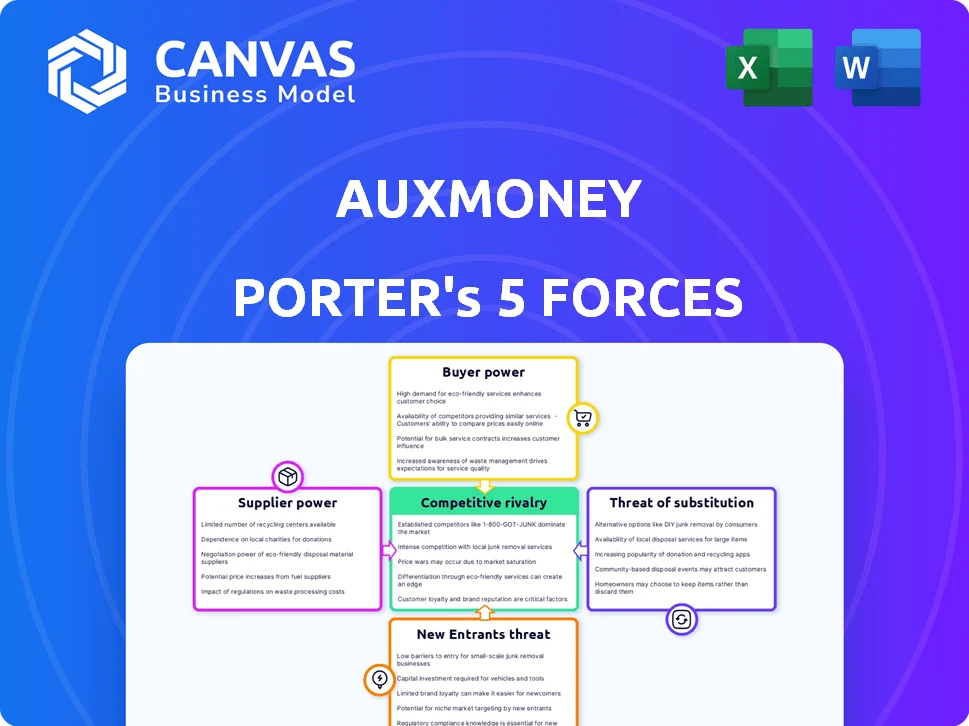
AUXMONEY PORTER'S FIVE FORCES TEMPLATE RESEARCH
What is included in the product
 Detailed Word Document
Evaluates control by suppliers & buyers, influencing pricing & profitability for auxmoney.

 Customizable Excel Spreadsheet
Instantly assess competitive pressure with the force levels, visualized in an easy-to-understand spider chart.
What You See Is What You Get
auxmoney Porter's Five Forces Analysis
This preview showcases the full, in-depth auxmoney Porter's Five Forces analysis.
The document presented here is identical to the one you'll receive immediately after purchase.
We provide the complete analysis, ready for your immediate download and review.
No need to wait, you'll receive this exact, fully-formatted report.
Get instant access to the analysis displayed here after your purchase.

Porter's Five Forces Analysis Template

From Overview to Strategy Blueprint
auxmoney operates in a dynamic lending landscape, facing varied competitive pressures. The threat of new entrants, especially fintechs, is moderate, increasing rivalry. Buyer power is also moderate, as customers have options. Supplier power, mainly from funding sources, is a key factor. Substitute threats, like traditional banks, remain relevant.
This preview is just the beginning. Dive into a complete, consultant-grade breakdown of auxmoney’s industry competitiveness—ready for immediate use.
Suppliers Bargaining Power

Concentration of Funding Sources
Auxmoney's reliance on a concentrated group of financial institutions for funding heightens supplier power. In 2024, a substantial portion of its capital came from a few key investors. This concentration grants these funding sources leverage. They can dictate terms that affect Auxmoney’s operational costs. This potentially impacts its profitability, as seen in similar fintech models.
Dependence on Financial Institutions
Auxmoney heavily relies on financial institutions for funding, a significant portion of its capital. This dependence makes the company vulnerable to shifts in interest rates and lending regulations. For instance, in 2024, rising interest rates impacted the cost of capital for fintechs like Auxmoney. Changes in these areas can directly influence Auxmoney's loan availability and terms.

Availability of Alternative Funding Options
While banks remain key suppliers, alternative funding such as peer-to-peer lending and crowdfunding are gaining traction. In 2024, the global alternative finance market reached an estimated $300 billion, presenting auxmoney with diversified funding possibilities. This diversification could lessen dependence on traditional suppliers, potentially lowering their bargaining power.

Influence of Macroeconomic Factors
Broader economic conditions significantly affect auxmoney's operations. Inflation rates and central bank interest rate decisions influence the cost of capital. These macroeconomic factors indirectly impact auxmoney's lending terms and profitability. For example, in 2024, the European Central Bank has adjusted interest rates to combat inflation.
- Inflation: The Eurozone's inflation rate was around 2.4% in March 2024, influencing borrowing costs.
- Interest Rates: The ECB's key interest rate is a major factor affecting auxmoney's funding expenses.
- Economic Growth: Overall economic health in the Eurozone impacts the demand for loans.
Technology and Data Providers
Auxmoney depends on technology and data providers for credit scoring and risk assessment. These providers are crucial, affecting auxmoney's efficiency. The bargaining power of these suppliers is moderate. In 2024, the global fintech market is projected to be worth over $300 billion.
- Reliance on tech is high, but alternatives exist.
- Provider concentration might increase their power.
- Data quality directly impacts loan performance.
- Costs from these providers affect profitability.
Auxmoney's Supplier Power Dynamics in 2024
Auxmoney faces supplier power challenges from key funders and tech providers. In 2024, a few financial institutions provided a substantial portion of its capital. This concentration gives these suppliers leverage to dictate terms. Dependence on tech suppliers affects operational efficiency and costs.
| Supplier Type | Impact | 2024 Data |
|---|---|---|
| Financial Institutions | High leverage | Interest rates influenced funding costs. |
| Tech Providers | Moderate power | Fintech market valued over $300B. |
| Economic Conditions | Indirect impact | Eurozone inflation around 2.4% in March. |
Customers Bargaining Power

Customer Access to Multiple Platforms
Borrowers at auxmoney have access to many digital lending platforms and banks. This access allows them to compare offers easily. In 2024, the digital lending market grew, with platforms offering competitive rates. This competition gives customers power to select better terms. Banks also compete, increasing customer bargaining power.
Transparency of Loan Terms
Regulatory frameworks like the EU's Consumer Credit Directive enhance loan term transparency. This gives customers crucial information. In 2024, 85% of EU consumers reported understanding their loan terms. This transparency boosts customer bargaining power.

Switching Costs for Borrowers
Switching costs for borrowers on platforms like auxmoney are minimal, allowing them to easily compare and switch lenders. This low barrier to switching enhances customer bargaining power. For instance, in 2024, the average time to apply for a loan online was under 30 minutes, facilitating easy comparisons. This ease enables borrowers to negotiate better terms, increasing their influence. Data from 2024 showed that borrowers frequently switched lenders to secure lower interest rates or more favorable repayment terms.

Availability of Diverse Loan Products
Customers of Auxmoney and its competitors have significant bargaining power due to the wide array of loan products available. This includes personal loans, car loans, and debt consolidation options. The variety allows customers to select the most suitable product, enhancing their ability to negotiate terms. This competitive landscape is evident; for example, in 2024, personal loan rates varied significantly between lenders, reflecting customer choice.
- Auxmoney offers various loan types, increasing customer options.
- Customers can compare products like personal and car loans.
- Debt consolidation loans are another available choice.
- Diverse options empower customers in negotiations.
Customer Feedback and Reviews
Customer feedback significantly shapes lending platforms' reputations. Online reviews allow customers to share experiences, influencing potential borrowers. Positive reviews attract, while negative ones deter, giving customers indirect power. For instance, 85% of consumers trust online reviews as much as personal recommendations. This impacts platforms like auxmoney.
- 85% of consumers trust online reviews as much as personal recommendations.
- Negative reviews can reduce a platform's application volume by up to 20%.
- Platforms with higher ratings generally have lower customer acquisition costs.
- Auxmoney's rating on Trustpilot is a key performance indicator.
Borrowers' Power: Rates, Choice, and Speed
Customers at auxmoney have strong bargaining power due to easy access to many lenders. Digital lending platforms offer competitive rates, increasing customer choice. Regulatory transparency and low switching costs further empower borrowers.
| Factor | Impact | Data (2024) |
|---|---|---|
| Market Competition | High | Average loan rates varied by 4%, reflecting competition. |
| Transparency | High | 85% of consumers understood loan terms. |
| Switching Costs | Low | Application time under 30 minutes. |
Rivalry Among Competitors

Number and Diversity of Competitors
The digital lending space sees fierce competition. Auxmoney faces traditional banks, fintech firms, and P2P platforms. This variety increases competitive pressure. In 2024, the market grew, with more players vying for market share. This boosts rivalry.
Market Growth Rate
The European consumer credit market's growth attracts competitors, intensifying rivalry. In 2024, the market grew, with transactions reaching €1.2 trillion. This expansion fuels competition as companies seek market share. Auxmoney faces heightened pressure from both established and emerging lenders. The market's attractiveness ensures sustained competitive intensity.

Differentiation Strategies
auxmoney distinguishes itself through innovative risk models, tech platforms, and focusing on underserved segments. This differentiation strategy affects competitive rivalry. In 2024, fintechs like auxmoney increased their market share, showing the impact of unique offerings. The more competitors differentiate, the less intense the rivalry becomes.

Market Share and Concentration
Auxmoney competes in the German online consumer credit market, but faces strong rivalry. While auxmoney has a significant presence, traditional banks maintain a larger market share in the broader European consumer credit sector. This competitive landscape is influenced by how market share is distributed among key players. This impacts pricing strategies and innovation.
- In 2024, German consumer credit market size was around €200 billion.
- Traditional banks in Europe control over 60% of the consumer credit market.
- Auxmoney's market share in Germany is approximately 10-15%.
- Concentration of market share among banks and fintechs varies across European countries.
Acquisition and Consolidation Activity
Acquisitions and consolidation significantly impact competitive rivalry in digital lending. auxmoney's purchase of Lender & Spender exemplifies this trend, potentially increasing market concentration. Such moves can reduce the number of competitors, altering pricing dynamics and market share. This leads to a more concentrated market with fewer but larger players.
- auxmoney acquired Lender & Spender in 2023.
- Consolidation can lead to higher market concentration.
- Fewer competitors may influence pricing strategies.
- Market share distribution shifts with acquisitions.
Digital Lending's Fierce Battleground: Auxmoney's Rivals
Competitive rivalry in digital lending is intense, driven by market growth and a diverse range of competitors. Auxmoney faces pressure from traditional banks, fintechs, and P2P platforms, all vying for market share in the expanding European consumer credit market. Differentiation through risk models and tech platforms is crucial, but acquisitions like auxmoney's purchase of Lender & Spender also reshape the competitive landscape.
| Aspect | Details | Data (2024) |
|---|---|---|
| Market Size (Germany) | Consumer Credit Market | €200 billion |
| Market Share (Banks) | European Consumer Credit | >60% |
| Auxmoney Share (Germany) | Online Consumer Credit | 10-15% |
AUXMONEY PORTER'S FIVE FORCES TEMPLATE RESEARCH
What is included in the product
Detailed Word Document
Evaluates control by suppliers & buyers, influencing pricing & profitability for auxmoney.
Customizable Excel Spreadsheet
Instantly assess competitive pressure with the force levels, visualized in an easy-to-understand spider chart.
What You See Is What You Get
auxmoney Porter's Five Forces Analysis
This preview showcases the full, in-depth auxmoney Porter's Five Forces analysis.
The document presented here is identical to the one you'll receive immediately after purchase.
We provide the complete analysis, ready for your immediate download and review.
No need to wait, you'll receive this exact, fully-formatted report.
Get instant access to the analysis displayed here after your purchase.
Porter's Five Forces Analysis Template
From Overview to Strategy Blueprint
auxmoney operates in a dynamic lending landscape, facing varied competitive pressures. The threat of new entrants, especially fintechs, is moderate, increasing rivalry. Buyer power is also moderate, as customers have options. Supplier power, mainly from funding sources, is a key factor. Substitute threats, like traditional banks, remain relevant.
This preview is just the beginning. Dive into a complete, consultant-grade breakdown of auxmoney’s industry competitiveness—ready for immediate use.
Suppliers Bargaining Power
Concentration of Funding Sources
Auxmoney's reliance on a concentrated group of financial institutions for funding heightens supplier power. In 2024, a substantial portion of its capital came from a few key investors. This concentration grants these funding sources leverage. They can dictate terms that affect Auxmoney’s operational costs. This potentially impacts its profitability, as seen in similar fintech models.
Dependence on Financial Institutions
Auxmoney heavily relies on financial institutions for funding, a significant portion of its capital. This dependence makes the company vulnerable to shifts in interest rates and lending regulations. For instance, in 2024, rising interest rates impacted the cost of capital for fintechs like Auxmoney. Changes in these areas can directly influence Auxmoney's loan availability and terms.
Availability of Alternative Funding Options
While banks remain key suppliers, alternative funding such as peer-to-peer lending and crowdfunding are gaining traction. In 2024, the global alternative finance market reached an estimated $300 billion, presenting auxmoney with diversified funding possibilities. This diversification could lessen dependence on traditional suppliers, potentially lowering their bargaining power.
Influence of Macroeconomic Factors
Broader economic conditions significantly affect auxmoney's operations. Inflation rates and central bank interest rate decisions influence the cost of capital. These macroeconomic factors indirectly impact auxmoney's lending terms and profitability. For example, in 2024, the European Central Bank has adjusted interest rates to combat inflation.
- Inflation: The Eurozone's inflation rate was around 2.4% in March 2024, influencing borrowing costs.
- Interest Rates: The ECB's key interest rate is a major factor affecting auxmoney's funding expenses.
- Economic Growth: Overall economic health in the Eurozone impacts the demand for loans.
Technology and Data Providers
Auxmoney depends on technology and data providers for credit scoring and risk assessment. These providers are crucial, affecting auxmoney's efficiency. The bargaining power of these suppliers is moderate. In 2024, the global fintech market is projected to be worth over $300 billion.
- Reliance on tech is high, but alternatives exist.
- Provider concentration might increase their power.
- Data quality directly impacts loan performance.
- Costs from these providers affect profitability.
Auxmoney's Supplier Power Dynamics in 2024
Auxmoney faces supplier power challenges from key funders and tech providers. In 2024, a few financial institutions provided a substantial portion of its capital. This concentration gives these suppliers leverage to dictate terms. Dependence on tech suppliers affects operational efficiency and costs.
| Supplier Type | Impact | 2024 Data |
|---|---|---|
| Financial Institutions | High leverage | Interest rates influenced funding costs. |
| Tech Providers | Moderate power | Fintech market valued over $300B. |
| Economic Conditions | Indirect impact | Eurozone inflation around 2.4% in March. |
Customers Bargaining Power
Customer Access to Multiple Platforms
Borrowers at auxmoney have access to many digital lending platforms and banks. This access allows them to compare offers easily. In 2024, the digital lending market grew, with platforms offering competitive rates. This competition gives customers power to select better terms. Banks also compete, increasing customer bargaining power.
Transparency of Loan Terms
Regulatory frameworks like the EU's Consumer Credit Directive enhance loan term transparency. This gives customers crucial information. In 2024, 85% of EU consumers reported understanding their loan terms. This transparency boosts customer bargaining power.
Switching Costs for Borrowers
Switching costs for borrowers on platforms like auxmoney are minimal, allowing them to easily compare and switch lenders. This low barrier to switching enhances customer bargaining power. For instance, in 2024, the average time to apply for a loan online was under 30 minutes, facilitating easy comparisons. This ease enables borrowers to negotiate better terms, increasing their influence. Data from 2024 showed that borrowers frequently switched lenders to secure lower interest rates or more favorable repayment terms.
Availability of Diverse Loan Products
Customers of Auxmoney and its competitors have significant bargaining power due to the wide array of loan products available. This includes personal loans, car loans, and debt consolidation options. The variety allows customers to select the most suitable product, enhancing their ability to negotiate terms. This competitive landscape is evident; for example, in 2024, personal loan rates varied significantly between lenders, reflecting customer choice.
- Auxmoney offers various loan types, increasing customer options.
- Customers can compare products like personal and car loans.
- Debt consolidation loans are another available choice.
- Diverse options empower customers in negotiations.
Customer Feedback and Reviews
Customer feedback significantly shapes lending platforms' reputations. Online reviews allow customers to share experiences, influencing potential borrowers. Positive reviews attract, while negative ones deter, giving customers indirect power. For instance, 85% of consumers trust online reviews as much as personal recommendations. This impacts platforms like auxmoney.
- 85% of consumers trust online reviews as much as personal recommendations.
- Negative reviews can reduce a platform's application volume by up to 20%.
- Platforms with higher ratings generally have lower customer acquisition costs.
- Auxmoney's rating on Trustpilot is a key performance indicator.
Borrowers' Power: Rates, Choice, and Speed
Customers at auxmoney have strong bargaining power due to easy access to many lenders. Digital lending platforms offer competitive rates, increasing customer choice. Regulatory transparency and low switching costs further empower borrowers.
| Factor | Impact | Data (2024) |
|---|---|---|
| Market Competition | High | Average loan rates varied by 4%, reflecting competition. |
| Transparency | High | 85% of consumers understood loan terms. |
| Switching Costs | Low | Application time under 30 minutes. |
Rivalry Among Competitors
Number and Diversity of Competitors
The digital lending space sees fierce competition. Auxmoney faces traditional banks, fintech firms, and P2P platforms. This variety increases competitive pressure. In 2024, the market grew, with more players vying for market share. This boosts rivalry.
Market Growth Rate
The European consumer credit market's growth attracts competitors, intensifying rivalry. In 2024, the market grew, with transactions reaching €1.2 trillion. This expansion fuels competition as companies seek market share. Auxmoney faces heightened pressure from both established and emerging lenders. The market's attractiveness ensures sustained competitive intensity.
Differentiation Strategies
auxmoney distinguishes itself through innovative risk models, tech platforms, and focusing on underserved segments. This differentiation strategy affects competitive rivalry. In 2024, fintechs like auxmoney increased their market share, showing the impact of unique offerings. The more competitors differentiate, the less intense the rivalry becomes.
Market Share and Concentration
Auxmoney competes in the German online consumer credit market, but faces strong rivalry. While auxmoney has a significant presence, traditional banks maintain a larger market share in the broader European consumer credit sector. This competitive landscape is influenced by how market share is distributed among key players. This impacts pricing strategies and innovation.
- In 2024, German consumer credit market size was around €200 billion.
- Traditional banks in Europe control over 60% of the consumer credit market.
- Auxmoney's market share in Germany is approximately 10-15%.
- Concentration of market share among banks and fintechs varies across European countries.
Acquisition and Consolidation Activity
Acquisitions and consolidation significantly impact competitive rivalry in digital lending. auxmoney's purchase of Lender & Spender exemplifies this trend, potentially increasing market concentration. Such moves can reduce the number of competitors, altering pricing dynamics and market share. This leads to a more concentrated market with fewer but larger players.
- auxmoney acquired Lender & Spender in 2023.
- Consolidation can lead to higher market concentration.
- Fewer competitors may influence pricing strategies.
- Market share distribution shifts with acquisitions.
Digital Lending's Fierce Battleground: Auxmoney's Rivals
Competitive rivalry in digital lending is intense, driven by market growth and a diverse range of competitors. Auxmoney faces pressure from traditional banks, fintechs, and P2P platforms, all vying for market share in the expanding European consumer credit market. Differentiation through risk models and tech platforms is crucial, but acquisitions like auxmoney's purchase of Lender & Spender also reshape the competitive landscape.
| Aspect | Details | Data (2024) |
|---|---|---|
| Market Size (Germany) | Consumer Credit Market | €200 billion |
| Market Share (Banks) | European Consumer Credit | >60% |
| Auxmoney Share (Germany) | Online Consumer Credit | 10-15% |
Product Information
Product Information
Shipping & Returns
Shipping & Returns
Description
What is included in the product
Detailed Word Document
Evaluates control by suppliers & buyers, influencing pricing & profitability for auxmoney.
Customizable Excel Spreadsheet
Instantly assess competitive pressure with the force levels, visualized in an easy-to-understand spider chart.
What You See Is What You Get
auxmoney Porter's Five Forces Analysis
This preview showcases the full, in-depth auxmoney Porter's Five Forces analysis.
The document presented here is identical to the one you'll receive immediately after purchase.
We provide the complete analysis, ready for your immediate download and review.
No need to wait, you'll receive this exact, fully-formatted report.
Get instant access to the analysis displayed here after your purchase.
Porter's Five Forces Analysis Template
From Overview to Strategy Blueprint
auxmoney operates in a dynamic lending landscape, facing varied competitive pressures. The threat of new entrants, especially fintechs, is moderate, increasing rivalry. Buyer power is also moderate, as customers have options. Supplier power, mainly from funding sources, is a key factor. Substitute threats, like traditional banks, remain relevant.
This preview is just the beginning. Dive into a complete, consultant-grade breakdown of auxmoney’s industry competitiveness—ready for immediate use.
Suppliers Bargaining Power
Concentration of Funding Sources
Auxmoney's reliance on a concentrated group of financial institutions for funding heightens supplier power. In 2024, a substantial portion of its capital came from a few key investors. This concentration grants these funding sources leverage. They can dictate terms that affect Auxmoney’s operational costs. This potentially impacts its profitability, as seen in similar fintech models.
Dependence on Financial Institutions
Auxmoney heavily relies on financial institutions for funding, a significant portion of its capital. This dependence makes the company vulnerable to shifts in interest rates and lending regulations. For instance, in 2024, rising interest rates impacted the cost of capital for fintechs like Auxmoney. Changes in these areas can directly influence Auxmoney's loan availability and terms.
Availability of Alternative Funding Options
While banks remain key suppliers, alternative funding such as peer-to-peer lending and crowdfunding are gaining traction. In 2024, the global alternative finance market reached an estimated $300 billion, presenting auxmoney with diversified funding possibilities. This diversification could lessen dependence on traditional suppliers, potentially lowering their bargaining power.
Influence of Macroeconomic Factors
Broader economic conditions significantly affect auxmoney's operations. Inflation rates and central bank interest rate decisions influence the cost of capital. These macroeconomic factors indirectly impact auxmoney's lending terms and profitability. For example, in 2024, the European Central Bank has adjusted interest rates to combat inflation.
- Inflation: The Eurozone's inflation rate was around 2.4% in March 2024, influencing borrowing costs.
- Interest Rates: The ECB's key interest rate is a major factor affecting auxmoney's funding expenses.
- Economic Growth: Overall economic health in the Eurozone impacts the demand for loans.
Technology and Data Providers
Auxmoney depends on technology and data providers for credit scoring and risk assessment. These providers are crucial, affecting auxmoney's efficiency. The bargaining power of these suppliers is moderate. In 2024, the global fintech market is projected to be worth over $300 billion.
- Reliance on tech is high, but alternatives exist.
- Provider concentration might increase their power.
- Data quality directly impacts loan performance.
- Costs from these providers affect profitability.
Auxmoney's Supplier Power Dynamics in 2024
Auxmoney faces supplier power challenges from key funders and tech providers. In 2024, a few financial institutions provided a substantial portion of its capital. This concentration gives these suppliers leverage to dictate terms. Dependence on tech suppliers affects operational efficiency and costs.
| Supplier Type | Impact | 2024 Data |
|---|---|---|
| Financial Institutions | High leverage | Interest rates influenced funding costs. |
| Tech Providers | Moderate power | Fintech market valued over $300B. |
| Economic Conditions | Indirect impact | Eurozone inflation around 2.4% in March. |
Customers Bargaining Power
Customer Access to Multiple Platforms
Borrowers at auxmoney have access to many digital lending platforms and banks. This access allows them to compare offers easily. In 2024, the digital lending market grew, with platforms offering competitive rates. This competition gives customers power to select better terms. Banks also compete, increasing customer bargaining power.
Transparency of Loan Terms
Regulatory frameworks like the EU's Consumer Credit Directive enhance loan term transparency. This gives customers crucial information. In 2024, 85% of EU consumers reported understanding their loan terms. This transparency boosts customer bargaining power.
Switching Costs for Borrowers
Switching costs for borrowers on platforms like auxmoney are minimal, allowing them to easily compare and switch lenders. This low barrier to switching enhances customer bargaining power. For instance, in 2024, the average time to apply for a loan online was under 30 minutes, facilitating easy comparisons. This ease enables borrowers to negotiate better terms, increasing their influence. Data from 2024 showed that borrowers frequently switched lenders to secure lower interest rates or more favorable repayment terms.
Availability of Diverse Loan Products
Customers of Auxmoney and its competitors have significant bargaining power due to the wide array of loan products available. This includes personal loans, car loans, and debt consolidation options. The variety allows customers to select the most suitable product, enhancing their ability to negotiate terms. This competitive landscape is evident; for example, in 2024, personal loan rates varied significantly between lenders, reflecting customer choice.
- Auxmoney offers various loan types, increasing customer options.
- Customers can compare products like personal and car loans.
- Debt consolidation loans are another available choice.
- Diverse options empower customers in negotiations.
Customer Feedback and Reviews
Customer feedback significantly shapes lending platforms' reputations. Online reviews allow customers to share experiences, influencing potential borrowers. Positive reviews attract, while negative ones deter, giving customers indirect power. For instance, 85% of consumers trust online reviews as much as personal recommendations. This impacts platforms like auxmoney.
- 85% of consumers trust online reviews as much as personal recommendations.
- Negative reviews can reduce a platform's application volume by up to 20%.
- Platforms with higher ratings generally have lower customer acquisition costs.
- Auxmoney's rating on Trustpilot is a key performance indicator.
Borrowers' Power: Rates, Choice, and Speed
Customers at auxmoney have strong bargaining power due to easy access to many lenders. Digital lending platforms offer competitive rates, increasing customer choice. Regulatory transparency and low switching costs further empower borrowers.
| Factor | Impact | Data (2024) |
|---|---|---|
| Market Competition | High | Average loan rates varied by 4%, reflecting competition. |
| Transparency | High | 85% of consumers understood loan terms. |
| Switching Costs | Low | Application time under 30 minutes. |
Rivalry Among Competitors
Number and Diversity of Competitors
The digital lending space sees fierce competition. Auxmoney faces traditional banks, fintech firms, and P2P platforms. This variety increases competitive pressure. In 2024, the market grew, with more players vying for market share. This boosts rivalry.
Market Growth Rate
The European consumer credit market's growth attracts competitors, intensifying rivalry. In 2024, the market grew, with transactions reaching €1.2 trillion. This expansion fuels competition as companies seek market share. Auxmoney faces heightened pressure from both established and emerging lenders. The market's attractiveness ensures sustained competitive intensity.
Differentiation Strategies
auxmoney distinguishes itself through innovative risk models, tech platforms, and focusing on underserved segments. This differentiation strategy affects competitive rivalry. In 2024, fintechs like auxmoney increased their market share, showing the impact of unique offerings. The more competitors differentiate, the less intense the rivalry becomes.
Market Share and Concentration
Auxmoney competes in the German online consumer credit market, but faces strong rivalry. While auxmoney has a significant presence, traditional banks maintain a larger market share in the broader European consumer credit sector. This competitive landscape is influenced by how market share is distributed among key players. This impacts pricing strategies and innovation.
- In 2024, German consumer credit market size was around €200 billion.
- Traditional banks in Europe control over 60% of the consumer credit market.
- Auxmoney's market share in Germany is approximately 10-15%.
- Concentration of market share among banks and fintechs varies across European countries.
Acquisition and Consolidation Activity
Acquisitions and consolidation significantly impact competitive rivalry in digital lending. auxmoney's purchase of Lender & Spender exemplifies this trend, potentially increasing market concentration. Such moves can reduce the number of competitors, altering pricing dynamics and market share. This leads to a more concentrated market with fewer but larger players.
- auxmoney acquired Lender & Spender in 2023.
- Consolidation can lead to higher market concentration.
- Fewer competitors may influence pricing strategies.
- Market share distribution shifts with acquisitions.
Digital Lending's Fierce Battleground: Auxmoney's Rivals
Competitive rivalry in digital lending is intense, driven by market growth and a diverse range of competitors. Auxmoney faces pressure from traditional banks, fintechs, and P2P platforms, all vying for market share in the expanding European consumer credit market. Differentiation through risk models and tech platforms is crucial, but acquisitions like auxmoney's purchase of Lender & Spender also reshape the competitive landscape.
| Aspect | Details | Data (2024) |
|---|---|---|
| Market Size (Germany) | Consumer Credit Market | €200 billion |
| Market Share (Banks) | European Consumer Credit | >60% |
| Auxmoney Share (Germany) | Online Consumer Credit | 10-15% |