
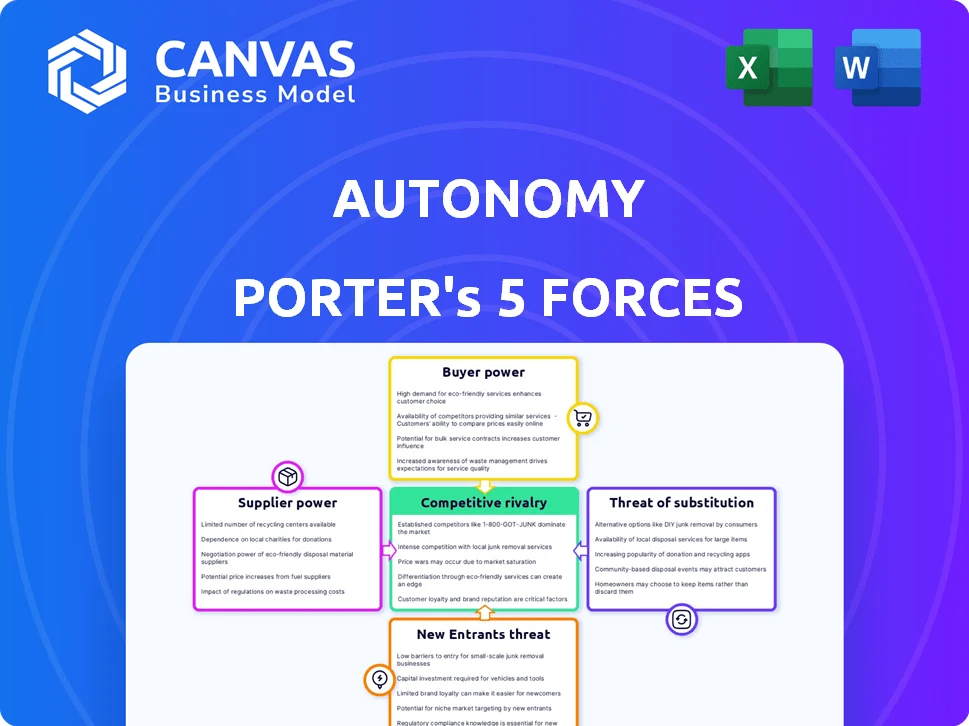
AUTONOMY PORTER'S FIVE FORCES TEMPLATE RESEARCH
What is included in the product
 Detailed Word Document
Analyzes Autonomy's competitive position, evaluating supplier/buyer power and threats within the market.

 Customizable Excel Spreadsheet
Instantly identify threats and opportunities with a dynamic and interactive interface.
Same Document Delivered
Autonomy Porter's Five Forces Analysis
This is an Autonomy Porter's Five Forces analysis preview. It examines industry competition, potential entrants, and more. The document assesses supplier and buyer power dynamically. You get this comprehensive analysis immediately. It's the full, finished document—no revisions needed.

Porter's Five Forces Analysis Template

Don't Miss the Bigger Picture
Autonomy’s industry landscape is shaped by five key forces. Bargaining power of suppliers and buyers significantly impact its margins. The threat of new entrants and substitute products constantly looms. Competitive rivalry among existing players is also intense.
This brief snapshot only scratches the surface. Unlock the full Porter's Five Forces Analysis to explore Autonomy’s competitive dynamics, market pressures, and strategic advantages in detail.
Suppliers Bargaining Power

Limited number of EV manufacturers and battery suppliers
The electric vehicle (EV) market's infancy means fewer major players. This includes EV manufacturers and battery suppliers. For example, in 2024, Tesla and BYD dominated EV sales. Limited suppliers, like CATL, hold significant negotiating power. They can influence pricing and terms.
Increasing demand for EVs and components
The surge in electric vehicle (EV) demand boosts the bargaining power of suppliers. This is mainly due to the rising demand for essential EV components, especially batteries. For instance, in 2024, battery costs made up a significant portion of EV production expenses. This allows suppliers to potentially raise prices and set terms.

Specialized technology and intellectual property
Suppliers with unique tech, like advanced battery makers, wield power. Autonomy, dependent on such suppliers, faces higher costs if these suppliers have strong bargaining power. In 2024, the average cost of an electric vehicle battery pack was around $138 per kWh, influencing Autonomy's production expenses. This can affect Autonomy's margins and its ability to compete effectively.

Potential for vertical integration by suppliers
Some suppliers in the EV market are considering vertical integration, potentially manufacturing more components themselves or acquiring companies in the value chain. This shift might influence pricing dynamics, potentially reducing Autonomy's bargaining power. For example, companies like CATL, a major battery supplier, are expanding their manufacturing capabilities. This could reduce Autonomy's ability to negotiate favorable terms. This trend is evident as the EV market evolves.
- CATL's revenue reached $40 billion in 2023, reflecting its growing market power.
- Vertical integration allows suppliers to control more of the value chain, increasing their influence.
- Autonomy, as a smaller player, could face tougher negotiations with vertically integrated suppliers.
- This trend is expected to continue as EV technology matures.
Existing relationships between manufacturers and suppliers
Established relationships between traditional automotive manufacturers and their long-standing suppliers influence market dynamics. These ties, like the decades-long partnership between Ford and Magna, may create preferred agreements. Such arrangements can impact new EV subscription market entrants. For example, in 2024, Ford's supply chain costs rose by 7% due to supplier price hikes.
- Long-term supplier contracts can stabilize costs for established manufacturers.
- New entrants might face higher initial costs due to a lack of pre-existing relationships.
- Strong supplier relationships can provide a competitive advantage in terms of pricing and supply.
- The EV subscription market could see established manufacturers leveraging their supplier power for cost efficiency.
Supplier Power: A Threat to Autonomy
Supplier bargaining power significantly impacts Autonomy. Limited suppliers, like CATL, control pricing and terms. Vertical integration by suppliers, such as CATL's $40B revenue in 2023, further increases their influence.
| Aspect | Impact on Autonomy | 2024 Data/Example |
|---|---|---|
| Supplier Concentration | Higher costs, reduced margins | Battery costs ~$138/kWh |
| Vertical Integration | Reduced negotiation power | CATL's expanding capabilities |
| Established Relationships | Disadvantage vs. incumbents | Ford's supply chain costs up 7% |
Customers Bargaining Power

Availability of various subscription models and competitors
Customers in the EV market wield considerable power due to the wide array of options available. They can choose from subscription services, traditional ownership, leasing, and rentals. This competitive landscape enables customers to compare prices and terms, putting pressure on providers like Autonomy.
Growing awareness of EV benefits and alternatives
Growing consumer awareness of electric vehicle (EV) benefits and mobility alternatives empowers them to negotiate better deals. In 2024, EV sales increased, yet customer demand for competitive pricing intensified. For example, the average price of a new EV was around $53,000 in late 2024, which influenced consumer choices. This heightened awareness strengthens their ability to influence the market.

Low switching costs for customers
Subscription services often have low switching costs. For instance, in 2024, the churn rate for streaming services averaged around 5-7% monthly, indicating customer mobility. This is because customers can easily cancel and switch to alternatives. This flexibility makes them more price-sensitive and gives them significant bargaining power.

Customer access to information and ease of comparison
The digital age has revolutionized how customers access information, significantly impacting their bargaining power. Online platforms and subscription services offer unparalleled transparency, allowing easy price comparisons and evaluation of terms. This shift empowers customers, enabling them to make more informed decisions and negotiate better deals. According to a 2024 study, 78% of consumers research products online before purchasing, highlighting the importance of this trend.
- Price comparison websites like Google Shopping saw a 20% increase in user traffic in 2024, indicating increased customer comparison behavior.
- The average customer now consults 4-5 sources before making a purchase decision, up from 2-3 in 2020.
- Subscription services face churn rates of up to 30% annually due to customer ease of switching providers based on better deals.
- Customer reviews and ratings now influence 85% of purchasing decisions.
Influence of customer reviews and feedback
In today's digital landscape, customer reviews and feedback hold considerable sway. Online platforms and social media amplify customer voices, shaping a service's reputation. Positive reviews can attract new customers, while negative ones may deter them. This collective influence gives customers a strong bargaining position.
- In 2024, 84% of consumers trust online reviews as much as personal recommendations.
- A single negative review can decrease sales by up to 10%.
- Businesses with higher ratings tend to generate more revenue.
- Around 90% of consumers read reviews before making a purchase.
EV Buyers: Power in Their Hands
Customers have substantial power in the EV market due to diverse choices and easy information access. This allows them to compare and negotiate prices effectively. Subscription models with low switching costs further amplify their bargaining power. Digital platforms and reviews also influence their decisions, strengthening their position.
| Factor | Impact | 2024 Data |
|---|---|---|
| Price Comparison | Increased ability to find the best deals | Price comparison website traffic up 20% |
| Switching Costs | Easily change providers | Subscription churn rates up to 30% annually |
| Reviews | Influences purchase decisions | 84% trust online reviews as much as personal recommendations |
Rivalry Among Competitors

Increasing number of players in the EV subscription market
The EV subscription market is heating up, with more companies vying for customers. This includes EV-focused firms, automakers offering subscriptions, and rental companies joining the fray. Increased competition drives down prices and could reduce profit margins for companies like Autonomy. Data from 2024 shows a 30% rise in new EV subscription services.
Differentiation of services and pricing strategies
EV subscription services compete by offering diverse vehicle models, flexible terms, and bundled services. These strategies, coupled with competitive pricing, intensify rivalry. For example, in 2024, some services offered EVs from various brands, with monthly prices ranging from $500 to $1,500, depending on the model and included features. This range reflects the price differentiation.

Brand recognition and customer loyalty
Established automotive brands entering the subscription market have a significant advantage due to their established brand recognition and customer loyalty. For example, in 2024, Tesla's brand value was estimated at over $60 billion, reflecting strong customer trust. Newer entrants like Autonomy face the challenge of building brand awareness in a competitive market where brand reputation significantly influences customer decisions. This requires substantial investment in marketing and customer relationship management to gain market share.

Pace of technological advancements and innovation
The electric vehicle (EV) sector sees swift tech changes, mainly in battery tech, charging networks, and in-car systems. Businesses must quickly innovate to compete, heightening rivalry as they vie for the newest features and performance. For example, Tesla's Supercharger network and battery tech constantly evolve, setting the pace. This rapid progress drives intense competition among automakers.
- Battery tech improvements have increased EV range by roughly 10-15% annually in recent years.
- Investments in EV technology reached $150 billion globally in 2024.
- The number of EV charging stations grew by about 30% from 2023 to 2024.
Market growth rate and potential
The EV subscription market is set for substantial growth, drawing in more competitors. This expansion intensifies rivalry as companies battle for market share. The global EV market is expected to reach $802.8 billion by 2027. Increased competition could lead to lower prices and more innovative offerings. This makes it crucial for companies to differentiate themselves.
- Projected market growth fuels competition.
- More competitors mean higher rivalry.
- Companies must differentiate to succeed.
- EV market size is expected to be $802.8 billion by 2027.
EV Subscription Wars: Fierce Competition Ahead!
Competitive rivalry in the EV subscription market is high due to many players and rapid tech changes. Increased competition impacts pricing and profit margins. Established brands have an advantage, while new entrants face challenges. The global EV market is projected to reach $802.8 billion by 2027.
| Factor | Impact | Data (2024) |
|---|---|---|
| Market Growth | Attracts more competitors. | 30% rise in new EV subscription services |
| Tech Advancements | Requires rapid innovation. | $150B invested in EV tech |
| Brand Recognition | Influences customer decisions. | Tesla's brand value: over $60B |
AUTONOMY PORTER'S FIVE FORCES TEMPLATE RESEARCH
What is included in the product
Detailed Word Document
Analyzes Autonomy's competitive position, evaluating supplier/buyer power and threats within the market.
Customizable Excel Spreadsheet
Instantly identify threats and opportunities with a dynamic and interactive interface.
Same Document Delivered
Autonomy Porter's Five Forces Analysis
This is an Autonomy Porter's Five Forces analysis preview. It examines industry competition, potential entrants, and more. The document assesses supplier and buyer power dynamically. You get this comprehensive analysis immediately. It's the full, finished document—no revisions needed.
Porter's Five Forces Analysis Template
Don't Miss the Bigger Picture
Autonomy’s industry landscape is shaped by five key forces. Bargaining power of suppliers and buyers significantly impact its margins. The threat of new entrants and substitute products constantly looms. Competitive rivalry among existing players is also intense.
This brief snapshot only scratches the surface. Unlock the full Porter's Five Forces Analysis to explore Autonomy’s competitive dynamics, market pressures, and strategic advantages in detail.
Suppliers Bargaining Power
Limited number of EV manufacturers and battery suppliers
The electric vehicle (EV) market's infancy means fewer major players. This includes EV manufacturers and battery suppliers. For example, in 2024, Tesla and BYD dominated EV sales. Limited suppliers, like CATL, hold significant negotiating power. They can influence pricing and terms.
Increasing demand for EVs and components
The surge in electric vehicle (EV) demand boosts the bargaining power of suppliers. This is mainly due to the rising demand for essential EV components, especially batteries. For instance, in 2024, battery costs made up a significant portion of EV production expenses. This allows suppliers to potentially raise prices and set terms.
Specialized technology and intellectual property
Suppliers with unique tech, like advanced battery makers, wield power. Autonomy, dependent on such suppliers, faces higher costs if these suppliers have strong bargaining power. In 2024, the average cost of an electric vehicle battery pack was around $138 per kWh, influencing Autonomy's production expenses. This can affect Autonomy's margins and its ability to compete effectively.
Potential for vertical integration by suppliers
Some suppliers in the EV market are considering vertical integration, potentially manufacturing more components themselves or acquiring companies in the value chain. This shift might influence pricing dynamics, potentially reducing Autonomy's bargaining power. For example, companies like CATL, a major battery supplier, are expanding their manufacturing capabilities. This could reduce Autonomy's ability to negotiate favorable terms. This trend is evident as the EV market evolves.
- CATL's revenue reached $40 billion in 2023, reflecting its growing market power.
- Vertical integration allows suppliers to control more of the value chain, increasing their influence.
- Autonomy, as a smaller player, could face tougher negotiations with vertically integrated suppliers.
- This trend is expected to continue as EV technology matures.
Existing relationships between manufacturers and suppliers
Established relationships between traditional automotive manufacturers and their long-standing suppliers influence market dynamics. These ties, like the decades-long partnership between Ford and Magna, may create preferred agreements. Such arrangements can impact new EV subscription market entrants. For example, in 2024, Ford's supply chain costs rose by 7% due to supplier price hikes.
- Long-term supplier contracts can stabilize costs for established manufacturers.
- New entrants might face higher initial costs due to a lack of pre-existing relationships.
- Strong supplier relationships can provide a competitive advantage in terms of pricing and supply.
- The EV subscription market could see established manufacturers leveraging their supplier power for cost efficiency.
Supplier Power: A Threat to Autonomy
Supplier bargaining power significantly impacts Autonomy. Limited suppliers, like CATL, control pricing and terms. Vertical integration by suppliers, such as CATL's $40B revenue in 2023, further increases their influence.
| Aspect | Impact on Autonomy | 2024 Data/Example |
|---|---|---|
| Supplier Concentration | Higher costs, reduced margins | Battery costs ~$138/kWh |
| Vertical Integration | Reduced negotiation power | CATL's expanding capabilities |
| Established Relationships | Disadvantage vs. incumbents | Ford's supply chain costs up 7% |
Customers Bargaining Power
Availability of various subscription models and competitors
Customers in the EV market wield considerable power due to the wide array of options available. They can choose from subscription services, traditional ownership, leasing, and rentals. This competitive landscape enables customers to compare prices and terms, putting pressure on providers like Autonomy.
Growing awareness of EV benefits and alternatives
Growing consumer awareness of electric vehicle (EV) benefits and mobility alternatives empowers them to negotiate better deals. In 2024, EV sales increased, yet customer demand for competitive pricing intensified. For example, the average price of a new EV was around $53,000 in late 2024, which influenced consumer choices. This heightened awareness strengthens their ability to influence the market.
Low switching costs for customers
Subscription services often have low switching costs. For instance, in 2024, the churn rate for streaming services averaged around 5-7% monthly, indicating customer mobility. This is because customers can easily cancel and switch to alternatives. This flexibility makes them more price-sensitive and gives them significant bargaining power.
Customer access to information and ease of comparison
The digital age has revolutionized how customers access information, significantly impacting their bargaining power. Online platforms and subscription services offer unparalleled transparency, allowing easy price comparisons and evaluation of terms. This shift empowers customers, enabling them to make more informed decisions and negotiate better deals. According to a 2024 study, 78% of consumers research products online before purchasing, highlighting the importance of this trend.
- Price comparison websites like Google Shopping saw a 20% increase in user traffic in 2024, indicating increased customer comparison behavior.
- The average customer now consults 4-5 sources before making a purchase decision, up from 2-3 in 2020.
- Subscription services face churn rates of up to 30% annually due to customer ease of switching providers based on better deals.
- Customer reviews and ratings now influence 85% of purchasing decisions.
Influence of customer reviews and feedback
In today's digital landscape, customer reviews and feedback hold considerable sway. Online platforms and social media amplify customer voices, shaping a service's reputation. Positive reviews can attract new customers, while negative ones may deter them. This collective influence gives customers a strong bargaining position.
- In 2024, 84% of consumers trust online reviews as much as personal recommendations.
- A single negative review can decrease sales by up to 10%.
- Businesses with higher ratings tend to generate more revenue.
- Around 90% of consumers read reviews before making a purchase.
EV Buyers: Power in Their Hands
Customers have substantial power in the EV market due to diverse choices and easy information access. This allows them to compare and negotiate prices effectively. Subscription models with low switching costs further amplify their bargaining power. Digital platforms and reviews also influence their decisions, strengthening their position.
| Factor | Impact | 2024 Data |
|---|---|---|
| Price Comparison | Increased ability to find the best deals | Price comparison website traffic up 20% |
| Switching Costs | Easily change providers | Subscription churn rates up to 30% annually |
| Reviews | Influences purchase decisions | 84% trust online reviews as much as personal recommendations |
Rivalry Among Competitors
Increasing number of players in the EV subscription market
The EV subscription market is heating up, with more companies vying for customers. This includes EV-focused firms, automakers offering subscriptions, and rental companies joining the fray. Increased competition drives down prices and could reduce profit margins for companies like Autonomy. Data from 2024 shows a 30% rise in new EV subscription services.
Differentiation of services and pricing strategies
EV subscription services compete by offering diverse vehicle models, flexible terms, and bundled services. These strategies, coupled with competitive pricing, intensify rivalry. For example, in 2024, some services offered EVs from various brands, with monthly prices ranging from $500 to $1,500, depending on the model and included features. This range reflects the price differentiation.
Brand recognition and customer loyalty
Established automotive brands entering the subscription market have a significant advantage due to their established brand recognition and customer loyalty. For example, in 2024, Tesla's brand value was estimated at over $60 billion, reflecting strong customer trust. Newer entrants like Autonomy face the challenge of building brand awareness in a competitive market where brand reputation significantly influences customer decisions. This requires substantial investment in marketing and customer relationship management to gain market share.
Pace of technological advancements and innovation
The electric vehicle (EV) sector sees swift tech changes, mainly in battery tech, charging networks, and in-car systems. Businesses must quickly innovate to compete, heightening rivalry as they vie for the newest features and performance. For example, Tesla's Supercharger network and battery tech constantly evolve, setting the pace. This rapid progress drives intense competition among automakers.
- Battery tech improvements have increased EV range by roughly 10-15% annually in recent years.
- Investments in EV technology reached $150 billion globally in 2024.
- The number of EV charging stations grew by about 30% from 2023 to 2024.
Market growth rate and potential
The EV subscription market is set for substantial growth, drawing in more competitors. This expansion intensifies rivalry as companies battle for market share. The global EV market is expected to reach $802.8 billion by 2027. Increased competition could lead to lower prices and more innovative offerings. This makes it crucial for companies to differentiate themselves.
- Projected market growth fuels competition.
- More competitors mean higher rivalry.
- Companies must differentiate to succeed.
- EV market size is expected to be $802.8 billion by 2027.
EV Subscription Wars: Fierce Competition Ahead!
Competitive rivalry in the EV subscription market is high due to many players and rapid tech changes. Increased competition impacts pricing and profit margins. Established brands have an advantage, while new entrants face challenges. The global EV market is projected to reach $802.8 billion by 2027.
| Factor | Impact | Data (2024) |
|---|---|---|
| Market Growth | Attracts more competitors. | 30% rise in new EV subscription services |
| Tech Advancements | Requires rapid innovation. | $150B invested in EV tech |
| Brand Recognition | Influences customer decisions. | Tesla's brand value: over $60B |
Product Information
Product Information
Shipping & Returns
Shipping & Returns
Description
What is included in the product
Detailed Word Document
Analyzes Autonomy's competitive position, evaluating supplier/buyer power and threats within the market.
Customizable Excel Spreadsheet
Instantly identify threats and opportunities with a dynamic and interactive interface.
Same Document Delivered
Autonomy Porter's Five Forces Analysis
This is an Autonomy Porter's Five Forces analysis preview. It examines industry competition, potential entrants, and more. The document assesses supplier and buyer power dynamically. You get this comprehensive analysis immediately. It's the full, finished document—no revisions needed.
Porter's Five Forces Analysis Template
Don't Miss the Bigger Picture
Autonomy’s industry landscape is shaped by five key forces. Bargaining power of suppliers and buyers significantly impact its margins. The threat of new entrants and substitute products constantly looms. Competitive rivalry among existing players is also intense.
This brief snapshot only scratches the surface. Unlock the full Porter's Five Forces Analysis to explore Autonomy’s competitive dynamics, market pressures, and strategic advantages in detail.
Suppliers Bargaining Power
Limited number of EV manufacturers and battery suppliers
The electric vehicle (EV) market's infancy means fewer major players. This includes EV manufacturers and battery suppliers. For example, in 2024, Tesla and BYD dominated EV sales. Limited suppliers, like CATL, hold significant negotiating power. They can influence pricing and terms.
Increasing demand for EVs and components
The surge in electric vehicle (EV) demand boosts the bargaining power of suppliers. This is mainly due to the rising demand for essential EV components, especially batteries. For instance, in 2024, battery costs made up a significant portion of EV production expenses. This allows suppliers to potentially raise prices and set terms.
Specialized technology and intellectual property
Suppliers with unique tech, like advanced battery makers, wield power. Autonomy, dependent on such suppliers, faces higher costs if these suppliers have strong bargaining power. In 2024, the average cost of an electric vehicle battery pack was around $138 per kWh, influencing Autonomy's production expenses. This can affect Autonomy's margins and its ability to compete effectively.
Potential for vertical integration by suppliers
Some suppliers in the EV market are considering vertical integration, potentially manufacturing more components themselves or acquiring companies in the value chain. This shift might influence pricing dynamics, potentially reducing Autonomy's bargaining power. For example, companies like CATL, a major battery supplier, are expanding their manufacturing capabilities. This could reduce Autonomy's ability to negotiate favorable terms. This trend is evident as the EV market evolves.
- CATL's revenue reached $40 billion in 2023, reflecting its growing market power.
- Vertical integration allows suppliers to control more of the value chain, increasing their influence.
- Autonomy, as a smaller player, could face tougher negotiations with vertically integrated suppliers.
- This trend is expected to continue as EV technology matures.
Existing relationships between manufacturers and suppliers
Established relationships between traditional automotive manufacturers and their long-standing suppliers influence market dynamics. These ties, like the decades-long partnership between Ford and Magna, may create preferred agreements. Such arrangements can impact new EV subscription market entrants. For example, in 2024, Ford's supply chain costs rose by 7% due to supplier price hikes.
- Long-term supplier contracts can stabilize costs for established manufacturers.
- New entrants might face higher initial costs due to a lack of pre-existing relationships.
- Strong supplier relationships can provide a competitive advantage in terms of pricing and supply.
- The EV subscription market could see established manufacturers leveraging their supplier power for cost efficiency.
Supplier Power: A Threat to Autonomy
Supplier bargaining power significantly impacts Autonomy. Limited suppliers, like CATL, control pricing and terms. Vertical integration by suppliers, such as CATL's $40B revenue in 2023, further increases their influence.
| Aspect | Impact on Autonomy | 2024 Data/Example |
|---|---|---|
| Supplier Concentration | Higher costs, reduced margins | Battery costs ~$138/kWh |
| Vertical Integration | Reduced negotiation power | CATL's expanding capabilities |
| Established Relationships | Disadvantage vs. incumbents | Ford's supply chain costs up 7% |
Customers Bargaining Power
Availability of various subscription models and competitors
Customers in the EV market wield considerable power due to the wide array of options available. They can choose from subscription services, traditional ownership, leasing, and rentals. This competitive landscape enables customers to compare prices and terms, putting pressure on providers like Autonomy.
Growing awareness of EV benefits and alternatives
Growing consumer awareness of electric vehicle (EV) benefits and mobility alternatives empowers them to negotiate better deals. In 2024, EV sales increased, yet customer demand for competitive pricing intensified. For example, the average price of a new EV was around $53,000 in late 2024, which influenced consumer choices. This heightened awareness strengthens their ability to influence the market.
Low switching costs for customers
Subscription services often have low switching costs. For instance, in 2024, the churn rate for streaming services averaged around 5-7% monthly, indicating customer mobility. This is because customers can easily cancel and switch to alternatives. This flexibility makes them more price-sensitive and gives them significant bargaining power.
Customer access to information and ease of comparison
The digital age has revolutionized how customers access information, significantly impacting their bargaining power. Online platforms and subscription services offer unparalleled transparency, allowing easy price comparisons and evaluation of terms. This shift empowers customers, enabling them to make more informed decisions and negotiate better deals. According to a 2024 study, 78% of consumers research products online before purchasing, highlighting the importance of this trend.
- Price comparison websites like Google Shopping saw a 20% increase in user traffic in 2024, indicating increased customer comparison behavior.
- The average customer now consults 4-5 sources before making a purchase decision, up from 2-3 in 2020.
- Subscription services face churn rates of up to 30% annually due to customer ease of switching providers based on better deals.
- Customer reviews and ratings now influence 85% of purchasing decisions.
Influence of customer reviews and feedback
In today's digital landscape, customer reviews and feedback hold considerable sway. Online platforms and social media amplify customer voices, shaping a service's reputation. Positive reviews can attract new customers, while negative ones may deter them. This collective influence gives customers a strong bargaining position.
- In 2024, 84% of consumers trust online reviews as much as personal recommendations.
- A single negative review can decrease sales by up to 10%.
- Businesses with higher ratings tend to generate more revenue.
- Around 90% of consumers read reviews before making a purchase.
EV Buyers: Power in Their Hands
Customers have substantial power in the EV market due to diverse choices and easy information access. This allows them to compare and negotiate prices effectively. Subscription models with low switching costs further amplify their bargaining power. Digital platforms and reviews also influence their decisions, strengthening their position.
| Factor | Impact | 2024 Data |
|---|---|---|
| Price Comparison | Increased ability to find the best deals | Price comparison website traffic up 20% |
| Switching Costs | Easily change providers | Subscription churn rates up to 30% annually |
| Reviews | Influences purchase decisions | 84% trust online reviews as much as personal recommendations |
Rivalry Among Competitors
Increasing number of players in the EV subscription market
The EV subscription market is heating up, with more companies vying for customers. This includes EV-focused firms, automakers offering subscriptions, and rental companies joining the fray. Increased competition drives down prices and could reduce profit margins for companies like Autonomy. Data from 2024 shows a 30% rise in new EV subscription services.
Differentiation of services and pricing strategies
EV subscription services compete by offering diverse vehicle models, flexible terms, and bundled services. These strategies, coupled with competitive pricing, intensify rivalry. For example, in 2024, some services offered EVs from various brands, with monthly prices ranging from $500 to $1,500, depending on the model and included features. This range reflects the price differentiation.
Brand recognition and customer loyalty
Established automotive brands entering the subscription market have a significant advantage due to their established brand recognition and customer loyalty. For example, in 2024, Tesla's brand value was estimated at over $60 billion, reflecting strong customer trust. Newer entrants like Autonomy face the challenge of building brand awareness in a competitive market where brand reputation significantly influences customer decisions. This requires substantial investment in marketing and customer relationship management to gain market share.
Pace of technological advancements and innovation
The electric vehicle (EV) sector sees swift tech changes, mainly in battery tech, charging networks, and in-car systems. Businesses must quickly innovate to compete, heightening rivalry as they vie for the newest features and performance. For example, Tesla's Supercharger network and battery tech constantly evolve, setting the pace. This rapid progress drives intense competition among automakers.
- Battery tech improvements have increased EV range by roughly 10-15% annually in recent years.
- Investments in EV technology reached $150 billion globally in 2024.
- The number of EV charging stations grew by about 30% from 2023 to 2024.
Market growth rate and potential
The EV subscription market is set for substantial growth, drawing in more competitors. This expansion intensifies rivalry as companies battle for market share. The global EV market is expected to reach $802.8 billion by 2027. Increased competition could lead to lower prices and more innovative offerings. This makes it crucial for companies to differentiate themselves.
- Projected market growth fuels competition.
- More competitors mean higher rivalry.
- Companies must differentiate to succeed.
- EV market size is expected to be $802.8 billion by 2027.
EV Subscription Wars: Fierce Competition Ahead!
Competitive rivalry in the EV subscription market is high due to many players and rapid tech changes. Increased competition impacts pricing and profit margins. Established brands have an advantage, while new entrants face challenges. The global EV market is projected to reach $802.8 billion by 2027.
| Factor | Impact | Data (2024) |
|---|---|---|
| Market Growth | Attracts more competitors. | 30% rise in new EV subscription services |
| Tech Advancements | Requires rapid innovation. | $150B invested in EV tech |
| Brand Recognition | Influences customer decisions. | Tesla's brand value: over $60B |


