
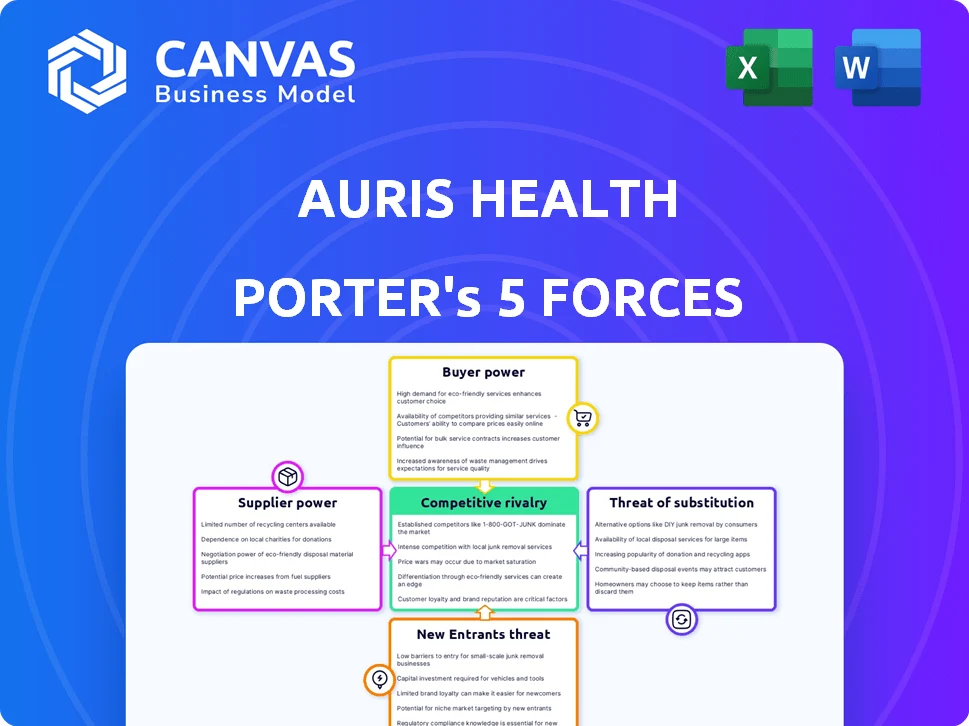
AURIS HEALTH PORTER'S FIVE FORCES TEMPLATE RESEARCH
What is included in the product
 Detailed Word Document
Tailored exclusively for Auris Health, analyzing its position within its competitive landscape.

 Customizable Excel Spreadsheet
Swap in your own data, labels, and notes to reflect current business conditions.
Same Document Delivered
Auris Health Porter's Five Forces Analysis
The document you're previewing is the Auris Health Porter's Five Forces Analysis. This provides a comprehensive analysis of the competitive landscape. It evaluates threats like rivalry, suppliers, and new entrants. The insights are presented clearly and concisely. After purchase, you receive this exact, fully-formatted document.

Porter's Five Forces Analysis Template

From Overview to Strategy Blueprint
Auris Health faces moderate rivalry in the surgical robotics market, with established players and rising competition. Supplier power is a key factor, particularly for specialized components. Buyer power is present, influenced by healthcare provider negotiations. The threat of new entrants is significant due to high R&D costs. Substitute products, like conventional surgery, pose a moderate threat.
Our full Porter's Five Forces report goes deeper—offering a data-driven framework to understand Auris Health's real business risks and market opportunities.
Suppliers Bargaining Power

Limited number of specialized robotics component manufacturers
The robotics component market, vital for Auris Health, is dominated by a few specialized manufacturers. This concentration grants suppliers substantial bargaining power, allowing them to dictate prices. Auris Health faces high switching costs due to specialized components. In 2024, the medical robotics market was valued at over $7.4 billion.
High switching costs for alternative suppliers
Auris Health's robotic systems' specialized parts and tech create high switching costs. These costs include redesign, testing, and regulatory hurdles. Switching suppliers could involve significant retraining expenses, boosting supplier power. In 2024, the medical robotics market was valued at approximately $7.4 billion.

Strong supplier relationships due to technical expertise
Auris Health, with its medical robotics, likely relies on suppliers for specialized components and technologies. Strong supplier relationships are vital, especially when suppliers hold unique technical expertise or intellectual property. This dependency can empower suppliers, potentially increasing their bargaining power. For instance, if a key supplier holds a patent on a crucial component, Auris Health's options are limited.

Potential for vertical integration by suppliers
Suppliers of crucial components or cutting-edge technologies could vertically integrate, possibly competing directly with Auris Health or gaining more control. This strategy is increasingly seen in the robotics sector. For instance, Intuitive Surgical, a key player, has integrated many of its supply chain functions. As of 2024, the medical robotics market is valued at over $9 billion, with significant supplier influence. This trend impacts Auris Health's bargaining power.
- Intuitive Surgical's integration strategy serves as a pertinent case study.
- The medical robotics market, valued at over $9B in 2024, gives suppliers leverage.
- Auris Health must monitor supplier integration moves closely.
Reliance on key suppliers for critical components
Auris Health's operations hinge on dependable, high-quality components from key suppliers, essential for both manufacturing and innovation. With a limited number of suppliers for these critical parts, those suppliers wield significant bargaining power, potentially dictating terms. This dependence can elevate production costs and disrupt operations if supply chains are unstable. For instance, in 2024, many medical device companies faced increased component costs due to supply chain disruptions.
- Limited Supplier Base: Auris Health may be vulnerable if it relies on a small number of suppliers.
- Specialized Components: The need for unique parts increases supplier power.
- Impact on Costs: Supplier power can directly influence production expenses.
- Supply Chain Risks: Dependence on suppliers can lead to operational vulnerabilities.
Robotics Component Suppliers: A Power Play
Auris Health's reliance on specialized suppliers for robotics components gives suppliers strong bargaining power. Switching costs, including redesign and regulatory hurdles, further bolster supplier influence. In 2024, the medical robotics market was valued at over $9 billion, underscoring supplier leverage.
| Aspect | Impact on Auris Health | Data (2024) |
|---|---|---|
| Supplier Concentration | High supplier bargaining power | Medical robotics market over $9B |
| Switching Costs | Increases supplier leverage | Redesign, testing, regulatory costs |
| Market Dynamics | Supplier influence on pricing | Supply chain disruptions affect costs |
Customers Bargaining Power

Healthcare providers' need for advanced technology
Hospitals and surgical centers, Auris Health's main clients, rely on advanced robotic systems for modern treatments and better patient care. This need somewhat limits their bargaining power, particularly if Auris Health's tech offers unique advantages. In 2024, the surgical robotics market is valued at approximately $6.5 billion, indicating the demand for such technologies. Auris Health, now part of Johnson & Johnson, benefits from this demand. This situation affects how hospitals negotiate pricing and services.
Influence of group purchasing organizations (GPOs)
Healthcare providers' membership in GPOs significantly impacts Auris Health. GPOs leverage collective buying to secure favorable prices. This increases customer bargaining power, especially for smaller hospitals. In 2024, GPOs managed over $300 billion in healthcare spending.

Availability of alternative robotic systems
Auris Health faces customer bargaining power due to alternative robotic systems. Companies like Intuitive Surgical, with its da Vinci system, compete in robotic surgery. The availability of such alternatives, even for different procedures, gives hospitals leverage. This can impact pricing strategies; in 2024, the global surgical robotics market was valued at over $6 billion.

Customer focus on patient outcomes and cost-effectiveness
Healthcare providers are increasingly focused on patient outcomes and cost-effectiveness, influencing their decisions regarding medical technologies. Auris Health's systems will be scrutinized based on these factors, giving providers considerable leverage. This pressure to demonstrate value enables providers to negotiate prices. For example, in 2024, hospitals faced a 4.5% increase in supply costs, intensifying the need for cost-efficient solutions.
- Hospitals are under constant pressure to improve patient outcomes.
- Cost-efficiency is a key criterion for evaluating Auris Health's systems.
- Providers can demand evidence of value to justify adoption.
- Negotiating prices is a strategy based on perceived benefits.
Long-term contracts and service agreements
Auris Health, like many medical device companies, likely utilizes long-term contracts for its robotic systems, encompassing sales, maintenance, and support. These agreements often establish switching costs, as hospitals become reliant on the technology and associated services. However, these contracts also offer customers some bargaining power in negotiating initial terms and service level agreements. In 2024, the average contract length for medical device maintenance services was around 3-5 years. This gives customers the ability to seek favorable terms.
- Contractual Obligations
- Switching Costs
- Service Level Agreements
- Negotiation Leverage
Hospital Bargaining Power: Tech, GPOs, and Costs
Hospitals' bargaining power varies, influenced by Auris Health's tech uniqueness and market competition. GPOs enhance this power through group purchasing, affecting pricing. Alternative robotic systems and the need for cost-effectiveness further empower customers. In 2024, the surgical robotics market was over $6 billion.
| Factor | Impact on Bargaining Power | 2024 Data/Example |
|---|---|---|
| Technology Uniqueness | Decreases Power | Auris Health's market share |
| GPO Membership | Increases Power | GPOs managed $300B+ in healthcare spending |
| Alternative Systems | Increases Power | da Vinci system by Intuitive Surgical |
| Cost-Effectiveness Focus | Increases Power | Hospitals face 4.5% supply cost increase |
Rivalry Among Competitors

Presence of established robotic surgery companies
The robotic surgery market sees fierce competition from established firms like Intuitive Surgical. These giants boast considerable resources and strong brand recognition, intensifying rivalry. Intuitive Surgical held about 70% of the global market share in 2024. This dominance creates a challenging environment for new entrants.
Increasing number of competitors in the medical robotics space
The medical robotics market sees intensifying competition. Beyond major players, many firms are developing robotic systems. This increases rivalry, impacting market dynamics. In 2024, the global medical robotics market was valued at $9.3 billion, and is expected to reach $16.7 billion by 2029, with a CAGR of 12.3%.

High stakes in innovation and technological advancement
The medical robotics sector sees intense competition driven by quick tech changes. Firms must constantly innovate and fund R&D to stay ahead. For example, Intuitive Surgical spent $400 million on R&D in 2024. This fuels a dynamic and highly competitive landscape.

Competition based on features, precision, and procedural applications
Auris Health faces intense competition, focusing on robotic platform features like precision and procedural applications. This rivalry spurs continuous tech enhancements and application expansions to outpace competitors. The surgical robotics market is expected to reach $12.9 billion by 2024, demonstrating significant growth. This competitive pressure drives innovation, with companies vying for market share.
- Market size: $12.9 billion in 2024.
- Focus: Precision and procedural applications.
- Impact: Constant tech advancement.
- Goal: Gain competitive edge.
Marketing and sales efforts to gain market share
Intense marketing and sales are crucial in the medical robotics sector, as companies vie for market share by showcasing their systems to healthcare providers. This aggressive pursuit heightens competition, especially in areas like surgical robotics, where convincing hospitals to adopt new technologies is key. For instance, in 2024, Intuitive Surgical, a major player, spent approximately $700 million on selling, general, and administrative expenses, reflecting the high costs associated with these efforts. This rivalry is further fueled by the need to educate and train medical professionals.
- Intuitive Surgical's SG&A expenses in 2024 were approximately $700 million.
- Marketing aims to demonstrate the value of robotic systems to healthcare providers.
- Competition is intense, particularly in the surgical robotics segment.
- Training and education of medical professionals are essential for market penetration.
Robotic Surgery Market: A Competitive Landscape
Auris Health faces tough competition in the robotic surgery market, with rivals like Intuitive Surgical. This high rivalry pushes companies to innovate, particularly in precision and procedural applications. The surgical robotics market, valued at $12.9 billion in 2024, sees intense marketing and sales efforts to gain market share. This competitive environment drives continuous tech advancements and application expansions.
| Aspect | Details | 2024 Data |
|---|---|---|
| Market Size | Surgical Robotics Market | $12.9 billion |
| Key Competitor | Intuitive Surgical | 70% market share |
| R&D Spending (example) | Intuitive Surgical | $400 million |
AURIS HEALTH PORTER'S FIVE FORCES TEMPLATE RESEARCH
What is included in the product
Detailed Word Document
Tailored exclusively for Auris Health, analyzing its position within its competitive landscape.
Customizable Excel Spreadsheet
Swap in your own data, labels, and notes to reflect current business conditions.
Same Document Delivered
Auris Health Porter's Five Forces Analysis
The document you're previewing is the Auris Health Porter's Five Forces Analysis. This provides a comprehensive analysis of the competitive landscape. It evaluates threats like rivalry, suppliers, and new entrants. The insights are presented clearly and concisely. After purchase, you receive this exact, fully-formatted document.
Porter's Five Forces Analysis Template
From Overview to Strategy Blueprint
Auris Health faces moderate rivalry in the surgical robotics market, with established players and rising competition. Supplier power is a key factor, particularly for specialized components. Buyer power is present, influenced by healthcare provider negotiations. The threat of new entrants is significant due to high R&D costs. Substitute products, like conventional surgery, pose a moderate threat.
Our full Porter's Five Forces report goes deeper—offering a data-driven framework to understand Auris Health's real business risks and market opportunities.
Suppliers Bargaining Power
Limited number of specialized robotics component manufacturers
The robotics component market, vital for Auris Health, is dominated by a few specialized manufacturers. This concentration grants suppliers substantial bargaining power, allowing them to dictate prices. Auris Health faces high switching costs due to specialized components. In 2024, the medical robotics market was valued at over $7.4 billion.
High switching costs for alternative suppliers
Auris Health's robotic systems' specialized parts and tech create high switching costs. These costs include redesign, testing, and regulatory hurdles. Switching suppliers could involve significant retraining expenses, boosting supplier power. In 2024, the medical robotics market was valued at approximately $7.4 billion.
Strong supplier relationships due to technical expertise
Auris Health, with its medical robotics, likely relies on suppliers for specialized components and technologies. Strong supplier relationships are vital, especially when suppliers hold unique technical expertise or intellectual property. This dependency can empower suppliers, potentially increasing their bargaining power. For instance, if a key supplier holds a patent on a crucial component, Auris Health's options are limited.
Potential for vertical integration by suppliers
Suppliers of crucial components or cutting-edge technologies could vertically integrate, possibly competing directly with Auris Health or gaining more control. This strategy is increasingly seen in the robotics sector. For instance, Intuitive Surgical, a key player, has integrated many of its supply chain functions. As of 2024, the medical robotics market is valued at over $9 billion, with significant supplier influence. This trend impacts Auris Health's bargaining power.
- Intuitive Surgical's integration strategy serves as a pertinent case study.
- The medical robotics market, valued at over $9B in 2024, gives suppliers leverage.
- Auris Health must monitor supplier integration moves closely.
Reliance on key suppliers for critical components
Auris Health's operations hinge on dependable, high-quality components from key suppliers, essential for both manufacturing and innovation. With a limited number of suppliers for these critical parts, those suppliers wield significant bargaining power, potentially dictating terms. This dependence can elevate production costs and disrupt operations if supply chains are unstable. For instance, in 2024, many medical device companies faced increased component costs due to supply chain disruptions.
- Limited Supplier Base: Auris Health may be vulnerable if it relies on a small number of suppliers.
- Specialized Components: The need for unique parts increases supplier power.
- Impact on Costs: Supplier power can directly influence production expenses.
- Supply Chain Risks: Dependence on suppliers can lead to operational vulnerabilities.
Robotics Component Suppliers: A Power Play
Auris Health's reliance on specialized suppliers for robotics components gives suppliers strong bargaining power. Switching costs, including redesign and regulatory hurdles, further bolster supplier influence. In 2024, the medical robotics market was valued at over $9 billion, underscoring supplier leverage.
| Aspect | Impact on Auris Health | Data (2024) |
|---|---|---|
| Supplier Concentration | High supplier bargaining power | Medical robotics market over $9B |
| Switching Costs | Increases supplier leverage | Redesign, testing, regulatory costs |
| Market Dynamics | Supplier influence on pricing | Supply chain disruptions affect costs |
Customers Bargaining Power
Healthcare providers' need for advanced technology
Hospitals and surgical centers, Auris Health's main clients, rely on advanced robotic systems for modern treatments and better patient care. This need somewhat limits their bargaining power, particularly if Auris Health's tech offers unique advantages. In 2024, the surgical robotics market is valued at approximately $6.5 billion, indicating the demand for such technologies. Auris Health, now part of Johnson & Johnson, benefits from this demand. This situation affects how hospitals negotiate pricing and services.
Influence of group purchasing organizations (GPOs)
Healthcare providers' membership in GPOs significantly impacts Auris Health. GPOs leverage collective buying to secure favorable prices. This increases customer bargaining power, especially for smaller hospitals. In 2024, GPOs managed over $300 billion in healthcare spending.
Availability of alternative robotic systems
Auris Health faces customer bargaining power due to alternative robotic systems. Companies like Intuitive Surgical, with its da Vinci system, compete in robotic surgery. The availability of such alternatives, even for different procedures, gives hospitals leverage. This can impact pricing strategies; in 2024, the global surgical robotics market was valued at over $6 billion.
Customer focus on patient outcomes and cost-effectiveness
Healthcare providers are increasingly focused on patient outcomes and cost-effectiveness, influencing their decisions regarding medical technologies. Auris Health's systems will be scrutinized based on these factors, giving providers considerable leverage. This pressure to demonstrate value enables providers to negotiate prices. For example, in 2024, hospitals faced a 4.5% increase in supply costs, intensifying the need for cost-efficient solutions.
- Hospitals are under constant pressure to improve patient outcomes.
- Cost-efficiency is a key criterion for evaluating Auris Health's systems.
- Providers can demand evidence of value to justify adoption.
- Negotiating prices is a strategy based on perceived benefits.
Long-term contracts and service agreements
Auris Health, like many medical device companies, likely utilizes long-term contracts for its robotic systems, encompassing sales, maintenance, and support. These agreements often establish switching costs, as hospitals become reliant on the technology and associated services. However, these contracts also offer customers some bargaining power in negotiating initial terms and service level agreements. In 2024, the average contract length for medical device maintenance services was around 3-5 years. This gives customers the ability to seek favorable terms.
- Contractual Obligations
- Switching Costs
- Service Level Agreements
- Negotiation Leverage
Hospital Bargaining Power: Tech, GPOs, and Costs
Hospitals' bargaining power varies, influenced by Auris Health's tech uniqueness and market competition. GPOs enhance this power through group purchasing, affecting pricing. Alternative robotic systems and the need for cost-effectiveness further empower customers. In 2024, the surgical robotics market was over $6 billion.
| Factor | Impact on Bargaining Power | 2024 Data/Example |
|---|---|---|
| Technology Uniqueness | Decreases Power | Auris Health's market share |
| GPO Membership | Increases Power | GPOs managed $300B+ in healthcare spending |
| Alternative Systems | Increases Power | da Vinci system by Intuitive Surgical |
| Cost-Effectiveness Focus | Increases Power | Hospitals face 4.5% supply cost increase |
Rivalry Among Competitors
Presence of established robotic surgery companies
The robotic surgery market sees fierce competition from established firms like Intuitive Surgical. These giants boast considerable resources and strong brand recognition, intensifying rivalry. Intuitive Surgical held about 70% of the global market share in 2024. This dominance creates a challenging environment for new entrants.
Increasing number of competitors in the medical robotics space
The medical robotics market sees intensifying competition. Beyond major players, many firms are developing robotic systems. This increases rivalry, impacting market dynamics. In 2024, the global medical robotics market was valued at $9.3 billion, and is expected to reach $16.7 billion by 2029, with a CAGR of 12.3%.
High stakes in innovation and technological advancement
The medical robotics sector sees intense competition driven by quick tech changes. Firms must constantly innovate and fund R&D to stay ahead. For example, Intuitive Surgical spent $400 million on R&D in 2024. This fuels a dynamic and highly competitive landscape.
Competition based on features, precision, and procedural applications
Auris Health faces intense competition, focusing on robotic platform features like precision and procedural applications. This rivalry spurs continuous tech enhancements and application expansions to outpace competitors. The surgical robotics market is expected to reach $12.9 billion by 2024, demonstrating significant growth. This competitive pressure drives innovation, with companies vying for market share.
- Market size: $12.9 billion in 2024.
- Focus: Precision and procedural applications.
- Impact: Constant tech advancement.
- Goal: Gain competitive edge.
Marketing and sales efforts to gain market share
Intense marketing and sales are crucial in the medical robotics sector, as companies vie for market share by showcasing their systems to healthcare providers. This aggressive pursuit heightens competition, especially in areas like surgical robotics, where convincing hospitals to adopt new technologies is key. For instance, in 2024, Intuitive Surgical, a major player, spent approximately $700 million on selling, general, and administrative expenses, reflecting the high costs associated with these efforts. This rivalry is further fueled by the need to educate and train medical professionals.
- Intuitive Surgical's SG&A expenses in 2024 were approximately $700 million.
- Marketing aims to demonstrate the value of robotic systems to healthcare providers.
- Competition is intense, particularly in the surgical robotics segment.
- Training and education of medical professionals are essential for market penetration.
Robotic Surgery Market: A Competitive Landscape
Auris Health faces tough competition in the robotic surgery market, with rivals like Intuitive Surgical. This high rivalry pushes companies to innovate, particularly in precision and procedural applications. The surgical robotics market, valued at $12.9 billion in 2024, sees intense marketing and sales efforts to gain market share. This competitive environment drives continuous tech advancements and application expansions.
| Aspect | Details | 2024 Data |
|---|---|---|
| Market Size | Surgical Robotics Market | $12.9 billion |
| Key Competitor | Intuitive Surgical | 70% market share |
| R&D Spending (example) | Intuitive Surgical | $400 million |
Product Information
Product Information
Shipping & Returns
Shipping & Returns
Description
What is included in the product
Detailed Word Document
Tailored exclusively for Auris Health, analyzing its position within its competitive landscape.
Customizable Excel Spreadsheet
Swap in your own data, labels, and notes to reflect current business conditions.
Same Document Delivered
Auris Health Porter's Five Forces Analysis
The document you're previewing is the Auris Health Porter's Five Forces Analysis. This provides a comprehensive analysis of the competitive landscape. It evaluates threats like rivalry, suppliers, and new entrants. The insights are presented clearly and concisely. After purchase, you receive this exact, fully-formatted document.
Porter's Five Forces Analysis Template
From Overview to Strategy Blueprint
Auris Health faces moderate rivalry in the surgical robotics market, with established players and rising competition. Supplier power is a key factor, particularly for specialized components. Buyer power is present, influenced by healthcare provider negotiations. The threat of new entrants is significant due to high R&D costs. Substitute products, like conventional surgery, pose a moderate threat.
Our full Porter's Five Forces report goes deeper—offering a data-driven framework to understand Auris Health's real business risks and market opportunities.
Suppliers Bargaining Power
Limited number of specialized robotics component manufacturers
The robotics component market, vital for Auris Health, is dominated by a few specialized manufacturers. This concentration grants suppliers substantial bargaining power, allowing them to dictate prices. Auris Health faces high switching costs due to specialized components. In 2024, the medical robotics market was valued at over $7.4 billion.
High switching costs for alternative suppliers
Auris Health's robotic systems' specialized parts and tech create high switching costs. These costs include redesign, testing, and regulatory hurdles. Switching suppliers could involve significant retraining expenses, boosting supplier power. In 2024, the medical robotics market was valued at approximately $7.4 billion.
Strong supplier relationships due to technical expertise
Auris Health, with its medical robotics, likely relies on suppliers for specialized components and technologies. Strong supplier relationships are vital, especially when suppliers hold unique technical expertise or intellectual property. This dependency can empower suppliers, potentially increasing their bargaining power. For instance, if a key supplier holds a patent on a crucial component, Auris Health's options are limited.
Potential for vertical integration by suppliers
Suppliers of crucial components or cutting-edge technologies could vertically integrate, possibly competing directly with Auris Health or gaining more control. This strategy is increasingly seen in the robotics sector. For instance, Intuitive Surgical, a key player, has integrated many of its supply chain functions. As of 2024, the medical robotics market is valued at over $9 billion, with significant supplier influence. This trend impacts Auris Health's bargaining power.
- Intuitive Surgical's integration strategy serves as a pertinent case study.
- The medical robotics market, valued at over $9B in 2024, gives suppliers leverage.
- Auris Health must monitor supplier integration moves closely.
Reliance on key suppliers for critical components
Auris Health's operations hinge on dependable, high-quality components from key suppliers, essential for both manufacturing and innovation. With a limited number of suppliers for these critical parts, those suppliers wield significant bargaining power, potentially dictating terms. This dependence can elevate production costs and disrupt operations if supply chains are unstable. For instance, in 2024, many medical device companies faced increased component costs due to supply chain disruptions.
- Limited Supplier Base: Auris Health may be vulnerable if it relies on a small number of suppliers.
- Specialized Components: The need for unique parts increases supplier power.
- Impact on Costs: Supplier power can directly influence production expenses.
- Supply Chain Risks: Dependence on suppliers can lead to operational vulnerabilities.
Robotics Component Suppliers: A Power Play
Auris Health's reliance on specialized suppliers for robotics components gives suppliers strong bargaining power. Switching costs, including redesign and regulatory hurdles, further bolster supplier influence. In 2024, the medical robotics market was valued at over $9 billion, underscoring supplier leverage.
| Aspect | Impact on Auris Health | Data (2024) |
|---|---|---|
| Supplier Concentration | High supplier bargaining power | Medical robotics market over $9B |
| Switching Costs | Increases supplier leverage | Redesign, testing, regulatory costs |
| Market Dynamics | Supplier influence on pricing | Supply chain disruptions affect costs |
Customers Bargaining Power
Healthcare providers' need for advanced technology
Hospitals and surgical centers, Auris Health's main clients, rely on advanced robotic systems for modern treatments and better patient care. This need somewhat limits their bargaining power, particularly if Auris Health's tech offers unique advantages. In 2024, the surgical robotics market is valued at approximately $6.5 billion, indicating the demand for such technologies. Auris Health, now part of Johnson & Johnson, benefits from this demand. This situation affects how hospitals negotiate pricing and services.
Influence of group purchasing organizations (GPOs)
Healthcare providers' membership in GPOs significantly impacts Auris Health. GPOs leverage collective buying to secure favorable prices. This increases customer bargaining power, especially for smaller hospitals. In 2024, GPOs managed over $300 billion in healthcare spending.
Availability of alternative robotic systems
Auris Health faces customer bargaining power due to alternative robotic systems. Companies like Intuitive Surgical, with its da Vinci system, compete in robotic surgery. The availability of such alternatives, even for different procedures, gives hospitals leverage. This can impact pricing strategies; in 2024, the global surgical robotics market was valued at over $6 billion.
Customer focus on patient outcomes and cost-effectiveness
Healthcare providers are increasingly focused on patient outcomes and cost-effectiveness, influencing their decisions regarding medical technologies. Auris Health's systems will be scrutinized based on these factors, giving providers considerable leverage. This pressure to demonstrate value enables providers to negotiate prices. For example, in 2024, hospitals faced a 4.5% increase in supply costs, intensifying the need for cost-efficient solutions.
- Hospitals are under constant pressure to improve patient outcomes.
- Cost-efficiency is a key criterion for evaluating Auris Health's systems.
- Providers can demand evidence of value to justify adoption.
- Negotiating prices is a strategy based on perceived benefits.
Long-term contracts and service agreements
Auris Health, like many medical device companies, likely utilizes long-term contracts for its robotic systems, encompassing sales, maintenance, and support. These agreements often establish switching costs, as hospitals become reliant on the technology and associated services. However, these contracts also offer customers some bargaining power in negotiating initial terms and service level agreements. In 2024, the average contract length for medical device maintenance services was around 3-5 years. This gives customers the ability to seek favorable terms.
- Contractual Obligations
- Switching Costs
- Service Level Agreements
- Negotiation Leverage
Hospital Bargaining Power: Tech, GPOs, and Costs
Hospitals' bargaining power varies, influenced by Auris Health's tech uniqueness and market competition. GPOs enhance this power through group purchasing, affecting pricing. Alternative robotic systems and the need for cost-effectiveness further empower customers. In 2024, the surgical robotics market was over $6 billion.
| Factor | Impact on Bargaining Power | 2024 Data/Example |
|---|---|---|
| Technology Uniqueness | Decreases Power | Auris Health's market share |
| GPO Membership | Increases Power | GPOs managed $300B+ in healthcare spending |
| Alternative Systems | Increases Power | da Vinci system by Intuitive Surgical |
| Cost-Effectiveness Focus | Increases Power | Hospitals face 4.5% supply cost increase |
Rivalry Among Competitors
Presence of established robotic surgery companies
The robotic surgery market sees fierce competition from established firms like Intuitive Surgical. These giants boast considerable resources and strong brand recognition, intensifying rivalry. Intuitive Surgical held about 70% of the global market share in 2024. This dominance creates a challenging environment for new entrants.
Increasing number of competitors in the medical robotics space
The medical robotics market sees intensifying competition. Beyond major players, many firms are developing robotic systems. This increases rivalry, impacting market dynamics. In 2024, the global medical robotics market was valued at $9.3 billion, and is expected to reach $16.7 billion by 2029, with a CAGR of 12.3%.
High stakes in innovation and technological advancement
The medical robotics sector sees intense competition driven by quick tech changes. Firms must constantly innovate and fund R&D to stay ahead. For example, Intuitive Surgical spent $400 million on R&D in 2024. This fuels a dynamic and highly competitive landscape.
Competition based on features, precision, and procedural applications
Auris Health faces intense competition, focusing on robotic platform features like precision and procedural applications. This rivalry spurs continuous tech enhancements and application expansions to outpace competitors. The surgical robotics market is expected to reach $12.9 billion by 2024, demonstrating significant growth. This competitive pressure drives innovation, with companies vying for market share.
- Market size: $12.9 billion in 2024.
- Focus: Precision and procedural applications.
- Impact: Constant tech advancement.
- Goal: Gain competitive edge.
Marketing and sales efforts to gain market share
Intense marketing and sales are crucial in the medical robotics sector, as companies vie for market share by showcasing their systems to healthcare providers. This aggressive pursuit heightens competition, especially in areas like surgical robotics, where convincing hospitals to adopt new technologies is key. For instance, in 2024, Intuitive Surgical, a major player, spent approximately $700 million on selling, general, and administrative expenses, reflecting the high costs associated with these efforts. This rivalry is further fueled by the need to educate and train medical professionals.
- Intuitive Surgical's SG&A expenses in 2024 were approximately $700 million.
- Marketing aims to demonstrate the value of robotic systems to healthcare providers.
- Competition is intense, particularly in the surgical robotics segment.
- Training and education of medical professionals are essential for market penetration.
Robotic Surgery Market: A Competitive Landscape
Auris Health faces tough competition in the robotic surgery market, with rivals like Intuitive Surgical. This high rivalry pushes companies to innovate, particularly in precision and procedural applications. The surgical robotics market, valued at $12.9 billion in 2024, sees intense marketing and sales efforts to gain market share. This competitive environment drives continuous tech advancements and application expansions.
| Aspect | Details | 2024 Data |
|---|---|---|
| Market Size | Surgical Robotics Market | $12.9 billion |
| Key Competitor | Intuitive Surgical | 70% market share |
| R&D Spending (example) | Intuitive Surgical | $400 million |


