
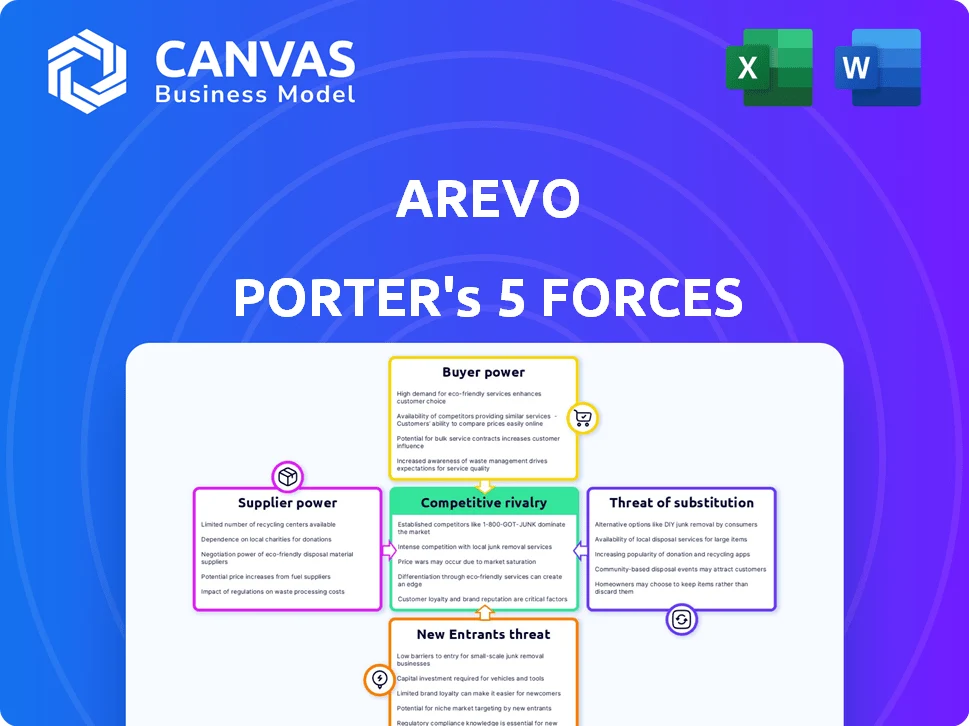
AREVO PORTER'S FIVE FORCES TEMPLATE RESEARCH
What is included in the product
 Detailed Word Document
Analyzes Arevo's competitive position by exploring the five forces impacting its industry.

 Customizable Excel Spreadsheet
Quickly identify threats and opportunities with interactive force sliders.
Preview Before You Purchase
Arevo Porter's Five Forces Analysis
This preview reveals the complete Porter's Five Forces analysis for Arevo. The document displayed here is exactly what you’ll receive—fully formatted and ready to use. There are no substitutions; this is the final, ready-to-download analysis. You'll get instant access after purchase, with the same content and structure. Enjoy this detailed and comprehensive assessment of Arevo's competitive landscape.

Porter's Five Forces Analysis Template

A Must-Have Tool for Decision-Makers
Arevo operates within a dynamic landscape, shaped by competitive forces. Analyzing these forces unveils crucial insights into its profitability. This snapshot explores buyer power, supplier influence, and competitive rivalry. Understanding the threat of new entrants and substitutes is key. Ready to move beyond the basics? Get a full strategic breakdown of Arevo’s market position, competitive intensity, and external threats—all in one powerful analysis.
Suppliers Bargaining Power

Material Suppliers
In additive manufacturing, Arevo's material suppliers wield considerable power. Arevo depends on specialized materials such as carbon fiber and high-performance polymers (PEEK and PAEK). The limited availability and unique properties of these materials can grant suppliers pricing and term advantages. In 2024, the global market for advanced composite materials reached $34 billion, with projections indicating continued growth.
Technology and Component Suppliers
Arevo's tech relies on specialized components, software, and robotics. Suppliers of these unique elements, like advanced laser systems, may exert strong bargaining power. For instance, in 2024, the market for industrial robotics grew by 8.7%, indicating supplier leverage. Limited alternatives further amplify this power.

Labor Market
The labor market significantly impacts supplier power, especially in specialized fields. A scarcity of skilled workers in additive manufacturing, robotics, and materials science can drive up labor costs.
This shortage empowers the workforce, increasing their 'supplier' power due to their essential expertise. For example, in 2024, the demand for skilled additive manufacturing technicians grew by 15%.
This rise in demand can lead to higher wages and potentially affect production costs. Companies in the sector must carefully manage labor costs to remain competitive.
Efficient workforce planning and talent acquisition are thus critical strategic elements. Consider that the average salary for such specialists rose by about 8% in the last year.
This trend highlights the importance of securing and retaining skilled labor to maintain a strong competitive position.

Equipment Manufacturers
Arevo's reliance on external equipment manufacturers, even for components of their robotic platform, influences supplier bargaining power. This power fluctuates with customization needs and supplier availability. Competition among suppliers can reduce this power, impacting Arevo's costs and margins. For example, the industrial robotics market, valued at $44.9 billion in 2023, offers several suppliers.
- High customization needs increase supplier power.
- Availability of alternatives reduces supplier influence.
- Market competition among suppliers is crucial.
- Supplier bargaining affects Arevo's profitability.
Software and AI Providers
Arevo's dependence on specialized software and AI for its operations gives significant power to these providers. These suppliers can influence Arevo's costs and efficiency. Their bargaining power increases if their technologies are unique or widely adopted. This dynamic affects Arevo's profitability and strategic choices.
- The global AI market was valued at $196.63 billion in 2023 and is projected to reach $1.811 trillion by 2030.
- The software industry's revenue is projected to reach $748.50 billion in 2024.
- Companies like Siemens and Dassault Systèmes, key players in industrial software, had revenues of $18.4 billion and $6.0 billion respectively in 2023.
Arevo's Suppliers: Power Dynamics in the Market
Arevo's suppliers, including material and tech providers, hold considerable bargaining power due to specialized needs. The scarcity of unique materials like carbon fiber and software, along with skilled labor, boosts their influence. In 2024, the industrial robotics market showed a growth of 8.7%, and the AI market reached $196.63 billion, highlighting supplier leverage.
| Supplier Type | Impact on Arevo | 2024 Market Data |
|---|---|---|
| Specialized Materials | Pricing and Term Advantages | Advanced Composites Market: $34B |
| Software/AI | Influence on Costs/Efficiency | Software Industry Revenue: $748.5B |
| Skilled Labor | Increased Labor Costs | Demand for Additive Technicians: +15% |
Customers Bargaining Power

High-Volume Orders
Arevo focuses on high-volume manufacturing. Large orders give customers strong bargaining power. In 2024, companies like Tesla, known for volume, drive supplier negotiations. High-volume buyers influence pricing and terms. This impacts Arevo's profitability.
Switching Costs
Switching costs significantly impact customer bargaining power. If customers can easily and cheaply switch to another additive manufacturing provider, their power grows. In 2024, the average cost to switch suppliers in manufacturing was about 5-10% of the contract value. This ease reduces Arevo Porter's pricing power.

Customer Concentration
If Arevo's revenue heavily relies on a few key clients, these customers gain substantial leverage. A concentrated customer base allows them to negotiate aggressively on prices and terms. For example, if 80% of Arevo's revenue comes from just three clients, those clients wield significant bargaining power.

Availability of Alternatives
The bargaining power of customers significantly hinges on the availability of alternatives. If customers can easily switch to other additive manufacturing companies or methods, their leverage increases. This competition forces companies like Arevo Porter to offer better pricing and terms to retain clients. For example, in 2024, the 3D printing market saw over 300 active companies, indicating a wide array of choices for customers. This abundance of options empowers buyers.
- Market competition drives down prices and improves service.
- Customers can easily move to competitors.
- The more alternatives, the higher the customer power.
- Customers can negotiate better deals.
Customer Knowledge and Expertise
Customers with deep knowledge of additive manufacturing hold significant bargaining power. They understand the nuances of 3D printing, materials, and pricing. This expertise enables them to assess Arevo's offerings meticulously and seek optimal value. This informed approach can lead to more favorable terms and conditions.
- 2024: The 3D printing market is estimated at $30.8 billion, with informed customers driving demand for competitive pricing.
- 2024: Industry reports show that customers with technical expertise negotiate discounts averaging 5-10% on large orders.
- 2024: Expert customers often influence product development, leading to tailored solutions and better pricing.
Buyer Power: High Volume, Easy Switches
Customer bargaining power at Arevo is strong due to high-volume orders and easy switching. A concentrated customer base and readily available alternatives further increase buyer leverage. In 2024, the 3D printing market's $30.8 billion size gives buyers plenty of options.
| Factor | Impact | 2024 Data |
|---|---|---|
| Order Volume | High volume buyers get better terms | Tesla's supplier negotiations |
| Switching Costs | Low costs increase buyer power | Avg. switch cost: 5-10% of contract |
| Customer Concentration | Few clients = more power | 80% revenue from 3 clients |
| Alternatives | More options = buyer strength | 300+ 3D printing companies |
| Customer Knowledge | Expertise drives better deals | Discounts of 5-10% for experts |
Rivalry Among Competitors

Number and Diversity of Competitors
The additive manufacturing sector sees fierce rivalry due to a rising number of competitors. Arevo competes with others in composite additive manufacturing and the larger 3D printing market. In 2024, the 3D printing market was valued at roughly $30.8 billion, reflecting its competitive nature. The market’s growth, projected to reach $62.7 billion by 2029, draws more firms.
Industry Growth Rate
The additive manufacturing market is forecasted to grow substantially. High growth often eases rivalry since there's room for multiple players. However, it also draws in more competitors. The 3D printing market reached $30.8 billion in 2024. This growth rate attracts new entrants, intensifying competition.

Product Differentiation
Arevo distinguishes itself through direct digital additive manufacturing of composite parts, targeting high-volume applications. Their capability to produce complex geometries and use high-performance materials sets them apart. In 2024, the 3D printing market for composites was valued at around $2.5 billion. Competition includes companies offering similar 3D printing solutions. This rivalry impacts pricing and market share.

Switching Costs for Customers
Low switching costs can significantly boost rivalry. If customers find it easy to switch, competition heats up. In the 3D printing sector, customer churn rates have been reported around 10-15% annually. This makes it crucial for Arevo to maintain customer loyalty.
- High customer churn rates increase competitive pressure.
- Loyalty programs and service are vital to combat this.
- Focus on unique offerings to lock in customers.
Market Saturation and Consolidation
Market saturation and consolidation are intensifying competitive rivalry in additive manufacturing. The acquisition of Arevo by Stratasys in 2024 exemplifies this trend. This consolidation can lead to fewer players, potentially increasing competitive pressure as companies vie for market share. The 3D printing market is projected to reach $55.8 billion by 2027, according to a 2024 report, and consolidation will likely shape this growth.
- Stratasys acquired Arevo in 2024.
- The 3D printing market is projected to hit $55.8 billion by 2027.
- Consolidation can increase competition.
3D Printing's Competitive Arena: A $30.8B Battleground
Competitive rivalry in additive manufacturing is intense, driven by market growth and a rising number of competitors. The 3D printing market, valued at $30.8 billion in 2024, attracts new entrants, intensifying competition. Consolidation, as seen with Stratasys acquiring Arevo in 2024, further shapes this landscape.
| Aspect | Details | Data (2024) |
|---|---|---|
| Market Value | Total 3D Printing Market | $30.8 billion |
| Composite 3D Printing | Market Size | $2.5 billion |
| Customer Churn | Reported Rates | 10-15% annually |
AREVO PORTER'S FIVE FORCES TEMPLATE RESEARCH
What is included in the product
Detailed Word Document
Analyzes Arevo's competitive position by exploring the five forces impacting its industry.
Customizable Excel Spreadsheet
Quickly identify threats and opportunities with interactive force sliders.
Preview Before You Purchase
Arevo Porter's Five Forces Analysis
This preview reveals the complete Porter's Five Forces analysis for Arevo. The document displayed here is exactly what you’ll receive—fully formatted and ready to use. There are no substitutions; this is the final, ready-to-download analysis. You'll get instant access after purchase, with the same content and structure. Enjoy this detailed and comprehensive assessment of Arevo's competitive landscape.
Porter's Five Forces Analysis Template
A Must-Have Tool for Decision-Makers
Arevo operates within a dynamic landscape, shaped by competitive forces. Analyzing these forces unveils crucial insights into its profitability. This snapshot explores buyer power, supplier influence, and competitive rivalry. Understanding the threat of new entrants and substitutes is key. Ready to move beyond the basics? Get a full strategic breakdown of Arevo’s market position, competitive intensity, and external threats—all in one powerful analysis.
Suppliers Bargaining Power
Material Suppliers
In additive manufacturing, Arevo's material suppliers wield considerable power. Arevo depends on specialized materials such as carbon fiber and high-performance polymers (PEEK and PAEK). The limited availability and unique properties of these materials can grant suppliers pricing and term advantages. In 2024, the global market for advanced composite materials reached $34 billion, with projections indicating continued growth.
Technology and Component Suppliers
Arevo's tech relies on specialized components, software, and robotics. Suppliers of these unique elements, like advanced laser systems, may exert strong bargaining power. For instance, in 2024, the market for industrial robotics grew by 8.7%, indicating supplier leverage. Limited alternatives further amplify this power.
Labor Market
The labor market significantly impacts supplier power, especially in specialized fields. A scarcity of skilled workers in additive manufacturing, robotics, and materials science can drive up labor costs.
This shortage empowers the workforce, increasing their 'supplier' power due to their essential expertise. For example, in 2024, the demand for skilled additive manufacturing technicians grew by 15%.
This rise in demand can lead to higher wages and potentially affect production costs. Companies in the sector must carefully manage labor costs to remain competitive.
Efficient workforce planning and talent acquisition are thus critical strategic elements. Consider that the average salary for such specialists rose by about 8% in the last year.
This trend highlights the importance of securing and retaining skilled labor to maintain a strong competitive position.
Equipment Manufacturers
Arevo's reliance on external equipment manufacturers, even for components of their robotic platform, influences supplier bargaining power. This power fluctuates with customization needs and supplier availability. Competition among suppliers can reduce this power, impacting Arevo's costs and margins. For example, the industrial robotics market, valued at $44.9 billion in 2023, offers several suppliers.
- High customization needs increase supplier power.
- Availability of alternatives reduces supplier influence.
- Market competition among suppliers is crucial.
- Supplier bargaining affects Arevo's profitability.
Software and AI Providers
Arevo's dependence on specialized software and AI for its operations gives significant power to these providers. These suppliers can influence Arevo's costs and efficiency. Their bargaining power increases if their technologies are unique or widely adopted. This dynamic affects Arevo's profitability and strategic choices.
- The global AI market was valued at $196.63 billion in 2023 and is projected to reach $1.811 trillion by 2030.
- The software industry's revenue is projected to reach $748.50 billion in 2024.
- Companies like Siemens and Dassault Systèmes, key players in industrial software, had revenues of $18.4 billion and $6.0 billion respectively in 2023.
Arevo's Suppliers: Power Dynamics in the Market
Arevo's suppliers, including material and tech providers, hold considerable bargaining power due to specialized needs. The scarcity of unique materials like carbon fiber and software, along with skilled labor, boosts their influence. In 2024, the industrial robotics market showed a growth of 8.7%, and the AI market reached $196.63 billion, highlighting supplier leverage.
| Supplier Type | Impact on Arevo | 2024 Market Data |
|---|---|---|
| Specialized Materials | Pricing and Term Advantages | Advanced Composites Market: $34B |
| Software/AI | Influence on Costs/Efficiency | Software Industry Revenue: $748.5B |
| Skilled Labor | Increased Labor Costs | Demand for Additive Technicians: +15% |
Customers Bargaining Power
High-Volume Orders
Arevo focuses on high-volume manufacturing. Large orders give customers strong bargaining power. In 2024, companies like Tesla, known for volume, drive supplier negotiations. High-volume buyers influence pricing and terms. This impacts Arevo's profitability.
Switching Costs
Switching costs significantly impact customer bargaining power. If customers can easily and cheaply switch to another additive manufacturing provider, their power grows. In 2024, the average cost to switch suppliers in manufacturing was about 5-10% of the contract value. This ease reduces Arevo Porter's pricing power.
Customer Concentration
If Arevo's revenue heavily relies on a few key clients, these customers gain substantial leverage. A concentrated customer base allows them to negotiate aggressively on prices and terms. For example, if 80% of Arevo's revenue comes from just three clients, those clients wield significant bargaining power.
Availability of Alternatives
The bargaining power of customers significantly hinges on the availability of alternatives. If customers can easily switch to other additive manufacturing companies or methods, their leverage increases. This competition forces companies like Arevo Porter to offer better pricing and terms to retain clients. For example, in 2024, the 3D printing market saw over 300 active companies, indicating a wide array of choices for customers. This abundance of options empowers buyers.
- Market competition drives down prices and improves service.
- Customers can easily move to competitors.
- The more alternatives, the higher the customer power.
- Customers can negotiate better deals.
Customer Knowledge and Expertise
Customers with deep knowledge of additive manufacturing hold significant bargaining power. They understand the nuances of 3D printing, materials, and pricing. This expertise enables them to assess Arevo's offerings meticulously and seek optimal value. This informed approach can lead to more favorable terms and conditions.
- 2024: The 3D printing market is estimated at $30.8 billion, with informed customers driving demand for competitive pricing.
- 2024: Industry reports show that customers with technical expertise negotiate discounts averaging 5-10% on large orders.
- 2024: Expert customers often influence product development, leading to tailored solutions and better pricing.
Buyer Power: High Volume, Easy Switches
Customer bargaining power at Arevo is strong due to high-volume orders and easy switching. A concentrated customer base and readily available alternatives further increase buyer leverage. In 2024, the 3D printing market's $30.8 billion size gives buyers plenty of options.
| Factor | Impact | 2024 Data |
|---|---|---|
| Order Volume | High volume buyers get better terms | Tesla's supplier negotiations |
| Switching Costs | Low costs increase buyer power | Avg. switch cost: 5-10% of contract |
| Customer Concentration | Few clients = more power | 80% revenue from 3 clients |
| Alternatives | More options = buyer strength | 300+ 3D printing companies |
| Customer Knowledge | Expertise drives better deals | Discounts of 5-10% for experts |
Rivalry Among Competitors
Number and Diversity of Competitors
The additive manufacturing sector sees fierce rivalry due to a rising number of competitors. Arevo competes with others in composite additive manufacturing and the larger 3D printing market. In 2024, the 3D printing market was valued at roughly $30.8 billion, reflecting its competitive nature. The market’s growth, projected to reach $62.7 billion by 2029, draws more firms.
Industry Growth Rate
The additive manufacturing market is forecasted to grow substantially. High growth often eases rivalry since there's room for multiple players. However, it also draws in more competitors. The 3D printing market reached $30.8 billion in 2024. This growth rate attracts new entrants, intensifying competition.
Product Differentiation
Arevo distinguishes itself through direct digital additive manufacturing of composite parts, targeting high-volume applications. Their capability to produce complex geometries and use high-performance materials sets them apart. In 2024, the 3D printing market for composites was valued at around $2.5 billion. Competition includes companies offering similar 3D printing solutions. This rivalry impacts pricing and market share.
Switching Costs for Customers
Low switching costs can significantly boost rivalry. If customers find it easy to switch, competition heats up. In the 3D printing sector, customer churn rates have been reported around 10-15% annually. This makes it crucial for Arevo to maintain customer loyalty.
- High customer churn rates increase competitive pressure.
- Loyalty programs and service are vital to combat this.
- Focus on unique offerings to lock in customers.
Market Saturation and Consolidation
Market saturation and consolidation are intensifying competitive rivalry in additive manufacturing. The acquisition of Arevo by Stratasys in 2024 exemplifies this trend. This consolidation can lead to fewer players, potentially increasing competitive pressure as companies vie for market share. The 3D printing market is projected to reach $55.8 billion by 2027, according to a 2024 report, and consolidation will likely shape this growth.
- Stratasys acquired Arevo in 2024.
- The 3D printing market is projected to hit $55.8 billion by 2027.
- Consolidation can increase competition.
3D Printing's Competitive Arena: A $30.8B Battleground
Competitive rivalry in additive manufacturing is intense, driven by market growth and a rising number of competitors. The 3D printing market, valued at $30.8 billion in 2024, attracts new entrants, intensifying competition. Consolidation, as seen with Stratasys acquiring Arevo in 2024, further shapes this landscape.
| Aspect | Details | Data (2024) |
|---|---|---|
| Market Value | Total 3D Printing Market | $30.8 billion |
| Composite 3D Printing | Market Size | $2.5 billion |
| Customer Churn | Reported Rates | 10-15% annually |
Product Information
Product Information
Shipping & Returns
Shipping & Returns
Description
What is included in the product
Detailed Word Document
Analyzes Arevo's competitive position by exploring the five forces impacting its industry.
Customizable Excel Spreadsheet
Quickly identify threats and opportunities with interactive force sliders.
Preview Before You Purchase
Arevo Porter's Five Forces Analysis
This preview reveals the complete Porter's Five Forces analysis for Arevo. The document displayed here is exactly what you’ll receive—fully formatted and ready to use. There are no substitutions; this is the final, ready-to-download analysis. You'll get instant access after purchase, with the same content and structure. Enjoy this detailed and comprehensive assessment of Arevo's competitive landscape.
Porter's Five Forces Analysis Template
A Must-Have Tool for Decision-Makers
Arevo operates within a dynamic landscape, shaped by competitive forces. Analyzing these forces unveils crucial insights into its profitability. This snapshot explores buyer power, supplier influence, and competitive rivalry. Understanding the threat of new entrants and substitutes is key. Ready to move beyond the basics? Get a full strategic breakdown of Arevo’s market position, competitive intensity, and external threats—all in one powerful analysis.
Suppliers Bargaining Power
Material Suppliers
In additive manufacturing, Arevo's material suppliers wield considerable power. Arevo depends on specialized materials such as carbon fiber and high-performance polymers (PEEK and PAEK). The limited availability and unique properties of these materials can grant suppliers pricing and term advantages. In 2024, the global market for advanced composite materials reached $34 billion, with projections indicating continued growth.
Technology and Component Suppliers
Arevo's tech relies on specialized components, software, and robotics. Suppliers of these unique elements, like advanced laser systems, may exert strong bargaining power. For instance, in 2024, the market for industrial robotics grew by 8.7%, indicating supplier leverage. Limited alternatives further amplify this power.
Labor Market
The labor market significantly impacts supplier power, especially in specialized fields. A scarcity of skilled workers in additive manufacturing, robotics, and materials science can drive up labor costs.
This shortage empowers the workforce, increasing their 'supplier' power due to their essential expertise. For example, in 2024, the demand for skilled additive manufacturing technicians grew by 15%.
This rise in demand can lead to higher wages and potentially affect production costs. Companies in the sector must carefully manage labor costs to remain competitive.
Efficient workforce planning and talent acquisition are thus critical strategic elements. Consider that the average salary for such specialists rose by about 8% in the last year.
This trend highlights the importance of securing and retaining skilled labor to maintain a strong competitive position.
Equipment Manufacturers
Arevo's reliance on external equipment manufacturers, even for components of their robotic platform, influences supplier bargaining power. This power fluctuates with customization needs and supplier availability. Competition among suppliers can reduce this power, impacting Arevo's costs and margins. For example, the industrial robotics market, valued at $44.9 billion in 2023, offers several suppliers.
- High customization needs increase supplier power.
- Availability of alternatives reduces supplier influence.
- Market competition among suppliers is crucial.
- Supplier bargaining affects Arevo's profitability.
Software and AI Providers
Arevo's dependence on specialized software and AI for its operations gives significant power to these providers. These suppliers can influence Arevo's costs and efficiency. Their bargaining power increases if their technologies are unique or widely adopted. This dynamic affects Arevo's profitability and strategic choices.
- The global AI market was valued at $196.63 billion in 2023 and is projected to reach $1.811 trillion by 2030.
- The software industry's revenue is projected to reach $748.50 billion in 2024.
- Companies like Siemens and Dassault Systèmes, key players in industrial software, had revenues of $18.4 billion and $6.0 billion respectively in 2023.
Arevo's Suppliers: Power Dynamics in the Market
Arevo's suppliers, including material and tech providers, hold considerable bargaining power due to specialized needs. The scarcity of unique materials like carbon fiber and software, along with skilled labor, boosts their influence. In 2024, the industrial robotics market showed a growth of 8.7%, and the AI market reached $196.63 billion, highlighting supplier leverage.
| Supplier Type | Impact on Arevo | 2024 Market Data |
|---|---|---|
| Specialized Materials | Pricing and Term Advantages | Advanced Composites Market: $34B |
| Software/AI | Influence on Costs/Efficiency | Software Industry Revenue: $748.5B |
| Skilled Labor | Increased Labor Costs | Demand for Additive Technicians: +15% |
Customers Bargaining Power
High-Volume Orders
Arevo focuses on high-volume manufacturing. Large orders give customers strong bargaining power. In 2024, companies like Tesla, known for volume, drive supplier negotiations. High-volume buyers influence pricing and terms. This impacts Arevo's profitability.
Switching Costs
Switching costs significantly impact customer bargaining power. If customers can easily and cheaply switch to another additive manufacturing provider, their power grows. In 2024, the average cost to switch suppliers in manufacturing was about 5-10% of the contract value. This ease reduces Arevo Porter's pricing power.
Customer Concentration
If Arevo's revenue heavily relies on a few key clients, these customers gain substantial leverage. A concentrated customer base allows them to negotiate aggressively on prices and terms. For example, if 80% of Arevo's revenue comes from just three clients, those clients wield significant bargaining power.
Availability of Alternatives
The bargaining power of customers significantly hinges on the availability of alternatives. If customers can easily switch to other additive manufacturing companies or methods, their leverage increases. This competition forces companies like Arevo Porter to offer better pricing and terms to retain clients. For example, in 2024, the 3D printing market saw over 300 active companies, indicating a wide array of choices for customers. This abundance of options empowers buyers.
- Market competition drives down prices and improves service.
- Customers can easily move to competitors.
- The more alternatives, the higher the customer power.
- Customers can negotiate better deals.
Customer Knowledge and Expertise
Customers with deep knowledge of additive manufacturing hold significant bargaining power. They understand the nuances of 3D printing, materials, and pricing. This expertise enables them to assess Arevo's offerings meticulously and seek optimal value. This informed approach can lead to more favorable terms and conditions.
- 2024: The 3D printing market is estimated at $30.8 billion, with informed customers driving demand for competitive pricing.
- 2024: Industry reports show that customers with technical expertise negotiate discounts averaging 5-10% on large orders.
- 2024: Expert customers often influence product development, leading to tailored solutions and better pricing.
Buyer Power: High Volume, Easy Switches
Customer bargaining power at Arevo is strong due to high-volume orders and easy switching. A concentrated customer base and readily available alternatives further increase buyer leverage. In 2024, the 3D printing market's $30.8 billion size gives buyers plenty of options.
| Factor | Impact | 2024 Data |
|---|---|---|
| Order Volume | High volume buyers get better terms | Tesla's supplier negotiations |
| Switching Costs | Low costs increase buyer power | Avg. switch cost: 5-10% of contract |
| Customer Concentration | Few clients = more power | 80% revenue from 3 clients |
| Alternatives | More options = buyer strength | 300+ 3D printing companies |
| Customer Knowledge | Expertise drives better deals | Discounts of 5-10% for experts |
Rivalry Among Competitors
Number and Diversity of Competitors
The additive manufacturing sector sees fierce rivalry due to a rising number of competitors. Arevo competes with others in composite additive manufacturing and the larger 3D printing market. In 2024, the 3D printing market was valued at roughly $30.8 billion, reflecting its competitive nature. The market’s growth, projected to reach $62.7 billion by 2029, draws more firms.
Industry Growth Rate
The additive manufacturing market is forecasted to grow substantially. High growth often eases rivalry since there's room for multiple players. However, it also draws in more competitors. The 3D printing market reached $30.8 billion in 2024. This growth rate attracts new entrants, intensifying competition.
Product Differentiation
Arevo distinguishes itself through direct digital additive manufacturing of composite parts, targeting high-volume applications. Their capability to produce complex geometries and use high-performance materials sets them apart. In 2024, the 3D printing market for composites was valued at around $2.5 billion. Competition includes companies offering similar 3D printing solutions. This rivalry impacts pricing and market share.
Switching Costs for Customers
Low switching costs can significantly boost rivalry. If customers find it easy to switch, competition heats up. In the 3D printing sector, customer churn rates have been reported around 10-15% annually. This makes it crucial for Arevo to maintain customer loyalty.
- High customer churn rates increase competitive pressure.
- Loyalty programs and service are vital to combat this.
- Focus on unique offerings to lock in customers.
Market Saturation and Consolidation
Market saturation and consolidation are intensifying competitive rivalry in additive manufacturing. The acquisition of Arevo by Stratasys in 2024 exemplifies this trend. This consolidation can lead to fewer players, potentially increasing competitive pressure as companies vie for market share. The 3D printing market is projected to reach $55.8 billion by 2027, according to a 2024 report, and consolidation will likely shape this growth.
- Stratasys acquired Arevo in 2024.
- The 3D printing market is projected to hit $55.8 billion by 2027.
- Consolidation can increase competition.
3D Printing's Competitive Arena: A $30.8B Battleground
Competitive rivalry in additive manufacturing is intense, driven by market growth and a rising number of competitors. The 3D printing market, valued at $30.8 billion in 2024, attracts new entrants, intensifying competition. Consolidation, as seen with Stratasys acquiring Arevo in 2024, further shapes this landscape.
| Aspect | Details | Data (2024) |
|---|---|---|
| Market Value | Total 3D Printing Market | $30.8 billion |
| Composite 3D Printing | Market Size | $2.5 billion |
| Customer Churn | Reported Rates | 10-15% annually |


