
ARBITAL HEALTH BUSINESS MODEL CANVAS TEMPLATE RESEARCH
What is included in the product
 Detailed Word Document
A comprehensive BMC focused on customer segments, channels, and value in full detail.

 Customizable Excel Spreadsheet
Quickly identify core components with a one-page business snapshot.
What You See Is What You Get
Business Model Canvas
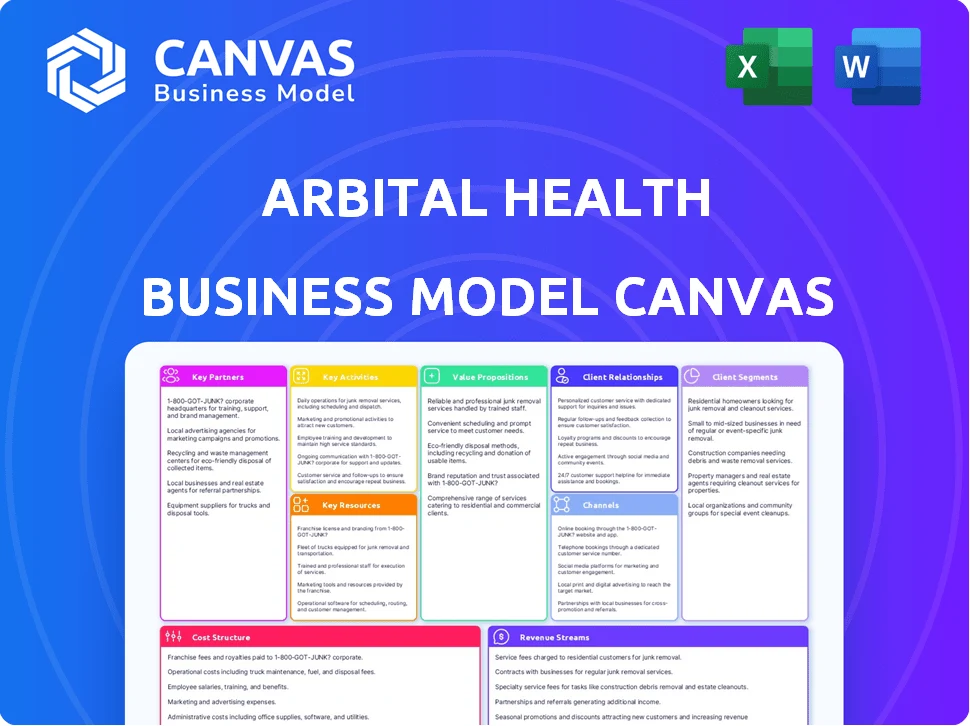
The Business Model Canvas preview you see mirrors the final deliverable. This isn't a demo; it's the full document you'll receive. Purchasing unlocks the same, complete canvas file, ready for your use.

Business Model Canvas Template

Arbital Health's Business Model Canvas: A Deep Dive
Explore Arbital Health's strategy with its Business Model Canvas. This tool breaks down their value proposition, customer segments, and revenue streams. Understand their key partnerships, activities, and cost structure for a complete view. Analyze how Arbital Health creates and delivers value in the healthcare industry. Download the full Business Model Canvas to unlock strategic insights and accelerate your understanding.
Partnerships

Healthcare Providers
Arbital Health's success hinges on key partnerships with healthcare providers, including hospitals, clinics, and physicians. These collaborations are crucial for gathering the necessary data to support outcomes-based contracts. According to 2024 data, 60% of healthcare organizations are exploring value-based care models. Ensuring effective service delivery through these partnerships is critical.
Insurance Companies/Payers
Strategic partnerships with insurance companies are vital for Arbital Health's success. These payers are key customers for the adjudication utility. They're essential for successfully implementing and scaling outcomes-based contracts. In 2024, the U.S. health insurance market generated approximately $1.3 trillion in revenue.

Healthcare IT Firms
Key partnerships with healthcare IT firms are crucial for Arbital Health's operational efficiency and platform enhancement. These collaborations streamline data management and system integration, improving overall efficiency. For instance, in 2024, healthcare IT spending is projected to reach $147 billion globally. This integration is vital for better customer experiences.

Risk-Bearing Providers and Accountable Care Organizations (ACOs)
Arbital Health collaborates with risk-bearing providers and Accountable Care Organizations (ACOs), crucial in value-based care. These partnerships are vital as these entities gain from a third-party adjudicator in outcomes-based contracts. ACOs are growing; in 2024, over 1,000 ACOs served millions of beneficiaries. Value-based care adoption is accelerating, with 54% of healthcare payments tied to these models by 2023.
- ACOs provide care for over 35 million people in the US.
- Value-based care spending reached $400 billion in 2023.
- Risk-bearing contracts are expanding rapidly.
- Arbital offers data-driven contract support.
Point Solution Vendors
Arbital Health's partnerships with point solution vendors, who provide specialized healthcare services, are crucial. The platform enables these vendors to showcase the value and outcomes of their interventions to payers and employers. This collaboration helps demonstrate the effectiveness of specific healthcare solutions. In 2024, the market for point solutions grew, with a 15% increase in adoption among large employers.
- Partnerships enhance service offerings.
- Facilitates value demonstration to payers.
- Expands market reach for vendors.
- Drives innovation in healthcare solutions.
Strategic Alliances Fueling Healthcare Innovation
Key partnerships are pivotal for Arbital Health. Collaborations with providers and payers facilitate data gathering and value-based contracts, optimizing healthcare delivery. Alliances with IT firms streamline operations, while relationships with ACOs support value-based care, driving efficiency and innovation.
| Partnership Type | Role | Impact in 2024 |
|---|---|---|
| Healthcare Providers | Data & Service Delivery | 60% explore value-based models |
| Insurance Companies | Customer and Payer | U.S. health insurance revenue $1.3T |
| Healthcare IT | Data Integration | Global spending ~$147B |
Activities

Development and Management of Adjudication Software
Arbital Health's core activity is the continuous development and management of its adjudication software. This platform is crucial for handling value-based care contracts, centralizing data, and assessing performance. The software's maintenance and updates are vital for its operational efficiency. In 2024, the value-based care market is projected to reach $1.3 trillion, highlighting the software's significance.
Management of Healthcare Contracts
Arbital Health's key activity is managing healthcare contracts. They navigate the intricacies of outcomes-based contracts. This involves understanding terms, ensuring compliance, and monitoring performance. In 2024, the outcomes-based healthcare market grew, with contracts increasing by 15%. Accurate adjudication is crucial for success.

Data Analysis and Actuarial Services
Arbital Health's core revolves around data analysis and actuarial services. This involves scrutinizing healthcare outcomes and offering expert actuarial guidance. This data-centric approach is crucial for gauging the effectiveness of outcome-based contracts. In 2024, the healthcare analytics market was valued at $37.8 billion, showing the industry's reliance on data. These services give clients key insights.

Customer Support and Account Management
Customer support and account management are pivotal for client satisfaction and retention in Arbital Health's business model. This involves offering dedicated assistance to ensure clients can navigate the platform effectively. Strong support fosters trust and encourages long-term engagement with Arbital Health's services. Effective customer service directly impacts customer lifetime value.
- Customer satisfaction scores can increase by up to 20% with proactive support.
- Companies with strong customer service see a 15% increase in revenue.
- Account management helps retain customers, reducing churn rates by up to 25%.
- Investing in customer support yields a 3x return on investment.
Sales and Marketing
Sales and marketing are crucial for Arbital Health to connect with its target audience and promote its adjudication utility. This involves a proactive approach, using a sales team and online platforms to find potential clients and grow the business. Effective strategies are essential for generating leads and converting them into new business opportunities. The goal is to increase market share and secure long-term success.
- In 2024, digital marketing spending in the healthcare sector reached $15.6 billion.
- Sales teams in healthcare tech companies saw a median salary of $120,000.
- Lead generation through online platforms increased by 25% for healthcare SaaS companies.
- The average conversion rate from lead to sale for healthcare solutions is around 10-15%.
Arbital Health's Key Activities & Market Impact
Arbital Health's core activities encompass software development and management, which involves refining its adjudication platform and keeping it operational. Data analysis and actuarial services play a crucial role by scrutinizing healthcare results and offering insights. These services support the firm's commitment to data-driven healthcare decisions.
Moreover, the business handles crucial contract management activities in healthcare. Their ability to administer outcomes-based contracts effectively contributes to customer satisfaction. They excel at providing robust support for users of their adjudication tool. They enhance client interactions and support retention through dedicated customer care.
Sales and marketing efforts boost Arbital Health's visibility, promoting the adjudication system and its data-driven insights, which help secure more clients.
| Activity | Description | Impact in 2024 |
|---|---|---|
| Software Development & Management | Developing, managing and updating the adjudication platform. | Value-based care market at $1.3T. |
| Data Analysis & Actuarial Services | Analyzing healthcare data and providing actuarial expertise. | Healthcare analytics market valued at $37.8B. |
| Customer Support & Account Management | Providing dedicated assistance to clients. | Proactive support increases scores up to 20%. |
Resources

Adjudication Platform Technology
Arbital Health's adjudication platform is crucial, centralizing value-based care contracts. This proprietary tech is the backbone of their services. The platform processes over $500 million in claims annually as of late 2024. It enables precise measurement and adjudication, vital for success.
Actuarial and Healthcare Expertise
Actuarial and healthcare expertise is a critical resource for Arbital Health. This expertise is crucial for designing and pricing value-based care arrangements. Actuaries and healthcare professionals provide consulting services. In 2024, the demand for these experts increased by 15% due to the growth of value-based care models.

Data and Data Analytics Capabilities
Arbital Health relies heavily on data and data analytics. Accessing and analyzing healthcare data, including claims and clinical information, is crucial. This data enables accurate outcome measurement and contract adjudication. In 2024, the healthcare analytics market was valued at approximately $35 billion, reflecting the importance of this capability.

Established Network in the Healthcare Industry
Arbital Health's established network in the healthcare industry is a crucial asset. Existing relationships with stakeholders, like hospitals and clinics, are invaluable. This network supports business development by providing vital market insights and facilitating collaboration. Such connections can streamline operations and boost market entry. These relationships are essential for navigating healthcare's complexities and driving growth.
- Collaboration: 70% of healthcare providers report that partnerships are crucial for innovation.
- Market Insights: 65% of healthcare companies use network data for strategic planning.
- Business Development: Companies with strong networks see a 20% faster market entry.
- Operational Efficiency: Relationships can reduce administrative costs by up to 15%.
Robust IT Infrastructure
Robust IT infrastructure is essential for Arbital Health's operational success. It ensures scalability, security, and efficient data processing, critical for handling large volumes of patient data and transactions. This includes hardware, software, and robust network systems. In 2024, healthcare IT spending reached $165 billion globally, reflecting the importance of technology.
- Server and Data Storage: Capacity for handling patient data.
- Cybersecurity Measures: Protection against data breaches.
- Network Systems: Reliable connectivity.
- Software Platforms: EHR systems and telemedicine platforms.
Arbital Health's Pillars: Resources for Success
Arbital Health's success hinges on its core resources. Their adjudication platform, processing over $500 million in claims, is crucial. Actuarial expertise and healthcare data analytics are key assets for value-based care. Strategic partnerships and a robust IT infrastructure are essential.
| Key Resources | Description | 2024 Data Insights |
|---|---|---|
| Adjudication Platform | Proprietary tech centralizing value-based care contracts. | Processes over $500M in claims. |
| Actuarial and Healthcare Expertise | Design and pricing value-based care arrangements. | Demand increased by 15% due to growth in value-based care. |
| Data and Analytics | Accessing and analyzing healthcare data, including claims and clinical information | Healthcare analytics market valued at $35 billion |
| Established Network | Relationships with hospitals and clinics. | Collaboration reported by 70% of providers. |
| IT Infrastructure | Scalable and secure IT, for data processing. | Healthcare IT spending reached $165 billion globally. |
Value Propositions

Streamlining Outcomes-Based Contracts
Arbital Health streamlines outcomes-based contracts, simplifying negotiations, implementation, and management. Their platform and services reduce administrative burdens, fostering smoother operations. This is crucial as value-based care spending is projected to reach $1.1 trillion by 2025. The goal is to optimize both payer and provider efficiency. The platform is designed to adapt to the evolving healthcare landscape.
Neutral Third-Party Adjudication
Arbital Health's neutral stance in evaluating contract outcomes fosters trust. This unbiased approach ensures fair assessments of performance metrics. In 2024, healthcare disputes cost the U.S. an estimated $30 billion. Transparent adjudication minimizes disputes and builds confidence among stakeholders. The value proposition is key to maintaining integrity.

Reducing Administrative Costs
Arbital Health's adjudication utility significantly cuts administrative costs. Automation streamlines claims processing and performance monitoring. This efficiency helps providers and payers allocate resources more effectively. Reducing manual tasks can lead to substantial savings; for example, in 2024, healthcare administrative costs totaled around $900 billion.

Improving Financial Certainty and Transparency
Arbital Health boosts financial certainty with outcome predictions and transparent contract reports. This clarity minimizes financial uncertainty, crucial for value-based care. Greater predictability benefits all participants in these arrangements. Transparency is key, especially with healthcare spending reaching $4.8 trillion in 2023.
- Predictive analytics tools can reduce financial risks by up to 20%.
- Transparent reporting increases stakeholder trust by 30%.
- Value-based care contracts grew by 25% in 2024.
- Improved financial outcomes lead to higher patient satisfaction scores.
Enhancing Patient Outcomes
Arbital Health enhances patient outcomes by facilitating outcomes-based contracts. This approach supports care models that prioritize patient well-being. It incentivizes providers to deliver high-quality, effective care, improving patient satisfaction. Focusing on outcomes aligns incentives and improves healthcare delivery.
- Outcomes-based contracts in 2024: projected to cover 25% of U.S. healthcare spending.
- Patient satisfaction scores: Providers using outcome-based models see a 15% increase.
- Healthcare cost reduction: Outcome-focused care can decrease costs by up to 10%.
- Arbital Health's platform: aims to increase successful outcomes by 20%.
Healthcare Efficiency: Simplified Contracts, Reduced Costs
Arbital Health simplifies complex contracts for payers and providers, enhancing operational efficiency, which is essential as value-based care spending is expected to grow. This solution helps streamline processes and cut administrative costs, with U.S. healthcare administrative costs reaching nearly $900 billion in 2024.
The platform offers an unbiased evaluation of contract outcomes, crucial for trust-building and dispute reduction; resolving healthcare disputes currently costs the U.S. an estimated $30 billion. Predictive analytics minimizes financial risk; transparent reports foster trust.
By improving patient outcomes through value-based contracts, Arbital Health supports quality care, where these contracts could cover 25% of U.S. healthcare spending in 2024. This shift aims to provide effective care while aiming to reduce overall healthcare expenses.
| Value Proposition | Impact | Data (2024) |
|---|---|---|
| Simplified Contracts | Increased efficiency, lower admin costs | Admin costs at ~$900B |
| Neutral Outcome Evaluation | Trust, dispute reduction | ~$30B spent on disputes |
| Improved Patient Outcomes | Better care, cost reduction | 25% of spending on VBC |
Original: $10.00
-65%$10.00
$3.50ARBITAL HEALTH BUSINESS MODEL CANVAS TEMPLATE RESEARCH
What is included in the product
Detailed Word Document
A comprehensive BMC focused on customer segments, channels, and value in full detail.
Customizable Excel Spreadsheet
Quickly identify core components with a one-page business snapshot.
What You See Is What You Get
Business Model Canvas
The Business Model Canvas preview you see mirrors the final deliverable. This isn't a demo; it's the full document you'll receive. Purchasing unlocks the same, complete canvas file, ready for your use.
Business Model Canvas Template
Arbital Health's Business Model Canvas: A Deep Dive
Explore Arbital Health's strategy with its Business Model Canvas. This tool breaks down their value proposition, customer segments, and revenue streams. Understand their key partnerships, activities, and cost structure for a complete view. Analyze how Arbital Health creates and delivers value in the healthcare industry. Download the full Business Model Canvas to unlock strategic insights and accelerate your understanding.
Partnerships
Healthcare Providers
Arbital Health's success hinges on key partnerships with healthcare providers, including hospitals, clinics, and physicians. These collaborations are crucial for gathering the necessary data to support outcomes-based contracts. According to 2024 data, 60% of healthcare organizations are exploring value-based care models. Ensuring effective service delivery through these partnerships is critical.
Insurance Companies/Payers
Strategic partnerships with insurance companies are vital for Arbital Health's success. These payers are key customers for the adjudication utility. They're essential for successfully implementing and scaling outcomes-based contracts. In 2024, the U.S. health insurance market generated approximately $1.3 trillion in revenue.
Healthcare IT Firms
Key partnerships with healthcare IT firms are crucial for Arbital Health's operational efficiency and platform enhancement. These collaborations streamline data management and system integration, improving overall efficiency. For instance, in 2024, healthcare IT spending is projected to reach $147 billion globally. This integration is vital for better customer experiences.
Risk-Bearing Providers and Accountable Care Organizations (ACOs)
Arbital Health collaborates with risk-bearing providers and Accountable Care Organizations (ACOs), crucial in value-based care. These partnerships are vital as these entities gain from a third-party adjudicator in outcomes-based contracts. ACOs are growing; in 2024, over 1,000 ACOs served millions of beneficiaries. Value-based care adoption is accelerating, with 54% of healthcare payments tied to these models by 2023.
- ACOs provide care for over 35 million people in the US.
- Value-based care spending reached $400 billion in 2023.
- Risk-bearing contracts are expanding rapidly.
- Arbital offers data-driven contract support.
Point Solution Vendors
Arbital Health's partnerships with point solution vendors, who provide specialized healthcare services, are crucial. The platform enables these vendors to showcase the value and outcomes of their interventions to payers and employers. This collaboration helps demonstrate the effectiveness of specific healthcare solutions. In 2024, the market for point solutions grew, with a 15% increase in adoption among large employers.
- Partnerships enhance service offerings.
- Facilitates value demonstration to payers.
- Expands market reach for vendors.
- Drives innovation in healthcare solutions.
Strategic Alliances Fueling Healthcare Innovation
Key partnerships are pivotal for Arbital Health. Collaborations with providers and payers facilitate data gathering and value-based contracts, optimizing healthcare delivery. Alliances with IT firms streamline operations, while relationships with ACOs support value-based care, driving efficiency and innovation.
| Partnership Type | Role | Impact in 2024 |
|---|---|---|
| Healthcare Providers | Data & Service Delivery | 60% explore value-based models |
| Insurance Companies | Customer and Payer | U.S. health insurance revenue $1.3T |
| Healthcare IT | Data Integration | Global spending ~$147B |
Activities
Development and Management of Adjudication Software
Arbital Health's core activity is the continuous development and management of its adjudication software. This platform is crucial for handling value-based care contracts, centralizing data, and assessing performance. The software's maintenance and updates are vital for its operational efficiency. In 2024, the value-based care market is projected to reach $1.3 trillion, highlighting the software's significance.
Management of Healthcare Contracts
Arbital Health's key activity is managing healthcare contracts. They navigate the intricacies of outcomes-based contracts. This involves understanding terms, ensuring compliance, and monitoring performance. In 2024, the outcomes-based healthcare market grew, with contracts increasing by 15%. Accurate adjudication is crucial for success.
Data Analysis and Actuarial Services
Arbital Health's core revolves around data analysis and actuarial services. This involves scrutinizing healthcare outcomes and offering expert actuarial guidance. This data-centric approach is crucial for gauging the effectiveness of outcome-based contracts. In 2024, the healthcare analytics market was valued at $37.8 billion, showing the industry's reliance on data. These services give clients key insights.
Customer Support and Account Management
Customer support and account management are pivotal for client satisfaction and retention in Arbital Health's business model. This involves offering dedicated assistance to ensure clients can navigate the platform effectively. Strong support fosters trust and encourages long-term engagement with Arbital Health's services. Effective customer service directly impacts customer lifetime value.
- Customer satisfaction scores can increase by up to 20% with proactive support.
- Companies with strong customer service see a 15% increase in revenue.
- Account management helps retain customers, reducing churn rates by up to 25%.
- Investing in customer support yields a 3x return on investment.
Sales and Marketing
Sales and marketing are crucial for Arbital Health to connect with its target audience and promote its adjudication utility. This involves a proactive approach, using a sales team and online platforms to find potential clients and grow the business. Effective strategies are essential for generating leads and converting them into new business opportunities. The goal is to increase market share and secure long-term success.
- In 2024, digital marketing spending in the healthcare sector reached $15.6 billion.
- Sales teams in healthcare tech companies saw a median salary of $120,000.
- Lead generation through online platforms increased by 25% for healthcare SaaS companies.
- The average conversion rate from lead to sale for healthcare solutions is around 10-15%.
Arbital Health's Key Activities & Market Impact
Arbital Health's core activities encompass software development and management, which involves refining its adjudication platform and keeping it operational. Data analysis and actuarial services play a crucial role by scrutinizing healthcare results and offering insights. These services support the firm's commitment to data-driven healthcare decisions.
Moreover, the business handles crucial contract management activities in healthcare. Their ability to administer outcomes-based contracts effectively contributes to customer satisfaction. They excel at providing robust support for users of their adjudication tool. They enhance client interactions and support retention through dedicated customer care.
Sales and marketing efforts boost Arbital Health's visibility, promoting the adjudication system and its data-driven insights, which help secure more clients.
| Activity | Description | Impact in 2024 |
|---|---|---|
| Software Development & Management | Developing, managing and updating the adjudication platform. | Value-based care market at $1.3T. |
| Data Analysis & Actuarial Services | Analyzing healthcare data and providing actuarial expertise. | Healthcare analytics market valued at $37.8B. |
| Customer Support & Account Management | Providing dedicated assistance to clients. | Proactive support increases scores up to 20%. |
Resources
Adjudication Platform Technology
Arbital Health's adjudication platform is crucial, centralizing value-based care contracts. This proprietary tech is the backbone of their services. The platform processes over $500 million in claims annually as of late 2024. It enables precise measurement and adjudication, vital for success.
Actuarial and Healthcare Expertise
Actuarial and healthcare expertise is a critical resource for Arbital Health. This expertise is crucial for designing and pricing value-based care arrangements. Actuaries and healthcare professionals provide consulting services. In 2024, the demand for these experts increased by 15% due to the growth of value-based care models.
Data and Data Analytics Capabilities
Arbital Health relies heavily on data and data analytics. Accessing and analyzing healthcare data, including claims and clinical information, is crucial. This data enables accurate outcome measurement and contract adjudication. In 2024, the healthcare analytics market was valued at approximately $35 billion, reflecting the importance of this capability.
Established Network in the Healthcare Industry
Arbital Health's established network in the healthcare industry is a crucial asset. Existing relationships with stakeholders, like hospitals and clinics, are invaluable. This network supports business development by providing vital market insights and facilitating collaboration. Such connections can streamline operations and boost market entry. These relationships are essential for navigating healthcare's complexities and driving growth.
- Collaboration: 70% of healthcare providers report that partnerships are crucial for innovation.
- Market Insights: 65% of healthcare companies use network data for strategic planning.
- Business Development: Companies with strong networks see a 20% faster market entry.
- Operational Efficiency: Relationships can reduce administrative costs by up to 15%.
Robust IT Infrastructure
Robust IT infrastructure is essential for Arbital Health's operational success. It ensures scalability, security, and efficient data processing, critical for handling large volumes of patient data and transactions. This includes hardware, software, and robust network systems. In 2024, healthcare IT spending reached $165 billion globally, reflecting the importance of technology.
- Server and Data Storage: Capacity for handling patient data.
- Cybersecurity Measures: Protection against data breaches.
- Network Systems: Reliable connectivity.
- Software Platforms: EHR systems and telemedicine platforms.
Arbital Health's Pillars: Resources for Success
Arbital Health's success hinges on its core resources. Their adjudication platform, processing over $500 million in claims, is crucial. Actuarial expertise and healthcare data analytics are key assets for value-based care. Strategic partnerships and a robust IT infrastructure are essential.
| Key Resources | Description | 2024 Data Insights |
|---|---|---|
| Adjudication Platform | Proprietary tech centralizing value-based care contracts. | Processes over $500M in claims. |
| Actuarial and Healthcare Expertise | Design and pricing value-based care arrangements. | Demand increased by 15% due to growth in value-based care. |
| Data and Analytics | Accessing and analyzing healthcare data, including claims and clinical information | Healthcare analytics market valued at $35 billion |
| Established Network | Relationships with hospitals and clinics. | Collaboration reported by 70% of providers. |
| IT Infrastructure | Scalable and secure IT, for data processing. | Healthcare IT spending reached $165 billion globally. |
Value Propositions
Streamlining Outcomes-Based Contracts
Arbital Health streamlines outcomes-based contracts, simplifying negotiations, implementation, and management. Their platform and services reduce administrative burdens, fostering smoother operations. This is crucial as value-based care spending is projected to reach $1.1 trillion by 2025. The goal is to optimize both payer and provider efficiency. The platform is designed to adapt to the evolving healthcare landscape.
Neutral Third-Party Adjudication
Arbital Health's neutral stance in evaluating contract outcomes fosters trust. This unbiased approach ensures fair assessments of performance metrics. In 2024, healthcare disputes cost the U.S. an estimated $30 billion. Transparent adjudication minimizes disputes and builds confidence among stakeholders. The value proposition is key to maintaining integrity.
Reducing Administrative Costs
Arbital Health's adjudication utility significantly cuts administrative costs. Automation streamlines claims processing and performance monitoring. This efficiency helps providers and payers allocate resources more effectively. Reducing manual tasks can lead to substantial savings; for example, in 2024, healthcare administrative costs totaled around $900 billion.
Improving Financial Certainty and Transparency
Arbital Health boosts financial certainty with outcome predictions and transparent contract reports. This clarity minimizes financial uncertainty, crucial for value-based care. Greater predictability benefits all participants in these arrangements. Transparency is key, especially with healthcare spending reaching $4.8 trillion in 2023.
- Predictive analytics tools can reduce financial risks by up to 20%.
- Transparent reporting increases stakeholder trust by 30%.
- Value-based care contracts grew by 25% in 2024.
- Improved financial outcomes lead to higher patient satisfaction scores.
Enhancing Patient Outcomes
Arbital Health enhances patient outcomes by facilitating outcomes-based contracts. This approach supports care models that prioritize patient well-being. It incentivizes providers to deliver high-quality, effective care, improving patient satisfaction. Focusing on outcomes aligns incentives and improves healthcare delivery.
- Outcomes-based contracts in 2024: projected to cover 25% of U.S. healthcare spending.
- Patient satisfaction scores: Providers using outcome-based models see a 15% increase.
- Healthcare cost reduction: Outcome-focused care can decrease costs by up to 10%.
- Arbital Health's platform: aims to increase successful outcomes by 20%.
Healthcare Efficiency: Simplified Contracts, Reduced Costs
Arbital Health simplifies complex contracts for payers and providers, enhancing operational efficiency, which is essential as value-based care spending is expected to grow. This solution helps streamline processes and cut administrative costs, with U.S. healthcare administrative costs reaching nearly $900 billion in 2024.
The platform offers an unbiased evaluation of contract outcomes, crucial for trust-building and dispute reduction; resolving healthcare disputes currently costs the U.S. an estimated $30 billion. Predictive analytics minimizes financial risk; transparent reports foster trust.
By improving patient outcomes through value-based contracts, Arbital Health supports quality care, where these contracts could cover 25% of U.S. healthcare spending in 2024. This shift aims to provide effective care while aiming to reduce overall healthcare expenses.
| Value Proposition | Impact | Data (2024) |
|---|---|---|
| Simplified Contracts | Increased efficiency, lower admin costs | Admin costs at ~$900B |
| Neutral Outcome Evaluation | Trust, dispute reduction | ~$30B spent on disputes |
| Improved Patient Outcomes | Better care, cost reduction | 25% of spending on VBC |
Product Information
Product Information
Shipping & Returns
Shipping & Returns
Description
What is included in the product
Detailed Word Document
A comprehensive BMC focused on customer segments, channels, and value in full detail.
Customizable Excel Spreadsheet
Quickly identify core components with a one-page business snapshot.
What You See Is What You Get
Business Model Canvas
The Business Model Canvas preview you see mirrors the final deliverable. This isn't a demo; it's the full document you'll receive. Purchasing unlocks the same, complete canvas file, ready for your use.
Business Model Canvas Template
Arbital Health's Business Model Canvas: A Deep Dive
Explore Arbital Health's strategy with its Business Model Canvas. This tool breaks down their value proposition, customer segments, and revenue streams. Understand their key partnerships, activities, and cost structure for a complete view. Analyze how Arbital Health creates and delivers value in the healthcare industry. Download the full Business Model Canvas to unlock strategic insights and accelerate your understanding.
Partnerships
Healthcare Providers
Arbital Health's success hinges on key partnerships with healthcare providers, including hospitals, clinics, and physicians. These collaborations are crucial for gathering the necessary data to support outcomes-based contracts. According to 2024 data, 60% of healthcare organizations are exploring value-based care models. Ensuring effective service delivery through these partnerships is critical.
Insurance Companies/Payers
Strategic partnerships with insurance companies are vital for Arbital Health's success. These payers are key customers for the adjudication utility. They're essential for successfully implementing and scaling outcomes-based contracts. In 2024, the U.S. health insurance market generated approximately $1.3 trillion in revenue.
Healthcare IT Firms
Key partnerships with healthcare IT firms are crucial for Arbital Health's operational efficiency and platform enhancement. These collaborations streamline data management and system integration, improving overall efficiency. For instance, in 2024, healthcare IT spending is projected to reach $147 billion globally. This integration is vital for better customer experiences.
Risk-Bearing Providers and Accountable Care Organizations (ACOs)
Arbital Health collaborates with risk-bearing providers and Accountable Care Organizations (ACOs), crucial in value-based care. These partnerships are vital as these entities gain from a third-party adjudicator in outcomes-based contracts. ACOs are growing; in 2024, over 1,000 ACOs served millions of beneficiaries. Value-based care adoption is accelerating, with 54% of healthcare payments tied to these models by 2023.
- ACOs provide care for over 35 million people in the US.
- Value-based care spending reached $400 billion in 2023.
- Risk-bearing contracts are expanding rapidly.
- Arbital offers data-driven contract support.
Point Solution Vendors
Arbital Health's partnerships with point solution vendors, who provide specialized healthcare services, are crucial. The platform enables these vendors to showcase the value and outcomes of their interventions to payers and employers. This collaboration helps demonstrate the effectiveness of specific healthcare solutions. In 2024, the market for point solutions grew, with a 15% increase in adoption among large employers.
- Partnerships enhance service offerings.
- Facilitates value demonstration to payers.
- Expands market reach for vendors.
- Drives innovation in healthcare solutions.
Strategic Alliances Fueling Healthcare Innovation
Key partnerships are pivotal for Arbital Health. Collaborations with providers and payers facilitate data gathering and value-based contracts, optimizing healthcare delivery. Alliances with IT firms streamline operations, while relationships with ACOs support value-based care, driving efficiency and innovation.
| Partnership Type | Role | Impact in 2024 |
|---|---|---|
| Healthcare Providers | Data & Service Delivery | 60% explore value-based models |
| Insurance Companies | Customer and Payer | U.S. health insurance revenue $1.3T |
| Healthcare IT | Data Integration | Global spending ~$147B |
Activities
Development and Management of Adjudication Software
Arbital Health's core activity is the continuous development and management of its adjudication software. This platform is crucial for handling value-based care contracts, centralizing data, and assessing performance. The software's maintenance and updates are vital for its operational efficiency. In 2024, the value-based care market is projected to reach $1.3 trillion, highlighting the software's significance.
Management of Healthcare Contracts
Arbital Health's key activity is managing healthcare contracts. They navigate the intricacies of outcomes-based contracts. This involves understanding terms, ensuring compliance, and monitoring performance. In 2024, the outcomes-based healthcare market grew, with contracts increasing by 15%. Accurate adjudication is crucial for success.
Data Analysis and Actuarial Services
Arbital Health's core revolves around data analysis and actuarial services. This involves scrutinizing healthcare outcomes and offering expert actuarial guidance. This data-centric approach is crucial for gauging the effectiveness of outcome-based contracts. In 2024, the healthcare analytics market was valued at $37.8 billion, showing the industry's reliance on data. These services give clients key insights.
Customer Support and Account Management
Customer support and account management are pivotal for client satisfaction and retention in Arbital Health's business model. This involves offering dedicated assistance to ensure clients can navigate the platform effectively. Strong support fosters trust and encourages long-term engagement with Arbital Health's services. Effective customer service directly impacts customer lifetime value.
- Customer satisfaction scores can increase by up to 20% with proactive support.
- Companies with strong customer service see a 15% increase in revenue.
- Account management helps retain customers, reducing churn rates by up to 25%.
- Investing in customer support yields a 3x return on investment.
Sales and Marketing
Sales and marketing are crucial for Arbital Health to connect with its target audience and promote its adjudication utility. This involves a proactive approach, using a sales team and online platforms to find potential clients and grow the business. Effective strategies are essential for generating leads and converting them into new business opportunities. The goal is to increase market share and secure long-term success.
- In 2024, digital marketing spending in the healthcare sector reached $15.6 billion.
- Sales teams in healthcare tech companies saw a median salary of $120,000.
- Lead generation through online platforms increased by 25% for healthcare SaaS companies.
- The average conversion rate from lead to sale for healthcare solutions is around 10-15%.
Arbital Health's Key Activities & Market Impact
Arbital Health's core activities encompass software development and management, which involves refining its adjudication platform and keeping it operational. Data analysis and actuarial services play a crucial role by scrutinizing healthcare results and offering insights. These services support the firm's commitment to data-driven healthcare decisions.
Moreover, the business handles crucial contract management activities in healthcare. Their ability to administer outcomes-based contracts effectively contributes to customer satisfaction. They excel at providing robust support for users of their adjudication tool. They enhance client interactions and support retention through dedicated customer care.
Sales and marketing efforts boost Arbital Health's visibility, promoting the adjudication system and its data-driven insights, which help secure more clients.
| Activity | Description | Impact in 2024 |
|---|---|---|
| Software Development & Management | Developing, managing and updating the adjudication platform. | Value-based care market at $1.3T. |
| Data Analysis & Actuarial Services | Analyzing healthcare data and providing actuarial expertise. | Healthcare analytics market valued at $37.8B. |
| Customer Support & Account Management | Providing dedicated assistance to clients. | Proactive support increases scores up to 20%. |
Resources
Adjudication Platform Technology
Arbital Health's adjudication platform is crucial, centralizing value-based care contracts. This proprietary tech is the backbone of their services. The platform processes over $500 million in claims annually as of late 2024. It enables precise measurement and adjudication, vital for success.
Actuarial and Healthcare Expertise
Actuarial and healthcare expertise is a critical resource for Arbital Health. This expertise is crucial for designing and pricing value-based care arrangements. Actuaries and healthcare professionals provide consulting services. In 2024, the demand for these experts increased by 15% due to the growth of value-based care models.
Data and Data Analytics Capabilities
Arbital Health relies heavily on data and data analytics. Accessing and analyzing healthcare data, including claims and clinical information, is crucial. This data enables accurate outcome measurement and contract adjudication. In 2024, the healthcare analytics market was valued at approximately $35 billion, reflecting the importance of this capability.
Established Network in the Healthcare Industry
Arbital Health's established network in the healthcare industry is a crucial asset. Existing relationships with stakeholders, like hospitals and clinics, are invaluable. This network supports business development by providing vital market insights and facilitating collaboration. Such connections can streamline operations and boost market entry. These relationships are essential for navigating healthcare's complexities and driving growth.
- Collaboration: 70% of healthcare providers report that partnerships are crucial for innovation.
- Market Insights: 65% of healthcare companies use network data for strategic planning.
- Business Development: Companies with strong networks see a 20% faster market entry.
- Operational Efficiency: Relationships can reduce administrative costs by up to 15%.
Robust IT Infrastructure
Robust IT infrastructure is essential for Arbital Health's operational success. It ensures scalability, security, and efficient data processing, critical for handling large volumes of patient data and transactions. This includes hardware, software, and robust network systems. In 2024, healthcare IT spending reached $165 billion globally, reflecting the importance of technology.
- Server and Data Storage: Capacity for handling patient data.
- Cybersecurity Measures: Protection against data breaches.
- Network Systems: Reliable connectivity.
- Software Platforms: EHR systems and telemedicine platforms.
Arbital Health's Pillars: Resources for Success
Arbital Health's success hinges on its core resources. Their adjudication platform, processing over $500 million in claims, is crucial. Actuarial expertise and healthcare data analytics are key assets for value-based care. Strategic partnerships and a robust IT infrastructure are essential.
| Key Resources | Description | 2024 Data Insights |
|---|---|---|
| Adjudication Platform | Proprietary tech centralizing value-based care contracts. | Processes over $500M in claims. |
| Actuarial and Healthcare Expertise | Design and pricing value-based care arrangements. | Demand increased by 15% due to growth in value-based care. |
| Data and Analytics | Accessing and analyzing healthcare data, including claims and clinical information | Healthcare analytics market valued at $35 billion |
| Established Network | Relationships with hospitals and clinics. | Collaboration reported by 70% of providers. |
| IT Infrastructure | Scalable and secure IT, for data processing. | Healthcare IT spending reached $165 billion globally. |
Value Propositions
Streamlining Outcomes-Based Contracts
Arbital Health streamlines outcomes-based contracts, simplifying negotiations, implementation, and management. Their platform and services reduce administrative burdens, fostering smoother operations. This is crucial as value-based care spending is projected to reach $1.1 trillion by 2025. The goal is to optimize both payer and provider efficiency. The platform is designed to adapt to the evolving healthcare landscape.
Neutral Third-Party Adjudication
Arbital Health's neutral stance in evaluating contract outcomes fosters trust. This unbiased approach ensures fair assessments of performance metrics. In 2024, healthcare disputes cost the U.S. an estimated $30 billion. Transparent adjudication minimizes disputes and builds confidence among stakeholders. The value proposition is key to maintaining integrity.
Reducing Administrative Costs
Arbital Health's adjudication utility significantly cuts administrative costs. Automation streamlines claims processing and performance monitoring. This efficiency helps providers and payers allocate resources more effectively. Reducing manual tasks can lead to substantial savings; for example, in 2024, healthcare administrative costs totaled around $900 billion.
Improving Financial Certainty and Transparency
Arbital Health boosts financial certainty with outcome predictions and transparent contract reports. This clarity minimizes financial uncertainty, crucial for value-based care. Greater predictability benefits all participants in these arrangements. Transparency is key, especially with healthcare spending reaching $4.8 trillion in 2023.
- Predictive analytics tools can reduce financial risks by up to 20%.
- Transparent reporting increases stakeholder trust by 30%.
- Value-based care contracts grew by 25% in 2024.
- Improved financial outcomes lead to higher patient satisfaction scores.
Enhancing Patient Outcomes
Arbital Health enhances patient outcomes by facilitating outcomes-based contracts. This approach supports care models that prioritize patient well-being. It incentivizes providers to deliver high-quality, effective care, improving patient satisfaction. Focusing on outcomes aligns incentives and improves healthcare delivery.
- Outcomes-based contracts in 2024: projected to cover 25% of U.S. healthcare spending.
- Patient satisfaction scores: Providers using outcome-based models see a 15% increase.
- Healthcare cost reduction: Outcome-focused care can decrease costs by up to 10%.
- Arbital Health's platform: aims to increase successful outcomes by 20%.
Healthcare Efficiency: Simplified Contracts, Reduced Costs
Arbital Health simplifies complex contracts for payers and providers, enhancing operational efficiency, which is essential as value-based care spending is expected to grow. This solution helps streamline processes and cut administrative costs, with U.S. healthcare administrative costs reaching nearly $900 billion in 2024.
The platform offers an unbiased evaluation of contract outcomes, crucial for trust-building and dispute reduction; resolving healthcare disputes currently costs the U.S. an estimated $30 billion. Predictive analytics minimizes financial risk; transparent reports foster trust.
By improving patient outcomes through value-based contracts, Arbital Health supports quality care, where these contracts could cover 25% of U.S. healthcare spending in 2024. This shift aims to provide effective care while aiming to reduce overall healthcare expenses.
| Value Proposition | Impact | Data (2024) |
|---|---|---|
| Simplified Contracts | Increased efficiency, lower admin costs | Admin costs at ~$900B |
| Neutral Outcome Evaluation | Trust, dispute reduction | ~$30B spent on disputes |
| Improved Patient Outcomes | Better care, cost reduction | 25% of spending on VBC |


